Costume vs. Character
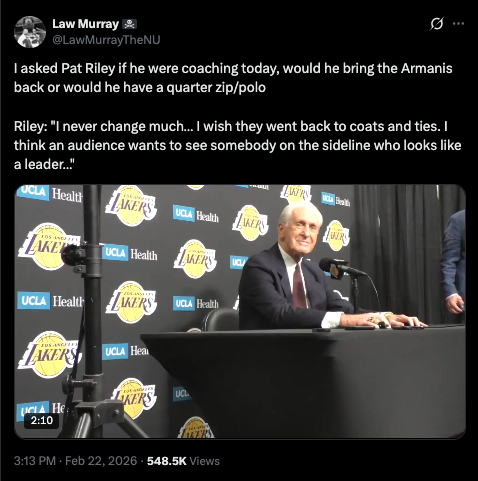
Today’s blog is in response to a recent Q&A with legendary NBA coach (and Heat GM) Pat Riley, where he was asked whether, if coaching today, he would bring the Armani suits back to the sideline or opt for the now common quarter-zip/polo look.
Full disclosure: I grew up on Pat Riley and the Showtime Lakers. They were one of my first FAVORITE teams. I respect a lot of what Riley has always been known for — grit, resilience, discipline, and a no-nonsense approach to accountability on the court.
I also understand the context here.
He was answering this question in advance of a ceremony where the Lakers are honoring him with a statue — literally sculpted in his famous suit. Of course he’s going to lean into that identity.
But his line about audiences wanting to “see somebody on the sideline who looks like a leader” is a great TeamsOfMen self-reflection moment for coaches today.
Because that statement is bathed in old scripts.
It assumes leadership is something you look like first, and something you are second. And there’s also an unrecognized privilege baked into that framing.
Pat Riley’s Armani suits were iconic — and expensive. But let’s be real: all suits are expensive. Leadership cannot be dependent upon your salary. If the visual marker of authority requires access to wealth, then we are defining leadership in a way that excludes a lot of people from the jump.
I don’t think my players suddenly pay more attention to me the one time a year I wear a suit on the sideline. And I don’t think it ever made sense for us as coaches to sweat through a hot gym or arena for two hours just to perform a version of authority. In 2026, we have plenty of options that are comfortable, professional, and representative of our team and school.
Think about it.
A suit screams “me.”
Sideline gear in your school colors — with your mascot, your logo, your identity — screams “us.”
There’s nothing wrong with loving a great suit. I do. But there is a manbox layer to assuming the suit gives you power. Authority that relies on costume is fragile. Leadership that relies on character isn’t.
Coach Prompts
What signals of “authority” do you rely on that aren’t actually tied to your behavior?
Do your players respect your wardrobe — or your consistency?
Where might image be masking insecurity in leadership?
How do you define leadership in your program: visually, verbally, or behaviorally?
Player Prompts
What makes someone look like a leader to you?
Has someone ever looked the part but failed to lead well?
What behaviors earn your respect more than appearance?
If leadership isn’t about clothes, what is it about?