Beyond the Good Guy Narrative
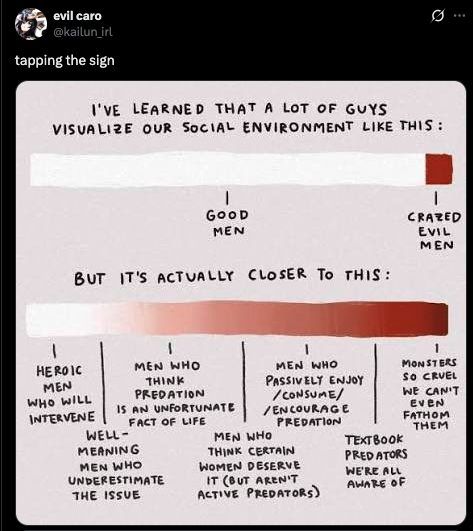
Today’s blog is less a declaration about this graphic and more a suggestion list of ways you could grapple with it in your team room.
Because I know exactly what 15-year-old me, 20-year-old me, and even 30-year-old me would have thought when looking at the ratio the graphic suggests.
I would have leaned HEAVILY toward the first version.
The clean, simple binary: good men vs evil men.
Most of us want to believe the world is that simple.
But over a decade into this journey of reimagining manhood and escaping the Manbox through the work of TeamsOfMen, I now feel the power of the lower chart much more strongly.
The nuance. The uncomfortable middle ground. The idea that harm is often sustained not just by “monsters,” but by people who minimize it, excuse it, or passively allow it.
So here’s the exercise.
Start with your staff.
Ask them: What would your ratio actually be?
What percentage of men fall into each category?
Where would the debate start?
Where would the tension show up?
Then ask the same question of your players.
What percentages would they assign?
Would they even feel equipped to break the scale into multiple categories?
Or are they still operating inside the false binary most of us were raised with — the Hollywood paradigm of heroes vs villains?
Because if that’s the framework, then most young men will automatically place themselves in the “good guy” category and stop examining their role.
A simple entry point might look like this (Start with something familiar:
Write on the board:
Good Player vs Bad Player
Then ask them to break that apart. What other descriptions exist between those two extremes?Selfish teammate. Lazy defender. Great scorer but poor communicator. Leader in practice but disappears in games.
Let them build the middle.
Then introduce the graphic. And repeat the exercise. Because escaping the Manbox requires more than just condemning “bad men.” It requires understanding the full spectrum of behaviors that allow harm to continue.
Coach Prompts
How do you currently talk about harm among men — as a binary or a spectrum?
Where do most men instinctively place themselves on this chart?
What behaviors fall into the “passive encouragement” category in sports culture?
Player Prompts
Why do most people believe the world is just “good guys vs bad guys”?
Where do people fall when they stay silent about harmful behavior?
Can someone see themselves as a good person while still contributing to harm?