
How Is “Swagger” The Priority Here?
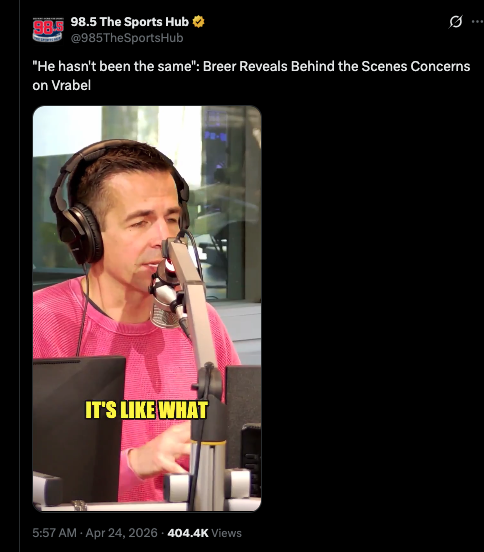
I was pretty stunned listening to this segment from Albert Breer during an appearance on 98.5 The Sports Hub yesterday.
It was in response to a question about how the ongoing reports regarding an alleged six-year affair between Mike Vrabel and Dianna Russini might affect the organization. What followed felt like a clear example of how quickly we default to protecting a version of a man we’re comfortable with, rather than dealing with the reality in front of us.
Breer’s comments leaned heavily on familiar language. He repeated versions of “I know Mike,” talked about him being a good guy at his core, someone who has done right by people. That framing shows up a lot when someone in our circle crosses a line. Proximity becomes proof. Personal experience becomes the filter for what we’re willing to believe. We’ve seen that same logic used to soften or dismiss all kinds of behavior—infidelity, racism, homophobia. The pattern doesn’t really change.
What really caught me, though, was the emphasis on getting Vrabel’s “swagger” back. That being framed as the priority felt completely off. Because if we’re being honest, the bravado being described there might be part of the problem, not the solution. The belief that you can move however you want without consequence, that you’re insulated from the impact of your choices—that’s not something to rebuild. That’s something to examine.
Instead, the conversation drifted toward timelines, training schedules, and whether this would carry into the season. There was a lot of focus on football readiness.
Very little on the people affected—his wife, his children.
Very little on accountability.
Very little on what actually needs to be repaired.
At one point, Breer mentioned that the players would have his back. That assumption deserves a pause. Not because support is wrong, but because it raises the question of what kind of support we’re talking about. Is it support that helps someone face what they’ve done and grow from it, or is it the kind that helps them move past it without really addressing it? Those are not the same thing.
What stood out most in all of this is how narrow the lens can become when everything is viewed through a football context. The situation gets reduced to impact on the team, on the season, on performance. But this isn’t just a football issue. There are real people involved. Real relationships. Real consequences that extend well beyond a facility or a schedule. That part can’t be brushed aside in favor of getting someone back to a version of themselves that feels more comfortable to everyone else.
Moments like this are a reminder of how easy it is to slip into defending instead of reflecting.
Coach Prompts
When someone in your circle messes up, what’s your first instinct—protect or confront?
How do you separate who someone has been from what they’ve done?
What does real accountability look like in your program?
Where have you seen performance prioritized over people?
Player Prompts
What does it mean to have someone’s back in a tough situation?
How do you respond when someone you respect makes a bad decision?
What’s the difference between defending someone and helping them grow?
What kind of teammate do you want to be in moments like that?