
If This Is the Opponent, What’s Your Response?
Today’s blog hit me with both an Oh my God and a why doesn’t this move men to immediate action? response.
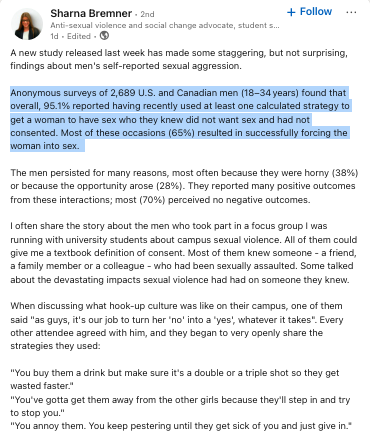
A post on LinkedIn by Sharna Bremner stopped me this week as she highlighted findings from a study of nearly 3,000 men ages 18–34 in the U.S. and Canada. These were men who reported using at least one calculated strategy to get a woman to have sex when they knew she did not want sex and had not consented.
Let’s be clear about what that means.
This is not confusion. This is not mixed signals. This is not “I thought she was into it.”
The entry point to the survey is essentially this: you know she does not want sex and you are still going to try to get it anyway.
That’s why I’m framing this as a scouting report on attacks.
The first thing that jumps off the film is the sheer volume. The number is staggering: 95.1% of this sample reported recently using at least one strategy. Whether we’re talking verbal pressure, isolation, alcohol, repeated touching, or outright force, this is not a one-off bad actor issue. This is something many young men have learned how to do.
Second, they run a two-man game. Nearly half reported using a friend, partner, or group of friends to help, and a striking number reported using a female friend to make the woman feel safe and convince her. Coaches, sit with that. Sometimes the room is not neutral. Sometimes the room is part of the problem.
Third, this is a selfish opponent. The most common reasons given were because they were horny or because the opportunity was there. That is entitlement language. Desire becomes permission. Impulse becomes justification.
Fourth, their best play is alcohol. The study repeatedly points to keeping women drunk, getting them drunk, or using substances as part of the strategy. That is not incidental. That is part of the game plan.
And finally, they are relentless. Repeated asking, continued touching, kissing, verbal pressure, and escalating physical persistence all show up as common tactics. They keep going until resistance wears down.
Now here’s the part I cannot stop thinking about: some men in the study saw themselves as better than their peers at getting what they wanted sexually, and that sense of status was linked to more forceful strategies.
There it is. This is exactly why challenging the Manbox in your space is not optional. If status in the male friend group is attached to pressure, conquest, and disregard for consent, then the team room has to become a place where a different version of status is built.
So my question for coaches today is simple:
What is your defensive game plan?
How are you disrupting the idea that dominance over women earns credibility with other men?
How are you giving your players language and courage to interrupt the two-man game?
How are you preparing them for party spaces where alcohol is the best play?
And if you read this scouting report and honestly do not know what your answer is, that is not a failure. That is exactly why TeamsOfMen belongs in your space.