
Interrupting Violence Without Becoming It
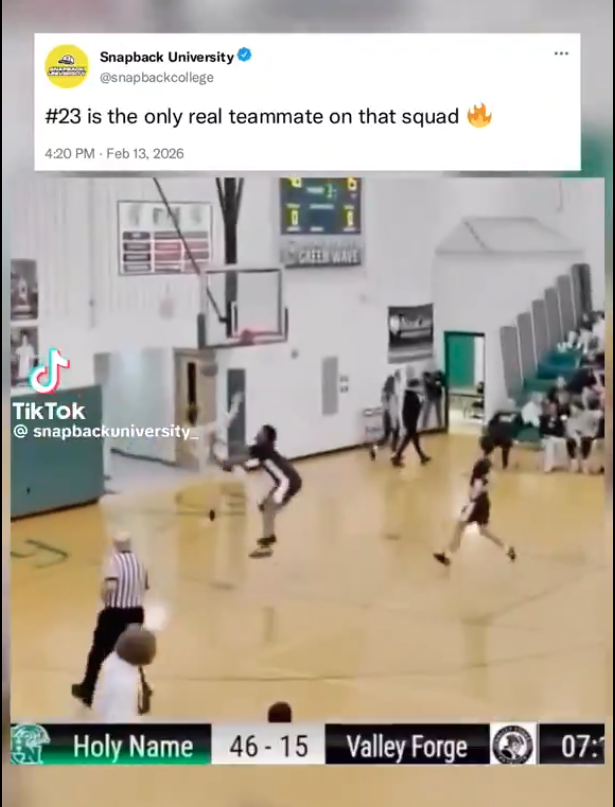
Today’s blog is in response to this boys HS basketball game that ended in a melee after a player brutally fouled an opponent on a fastbreak — and that player’s teammate came sprinting from the other end of the court and shoved the fouler to the ground himself.
The caption on the screen grab gives coaches an immediate entry point into discussion with their guys:
“The only real teammate.”
“Now THAT’S a teammate.”
These are the taglines being used to describe the retaliatory shove. And that’s where this becomes less about that game — and more about ours. Because this is a reflection moment for us as coaches.
What in our program would PREVENT the first ridiculous foul from happening in the first place?
What in our program would regulate the response from others IF our player was the one hammered like that?
SHOULD we even be regulating that response? Or do we quietly cosign it because of how hard the foul was? What have we explicitly talked about with our staff and players regarding leaving the bench, running onto the court, or inserting themselves physically into out-of-control situations?
All of these are worth discussion. And I’ll be honest — I struggle with the answers too.
Because that foul is BULLS***.
And there is a very real part of me that would want my guys standing up for their teammate. But could we rep that response to be verbal instead of physical — so they protect their teammate without triggering the automatic double-penalty and escalation? Could we train interruption without escalation?
I don’t know.
And that uncertainty is exactly why it deserves space in the team room.
Because maybe this isn’t even a “manhood” test.
Maybe this is something more universal.
A HUMAN test of loyalty.
A HUMAN test of protection.
A HUMAN test of emotional regulation inside loyalty.
Which is exactly why we can’t leave it unexamined.
Player Prompts
When you saw the shove, did you see loyalty… or loss of control? Why?
How can you protect a teammate without hurting your team?
What does a teammate owe another teammate in moments of injustice?
What response would make you trust a teammate most: retaliation, or restraint?