
Power, Scoreboards, and the Lie We Keep Telling Ourselves
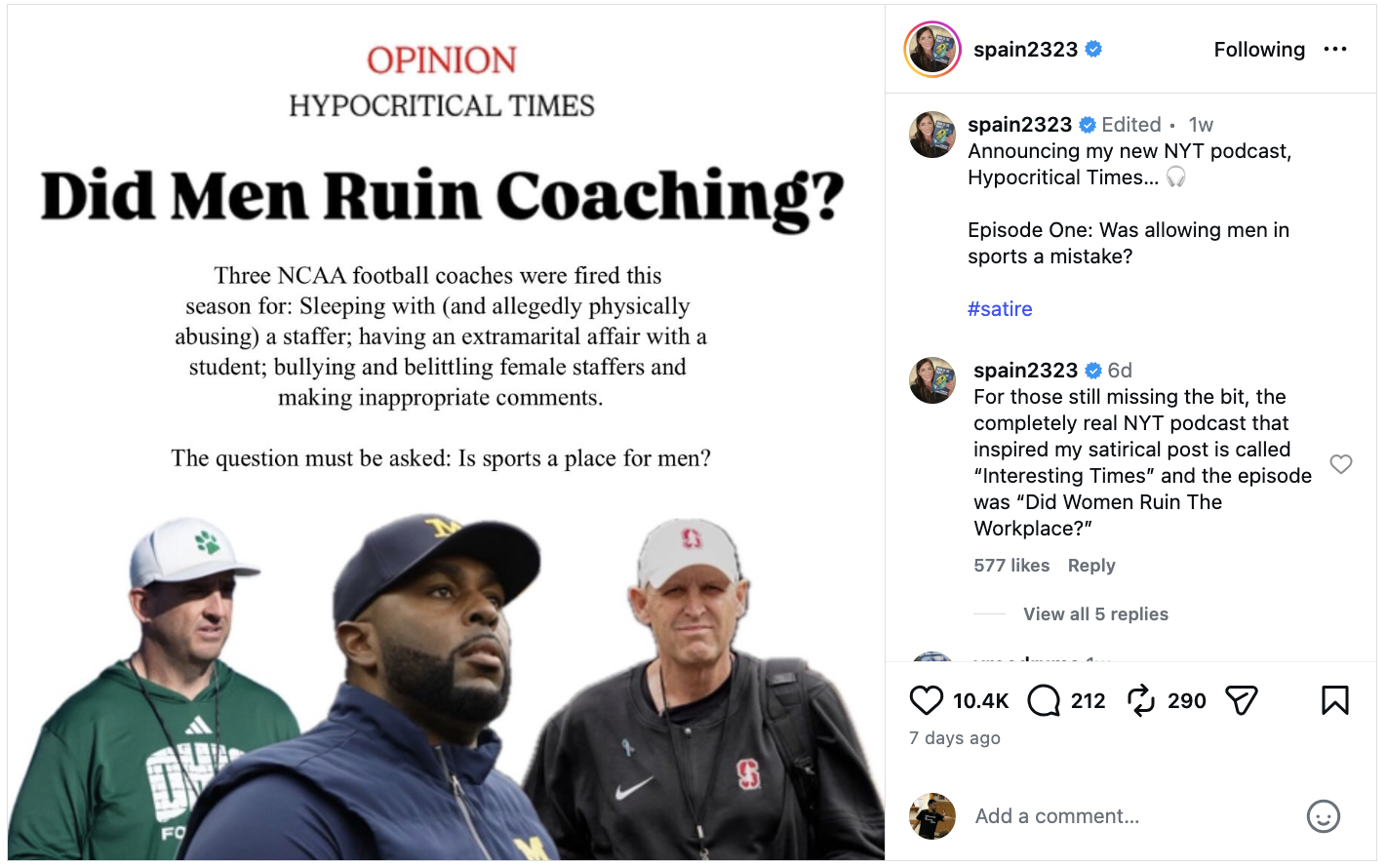
I’m sharing this spoof post from Sarah Spain not just because I respect her voice in the sports world, but because it lands on something we keep refusing to sit with.
Her satirical headline — “Did Men Ruin Coaching?” — is a direct response to two things happening at the same time:
a rash of college football coaches committing serious moral violations while in positions of power, and a very real New York Times podcast episode titled “Did Women Ruin the Workplace?”
That contrast matters.
Because we do have a long list of men who decided that scoreboard success should come bundled with either access to women’s bodies — often subordinates, often within clear power imbalances — or the right to rule their environment through vitriol, intimidation, and unchecked rage.
And yet we still call this a profession that “builds character” through the game alone.
Then comes the second wave — articles and commentary from other men saying, “We weren’t taught how to hold this kind of power,” followed by a full DARVO pivot that turns the disgraced coach into the victim. Suddenly the focus isn’t the wife, the children, or the younger woman now publicly branded for her proximity to power — it’s the coach’s pain, his pressure, his fall from grace.
Read the comments under Spain’s spoof and you’ll see it immediately:
Defensiveness. Anger. Blame-shifting.
“Women will get ya.”
“The power of the p***y.”
Every cliché soaked in Man Box thinking, all designed to avoid the same thing: accountability.
Here’s the reality we don’t want to face:
People who are willing to abuse power often seek it out — and are rewarded with it.
Which is exactly why I’ve always believed coaches of young men sit in a uniquely dangerous and hopeful position. We can reinforce the same scripts that keep producing these outcomes… or we can interrupt them early.
Reimagining manhood isn’t a side project to coaching.
It’s the work.
And whether we like it or not — WE are the work.
COACH PROMPTS
Where does your program explicitly talk about power — not just leadership?
How do you respond when accountability for men is framed as an attack instead of an expectation?
What messages about entitlement and access are your players absorbing without anyone naming them?
PLAYER PROMPTS
How do you usually react when someone you admire is held accountable — defensive, curious, or reflective?
What stories about success and access have you been taught that deserve to be questioned?
What kind of man do you want to be trusted with power — and why?