
The Monster He Named
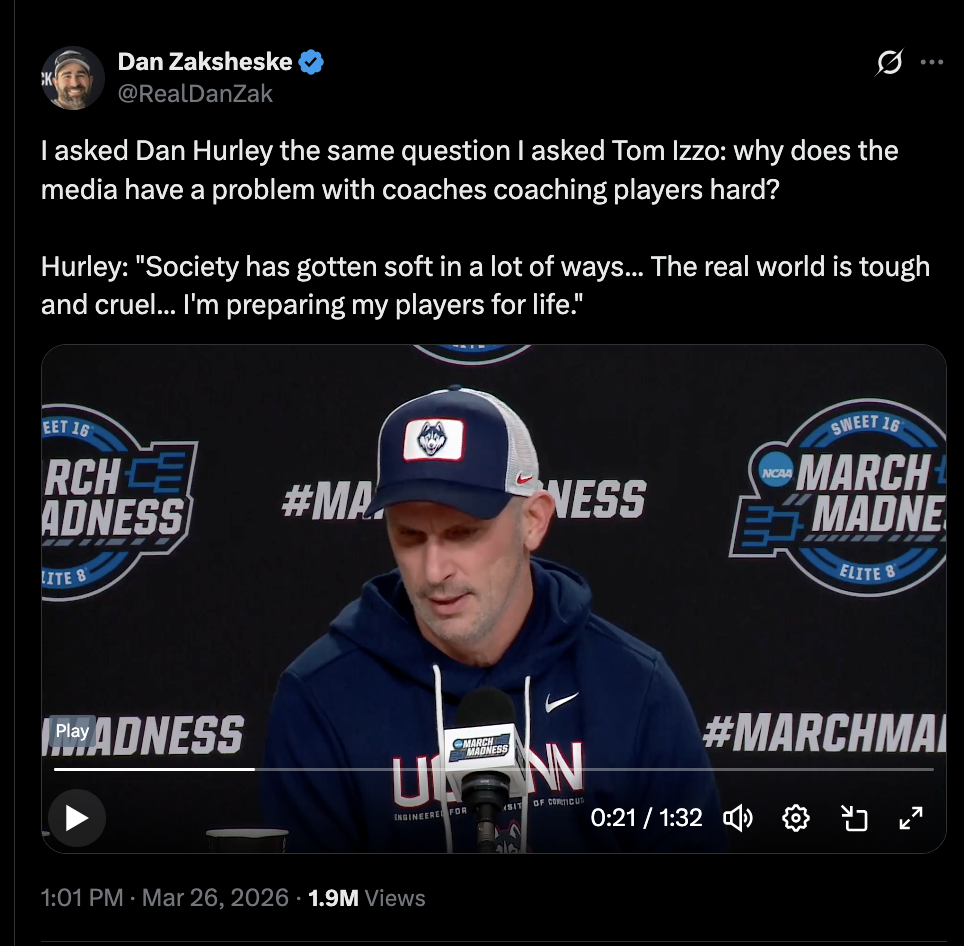
UCONN Head MBB Coach Dan Hurley (along with UCLA’s Mick Cronin) has become a frequent flashpoint in the coaching world—and for us here at TeamsOfMen. Hurley has won two national titles while displaying a sideline demeanor that at best is called “intense,” and at worst is clear emotional dysregulation and explosion. To his credit, he has been open about trying to regulate himself and reflect on his antics, but then is just as likely, as in this week’s press conference, to double down on what he believes is “hard coaching” in preparation for a “cruel world.”
In many ways, Hurley is the case study for this work. Can a coach be aware that parts of his behavior may be causing harm, but still believe those same behaviors are necessary because they’ve led to success? He is championed by the X’s and O’s crowd who see him as elite schematically, and also by coaches who would love the freedom to act however they want on the sideline and point to winning as justification.
In this recent press conference, you can hear him wrestling in real time. He answers a question about “hard coaching” by saying that we’ve “gotten soft” and that the teachers and coaches who impacted us most were the ones who pushed us, who made us do the work, who demanded more. On the surface, that idea isn’t problematic. But it starts with a Manbox entry point—“we’ve gotten soft”—which immediately frames any alternative approach as weak or unacceptable. Once that framing is in place, it becomes much easier to justify anything that follows.
Even the teacher example is telling. Yes, great teachers challenge you and hold standards. But do we really think those teachers were screaming, “you mf, you’re not getting a free pass on this test” when they handed it out? The idea of “hard” gets distorted from accountability and rigor into emotional volatility and aggression, and those are not the same thing.
What you’re really hearing underneath it is a familiar belief system: “I was pushed hard, maybe even treated harshly, and that’s why I became who I am.” And because of that, it becomes not just acceptable, but necessary to repeat. That’s the loop.
The most telling part of the interview comes later when he says, “They know I love them… there’s a lot the media doesn’t see… we laugh, we joke, we make fun of each other… sometimes you just see the monster.” That’s where it gets real. Because now you’re seeing a coach who wants connection, who wants to be a positive presence in his players’ lives, but is still defining that connection through old scripts. “We joke and make fun of each other” is often the stand-in men use for real connection, not proof of it.
And then there’s the line: “sometimes you just see the monster.” He names it. He gives it a separate identity. He acknowledges it shows up. He knows the outside world sees it. But the question that lingers for me is this—why can’t he say that his players see it? Why is the existence of that “monster” balanced out by laughter on a bus ride or joking in practice? Why is that considered enough?
That’s why Hurley is such a powerful case study. This isn’t someone unaware. This is someone aware, and still stuck in the tension between what he knows and what he’s always done.
And honestly, I’m grateful he’s sharing like this, because it shows a real journey in self-awareness. I just wish more of the conversations around him lived in this space of deeper analysis, instead of defaulting to the easy applause of “that’s hard coaching—it wins.”
Coach Prompts
Where are you aware of behaviors that don’t align with your values—but still justify them?
What parts of your coaching are rooted in “this is how I was coached”?
How do you define “hard coaching” vs harmful delivery?
Player Prompts
What’s the difference between being pushed and being disrespected?
How do you know when a coach actually cares about you?
Does joking and making fun of each other equal connection?