The Pressure to Prove It
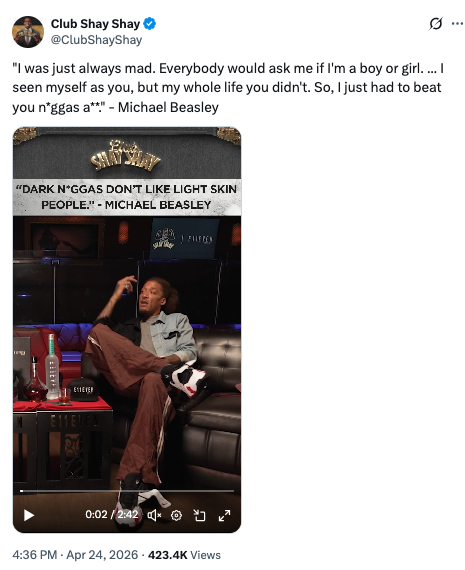
When you have 3 minutes today, this clip of honesty and vulnerability from former NBA player Michael Beasley is well worth your time. Yes, it is from Club Shay Shay, and from a TeamsOfMen perspective, host Shannon Sharpe is not exactly a figure we want our players taking cues with women from. That said, this clip is full of Beasley’s raw emotion about growing up black, light skinned, with green eyes and long hair, and what those traits caused him to experience from other black men.
“I grew up in Chocolate City. I was a light-skinned guy. Yeah. And my mom had barrettes in my hair, so I was like a boy and a girl. I got green eyes. “
“Because… you dark—don’t like light-skinned people. But you’re not hearing what I’m saying. Like literally, Black only matters to Black when Black is Black. The one percent minor don’t matter when a n***a got green eyes, because you think I’m better.”
I am a brown skinned, half Samoan 46 year old man. I am not black. I can only claim proximity to the experience of a black man in America, not the actual lived reality. I DO relate, though, to the idea of being “lighter” than you’re supposed to be, and to the idea that you are not “fully” what you claim to be. [NOTE: I may have mentioned this before in this space, but I’m aware of a shortcoming I carry: I am always willing to be a messenger, but that doesn’t always make me the right one. Writing on this today, I know some may see this as one of those moments. If that’s the case, I’m open to being called out on it.}
What landed with me, and perhaps with many players in your locker room, is the emotion tied to trying to find belonging while also navigating identity.
“So I was just always mad, because everybody asked me if I was a boy or a girl.”
“I see myself as you…But my whole life, you didn’t…so I just had to beat your ass.”
“So n***a, they asking me if I’m a girl, calling me white boy… I used to beat the shit out of n***as. A lot.”
I don’t know the makeup of your locker room. I don’t know which identities are represented or how they show up on your roster or your staff. I DO KNOW that I’ve heard and witnessed colorism in team spaces I been in and led. I DO KNOW that young men who display traits others deemed “feminine” or “gay” can become targets of not not just derogatory comments, but also for isolation and outright violence. These are real things. Beasley gives language to what that can feel like, and how it can shape behavior when it goes unchecked
I’m not sure there’s a clean answer here for coaches, especially if the question is “How do I avoid this in my team?” A more useful place to start might be asking how we address the beliefs that fuel it, and how we respond to the impact it has on the people who experience it.
Coach Prompts
Where have you seen players’ identity questioned, even subtly, in your team space?
What language or jokes get dismissed as normal but actually target someone’s identity?
How do you respond when a player’s behavior is rooted in something deeper than the moment?
What space do you create for players to talk about experiences that don’t fit the team’s “norm”?
How do you address both the behavior you see and the beliefs underneath it?
Player Prompts
Have you ever felt like you had to prove something about who you are just to be accepted?
What kinds of comments or labels get thrown around in your group?
How do you respond when someone is singled out for being different?
What does it feel like to not fully belong in a space that’s supposed to be your team?
What responsibility do you have when you see someone else being targeted?