What Actually Breaks the Manosphere’s Grip
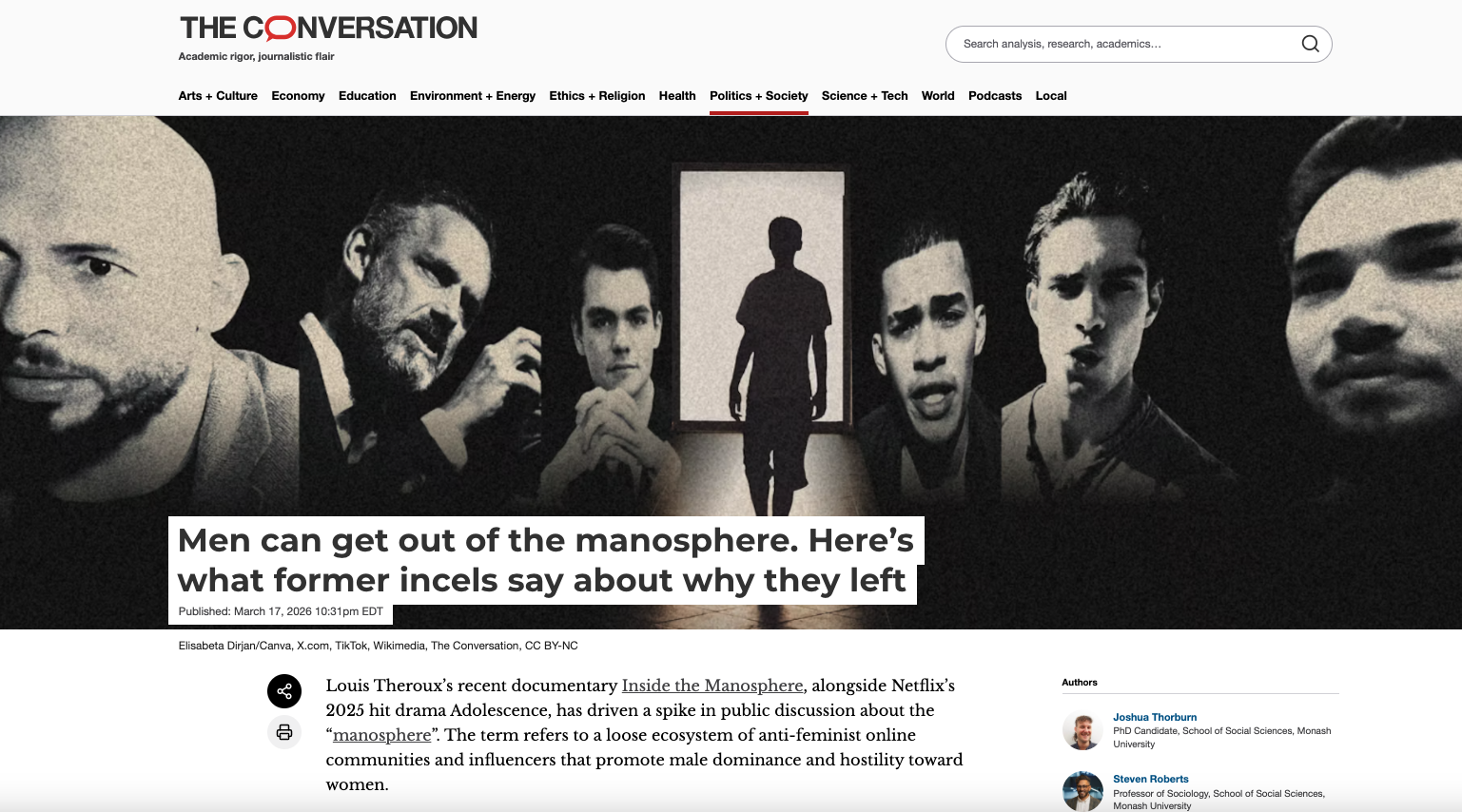
Today’s blog is in response to an article in The Conversation by Joshua Thorburn and Steven Roberts titled “Men can get out of the manosphere. Here’s what former incels say about why they left.”
Full credit for the share goes to a friend of ours, Dennis J. Barbour, Esq. (President and CEO, Partnership for Male Youth; Newsletter Editor).
Why this article for today?
Because it speaks directly to one of the HOPES we have at TeamsOfMen—that if you embrace this work in your coaching, you can help a player ESCAPE the manbox. But it also forces us to sit with two harder questions:
WHY do they get pulled into it in the first place?
And WHAT actually helps them get out?
I won’t lay out the entire article here (we live in an algorithm-dominated world—these authors need their clicks, so go give it to them), but two points hit hard.
First:
“A growing body of evidence suggests many men first encounter these communities during periods of insecurity or loneliness.”
And isn’t that exactly what we claim our SPORT is supposed to combat?
“Join us and you’ll get a family.”
“Play here and you’ll get brothers for life.”
But have we actually vetted our spaces to see if that’s true?
Second:
“Positive interactions with women, supportive friendships, or simply observing that relationships in the real world do not follow the rigid rules promoted online… can begin to undermine the worldview.”
Read that again.
Not lectures. Not punishments. Not one-off talks.
Experiences. Environments. Daily interactions.
If your program creates spaces—team room, bus, bench—where: emotional fluency is practiced, women, minorities, LGBTQ+ individuals are respected and celebrated and connection is real, not performative…it can counter the harmful ideology of the manbox.
That’s not theory. That’s proof.
The question is:
Are you creating that…or leaving space for something else to fill it?
Coach Prompts
Where are my players experiencing real belonging—and where are they not?
What messages about manhood are reinforced daily in my program (intentionally or not)?
Would an outside observer say our environment challenges harmful beliefs… or ignores them?
Player Prompts
When I feel insecure or alone, where do I go for answers?
What do I hear about women, relationships, and being a man from the people around me?
Do the spaces I’m in help me grow… or just help me fit in?