
What Is It Like to Be Around You When You're Angry?
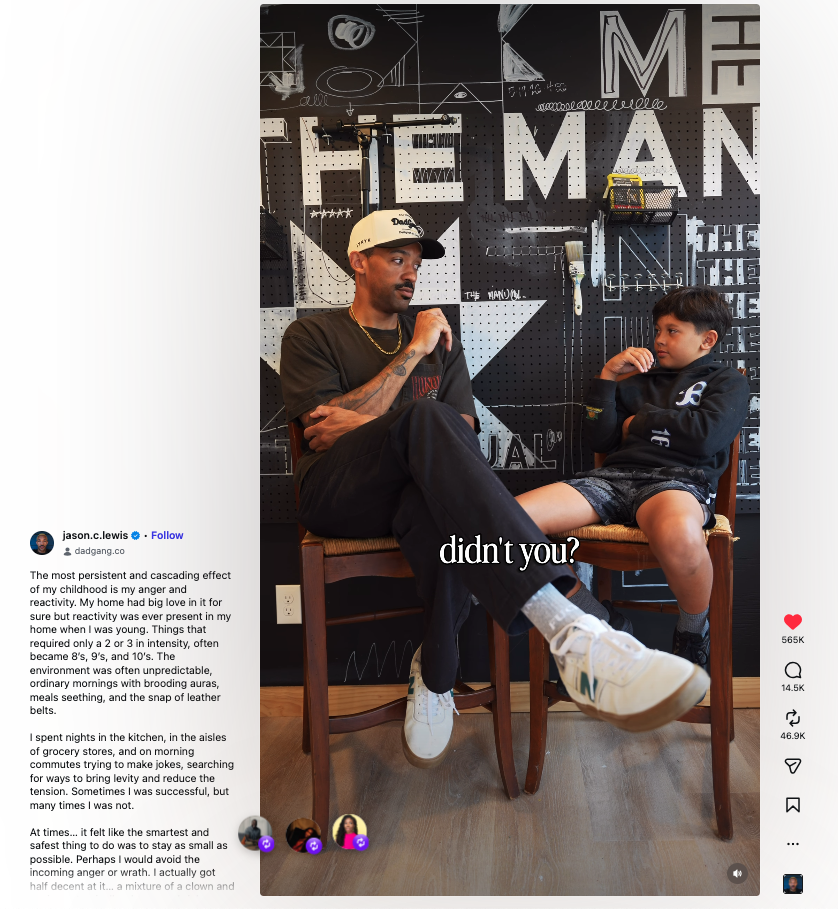
Shout out to TeamsOfMen Inner Circle Coach Joseph Jackson (Milwaukie HS Boys Basketball HC) for sending this my way via IG. Originally posted by @jason.c.lewis the video shows a father debriefing with his son their effort to build a new bed, and features the dad asking his son questions like “how often am I super angry” “what’s it like to talk to me when I’m angry” and the ways that anger showed up when the son was “messing up” in the construction of the bed.
Candidly, this hit me as a SON, as a FATHER and as a COACH.
The line in the caption “The most persistent and cascading effect of my childhood is my anger and reactivity” resonated with me, as much of my upbringing revolved around a fear of setting my father off. Like the author here states, my dad showed my brother and I HUGE expressions of love and was never shy in telling us how much he loved us. He, also, was capable of nuclear explosions that would make grown men quake, much less the boys we were.
As a dad myself, I know I have had reflection moments where I tell my wife, “oh god, that blow up when I was screaming at the kids, that was so [insert my dad’s name]” and the horror that came with remembering the fear I felt in those moments, combined with the knowledge that I could very well have done that to my own kids, was mortifying.
Finally, I know I use my voice selectively nowadays, but in the beginning of my head coaching career (almost 20 years ago now) I know I used it as a weapon often, deploying tirades and volume-intensified rants that I thought were “coaching tough”.
All these reflections and contemplation came from both the emotional video here AND the caption description. Both for me as the current pivot point of many rooms (the angry dad or coach) AND as a former person who “used levity to deflect the rage” or “got as small as possible to avoid it.”
What really sat with me is this:
“When you have the power to move rooms, you can’t assume you are always moving it in a good way. Sometimes, you are TERRIFYING them.”
And that made very uneasy. I don’t want to be that guy.
I believe we must hold our kids and our players and ourselves accountable. I believe we must strive to be better every day. BUT, I know there are so many more tools at your disposal as a father and a coach to make those things a reality.
Anger and volume are not the only solution (and often, part of the problem).
Maybe the rep from this video is as simple (and terrifying) as asking the question this dad was willing to ask his son:
“What is it like to be around me when I’m angry?”
And then shut the hell up and listen to the answer.
Coach Prompts
What is it actually like for your players to be around you when you're angry?
When you raise your voice, are you choosing a teaching tool—or have you lost access to the other tools you have?
Who in your program could tell you honestly that your anger scares the room without worrying about what you'll do with the answer?
Player Prompts
What's the difference between a coach being intense and a coach making players afraid of him?
What happens to your ability to listen and learn when you're worried about someone's reaction?
What does a coach do after losing his temper that helps rebuild trust?
One of the hardest gaps for a coach to see is the distance between what we intend our players to experience and what they actually experience.
“I was holding him accountable.”
“I was creating urgency.”
“They know I love them.”
Maybe.
But what did the room experience?
That gap between intention and experience is exactly the kind of thing DeCA is designed to help coaches examine.