
The Problem (and Possibility) of Men in Groups
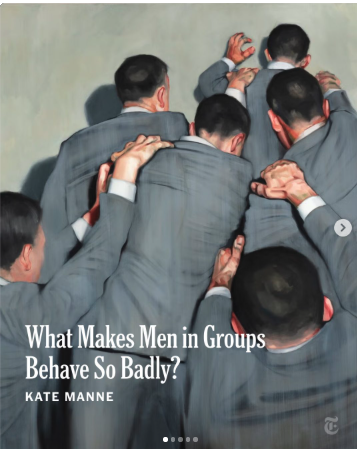
I know, I know.
“Kip, you are really sharing something from the NY Times in the year of our lord 2026?”
Yes, but only because it’s Kate Manne (author and professor) and she is dope (and it’s an opinion piece from her, so that makes it slightly easier for me to promote something found on the NYT servers).
And, if I’m honest, the headline of the piece (as you can see in the screengrab above) is one of the most consequential questions of our time (maybe history even) and why I have stood firmly behind “Teams” of men as the title of my work in coaching and reimagining manhood.
Back in 2012-13, when I was scouring campus resources and the internet for ways to START weaving sexual violence prevention into my coaching, I came across two things by Jackson Katz (yes, yes, I know, Jackson is a sort of pioneer in the work, but also very controversial himself). One was his documentary “Tough Guise” and one was his book “The Macho Paradox”. In both, he confronted a question that has never left me: What are men in groups most known for? VIOLENCE.
And the more I grappled with that, the more I realized how true it was, both from my lived experience as a man in those groups (violence being often in the form of words deployed to “clown” one another, but also often manifesting physically within the group) and as a leader of those groups (nothing makes me more nervous than a group of young dudes rolling deep somewhere).
I’m not going to ruin Kate’s work by giving you a synopsis here.
I will tell you to go read it.
I will tell you to examine the moments in your program when your guys are all together in a space (team room, bus, plane, hotel) that is unsupervised and ask you why we, as coaches, often spend more time planning for what might go wrong when our guys are together than when they're on their own.
I will ask you to reflect on what it means for men together to be holding each other to a “precarious manhood” standard, where “what you proved/did/said yesterday is not enough to earn your man badge today, you have to go further.”
And when the guys around you are the ones deciding whether you've earned that badge, what might you be willing to do to keep it?
And then I will ask you to join us in finding ways to not only interrupt the scripts these groups operate on, but also create versions of male groups that operate in the exact opposite way.
Because if men in groups can reinforce the worst in one another, shouldn't we be just as intentional about building groups that bring out the best?
Coaching Prompts
When your players are together without adult supervision, what behaviors are you most concerned about, and what does that reveal about the culture you've built?
What behaviors earn a young man status and influence within your team, and are those the same behaviors you publicly celebrate as a coach?
How intentionally are you building a team where players challenge one another to demonstrate care, accountability and humanity rather than dominance, humiliation or toughness?
Player Prompts
Have you ever said or done something around a group of guys that you wouldn't have done if you were alone? What made the difference?
What does a guy on your team have to do to earn respect from other players? What could cause him to lose that respect?
Agree or Disagree: Guys are more likely to do something harmful when they're surrounded by other guys than when they're alone. Why?