
Character Or Compliance?
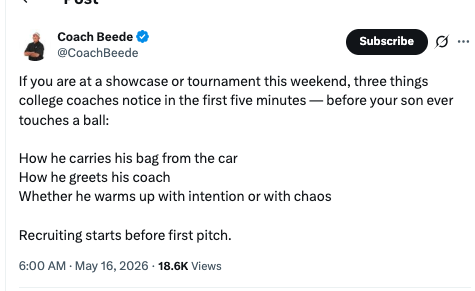
Well, we’re right back here today with another generalization wrapped in cliché.
I do not know @CoachBeede, and I can’t claim to have ever attended a baseball-specific recruiting event. But I did recruit for 20 years in college basketball, and I can guarantee you we were not in parking lots stalking young men as they arrived for games. So why focus on this post, especially in a blog dedicated to framing current events for coaches of male athletes trying to help them break free of the Manbox?
First, because this type of statement is bathed in policing a phony PERFORMANCE of who you are.
Even IF we decided baseball coaches were standing around in the wee hours of the morning, coffee and donuts in hand, watching young men get out of their cars (stalker behavior, by the way), they would only be able to glean meaningful information if the players were unaware of their presence. If the players simply acted the role for the coach’s eyes, it becomes performance, not proof of character or intent.
And that matters because the Manbox is constantly asking boys and men to put up a front, a veneer, a version of themselves designed to pass inspection. Posts like this rarely move beyond surface-level character analysis. Instead, they unintentionally reinforce the idea that being a “good man” is mostly about looking the part while someone is watching.
Second, because we could easily flip this on its head through the Mirror Training lens and ask: what happens if we stop making this player-focused and make it coach-focused instead?
Do parents get to watch you emerge from your hotel room before a long recruiting day and decide what kind of man you are?
Do players get to watch videos evaluating how you treat people who approach you in the stands?
Do high school coaches get to assess the chaos of your notebook, your organization, or your behavior behind closed doors?
Is that all fair game too?
For once, though, the comments didn’t co-sign the silliness. The author is getting rightfully skewered for the take and, surprise surprise, doesn’t appear to be modeling the composure or rigid character standards they claim to value in young men while responding to criticism.
Coach Prompts
How often do we mistake performance for character in the way we evaluate players?
What standards do coaches ask of players that would feel uncomfortable if applied back onto themselves?
Are we teaching boys integrity or simply teaching them how to look disciplined when watched?
Player Prompts
Have you ever felt pressure to “look like” the right kind of athlete or man instead of actually being yourself?
What’s the difference between character and performance?
How would it feel if adults were evaluated by the same standards they use on young people?