
Stress Test The Cliché
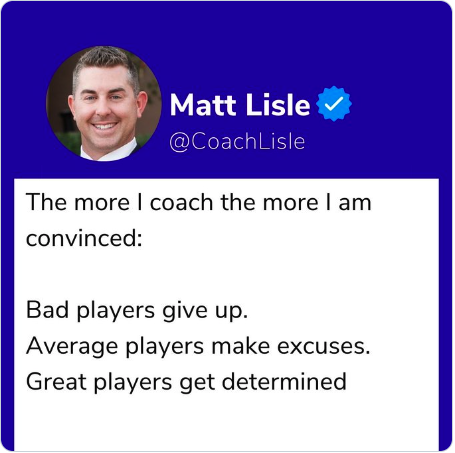
Today’s blog tackles a reframing of this post from @CoachLisle on X this week. Before going too far, I want to be clear: I’m not trying to attack Coach Lisle directly. I think a lot of coaches would (and did) repost this in support of the thought process behind it. And, to be fair, it’s not inherently WRONG. There is truth to the three bullet points. Bad players do give up. Average players do make excuses. Great players do get determined.
My issue with posts like this, always, is less about what they ask of players and more about where they START. They start with the players, not the coach himself.
In fact, before I’d even change “Bad players give up” to “Bad coaches give up,” I’d want us to sit with something even more uncomfortable. What do people feel, think, or believe about the phrase “Bad MEN give up”? Then proceed down the same road with the next two lines. “Average MEN make excuses.” “Great MEN get determined.”
It’s easy, and likely, that you’ve seen some version of this post and applied it to the way you approach coaching a season and a group of players. I think it’s just as likely that many of us HAVE NOT applied these same clichés to our coaching approach or the way we model healthy masculinity while serving as that coach.
That, for me, is really the core issue with these easy generalities. They work well in short bites. They work well as signs in team spaces. They work well as language to challenge players. But too often, they have NOT been stress tested by the coach looking inward first.
And if we’re constantly asking young men to interrogate themselves, push through adversity, and own their growth, then the least we can do is hold the mirror up to ourselves before demanding they stand in front of it.
Coach Prompts
What clichés or motivational sayings do you regularly ask players to live by but rarely interrogate yourself?
If your team applied your standards back onto you, where would you feel challenged?
Are your players seeing accountability modeled or simply demanded?
Player Prompts
What advice do adults give that feels different when they actually live it too?
How would it change your trust in a coach if they admitted where they are still growing?
What’s a phrase adults say all the time that deserves a deeper look?