Consent Still Counts When a Screen Is Involved
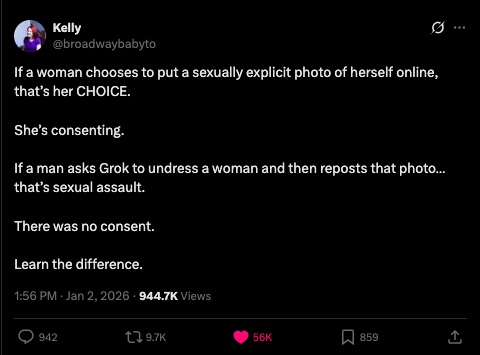
Today’s blog is based on this specific post and the alarming trend spreading across digital spaces — especially those frequented by teens and young adults — where AI is being prompted to undress women in real photos and produce what appear to be “real” images of them naked or semi-clothed.
It is horrifying.
It is disgusting.
And it is absolutely not a joke.
The post says it plainly:
If a woman chooses to put a sexually explicit photo of herself online, that is her choice.
That is consent.
If a man uses AI to undress a woman in a real photo — or reposts an image generated that way — that is sexual assault.
There was no consent.
That distinction matters. And it’s one too many men are pretending not to understand.
If you reflect honestly with your staff, this is not some distant issue your players might stumble into one day. It is something they will either: do in silence cosign with laughter forward in group chats or minimize with “It’s just a joke, Coach.”
It is not a joke.
It is a violation of consent.
It shows a complete disregard for the permanence of images once they exist online.
And it causes real harm to real people — often girls they know.
This is exactly why these conversations have to happen before an incident, not after. We cannot keep treating consent as something that only applies in physical spaces. Digital actions still involve real bodies, real people, and real consequences.
And if an act like this is committed, it cannot be handled with a shrug, a warning, or a “boys will be boys” explanation. It requires real accountability. Full stop.
Ignoring this doesn’t protect our players.
Coach Prompts
Have we ever clearly defined digital consent with our players, or have we assumed they’ll “figure it out”?
If this behavior surfaced in our program, do we have shared language — or would we scramble to react?
What consequences have we actually communicated for violations that happen online but impact real people?
Player Prompts
Why do people say “it’s just a joke” when someone else is clearly being harmed?
What’s the difference between someone choosing to share their body and someone else taking control of it?
How would you feel if an image like this existed of someone you care about — and you couldn’t make it disappear?