Failure Hurts. Denial Lasts Longer.
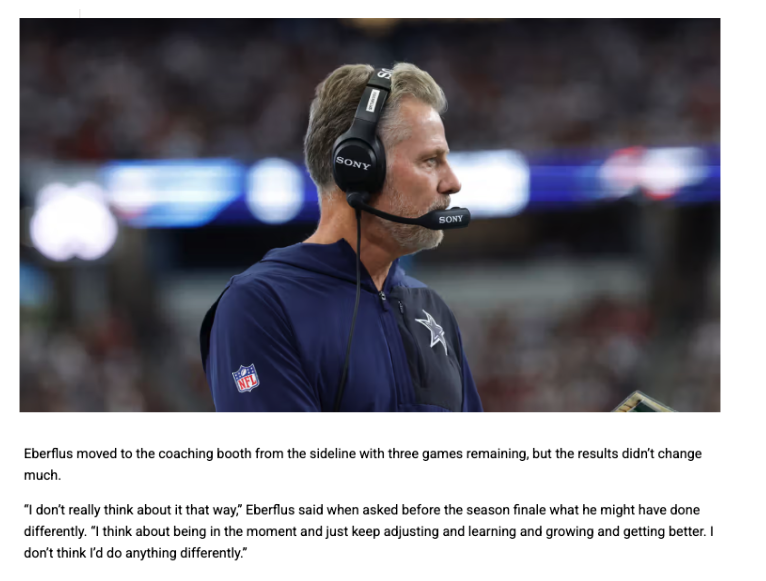
Today’s blog is in response to recently fired Dallas Cowboys DC Matt Eberflus’ statement:
“I think about being in the moment and just keep adjusting and learning and growing and getting better. I don't think I'd do anything differently.”
I have two direct connections to that quote.
First, as most know, I am a lifelong, die-hard Cowboys fanatic. That’s my team. That’s my fall mood dictator. That’s my oldest son and my most frequently discussed topic. Cowboys. Cowboys. Cowboys.
Second, as most also know, I’ve been fired as a coach.
It sucks. It is devastating. It is a scar — a wound — that never really leaves you.
I’m sharing this quote not to pile on the Cowboys or dehumanize the real cost of being fired. Being told “you can’t coach here anymore” hurts, no matter what the check looks like on the way out. Coach Eberflus will be fine financially, but that doesn’t erase the emotional reality of it.
What I want to sit with is the mindset reflected in that quote — because it’s one many men recognize.
You can hear the internal tension in the sentence itself.
On one hand, there’s language that aligns with TeamsOfMen values: learning, adjusting, growing. On the other hand, there’s a familiar manbox reflex that follows immediately: “But I wouldn’t change anything.”
I’ve heard that line over and over again. And I think it might be the last stronghold of a thought pattern that helped create the moment in the first place.
Because here’s the thing: If you genuinely believe in learning and growth, then by definition you would do something differently with the benefit of what you know now.
If you say you’re about adjusting, then you’re also saying, “I learned enough to coach this differently.”
What I’ve told people repeatedly is this: if I could go back to the losing seasons of my past and magically give those players more wins, I absolutely would. Without hesitation.
But I don’t want to lose the lessons I learned inside those failures — lessons that made me a better person and a better coach now.
Sometimes pride shows up in the form of cliches we repeat because they sound strong.
And if you’re responsible for the worst defense in the history of a franchise, it’s okay to say:
“Yeah, looking back, there are things I know now that I would have changed then if I had those tools.”
That doesn’t mean you lacked passion.
It doesn’t mean you didn’t care.
It means you grew.
And growth isn’t proven by saying you wouldn’t change a thing. It’s proven by being willing to say what you would.
Coach Prompts
When you say you’re “always learning,” what’s something you’d actually do differently if given another chance?
Where might pride be disguising itself as confidence in your leadership language?
If the results stayed the same, but you had today’s tools back then, what would you change without hesitation?
Player Prompts
Have you ever said “I wouldn’t change anything” to avoid sitting with a mistake?
What’s the difference between standing by your effort and refusing to adjust your approach?
How do you know when growth is real versus just something you say out loud?