
Manbox Loyalty vs. Moral Courage
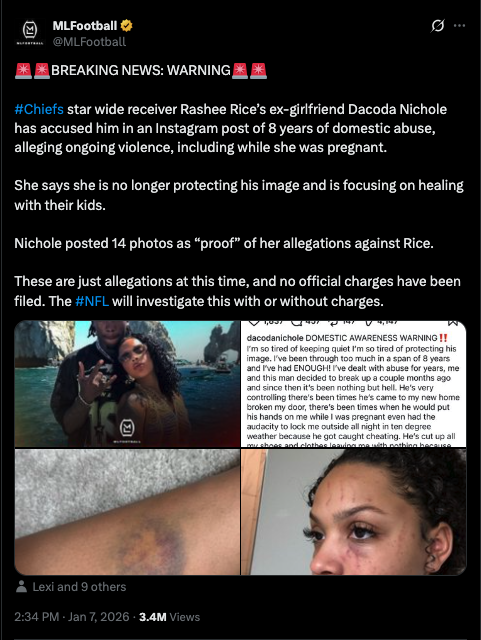
Today’s blog is in reaction to the recent allegations from Rashee Rice’s longtime girlfriend, Dacoda Nichole, regarding domestic violence and abuse.
I’m writing this to reiterate something that has been central to my TeamsOfMen work for over a decade: believing women and believing survivors matters. It is one of the hardest lifts in this work — and one of the most necessary.
Almost immediately, the comment sections filled with the same tired victim-blaming tropes that live inside DARVO tactics:
“Why did she wait so long?”
“How much money does she want?”
“She could have just left.”
“We don’t know the whole story.”
I will say this: I was genuinely encouraged to see some male Chiefs fans step up and say plainly, “We don’t want this type of person on our team.” That matters. It shows cracks forming in a culture that too often defaults to defense and denial.
But we also have to hold the larger context.
Earlier this year, Chiefs players wore “Free Rashee” shirts during warmups while he was serving a six-game suspension for a hit-and-run incident. That decision reeked of circling the wagons — not around accountability, but around image protection. It framed him as a wrongly accused victim rather than someone who, at bare minimum, deserved to sit out football games for his actions.
That instinct — defend at all costs, never admit fault, never show remorse — is straight out of the manbox playbook.
We teach men that loyalty means silence.
That accountability is betrayal.
That protecting “one of our own” matters more than truth or harm.
And then we act surprised when violence continues.
We can teach something different. We can show our players that accountability is not weakness. That honesty is not self-destruction. That reflecting on personal failure is not the end of a career — but often the beginning of real growth.
If we want young men to live differently, we have to model it differently.
And that starts with believing survivors, naming harm clearly, and refusing to hide behind the scoreboard.
Coach Prompts
What do you notice about your first instinct when allegations like this surface—defense, doubt, curiosity, discomfort?
How does “circling the wagons” show up in your program when a player messes up?
What language do you use with players to separate accountability from shame or abandonment?
Player Prompts
Why do you think people ask “Why did she wait?” instead of “Why did this happen?”
What’s the difference between supporting a teammate and excusing harmful behavior?
How might real accountability actually protect you—and others—long term?