Show Them This
I’ve spent much of this week in a slow-burning rage.
Much of that I can attribute directly to the Cornell situation, and not only my Monday writing on it, but subsequent follow-ups, not only across general culture and on social media, but direct commentary back to me that is, for lack of a better phrase, victim blaming at its height.
I watched in fury as The View co host Sonny Hostin tried to both sides, legalese her way around what I saw as a victim blaming stance.
I read in rage comments on various Cornell 7 posts that tried to excuse away the men’s alleged behavior, infantilize them AND deploy the usual DARVO tactics we all know and loathe (but also have come to expect).
Hell I went back and forth with a random on Bluesky who tried to hide behind the semantics of an awful New York state law and pretend they were having a hard time dealing with the “messy” of the situation.
If I’m at this point of exasperation and anger, I can only imagine what survivors are feeling this week.
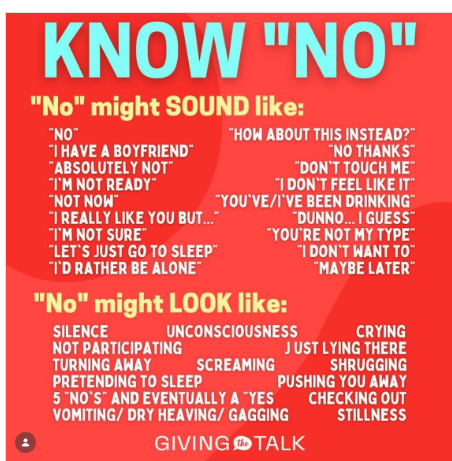
That being said, I wanted to share the above graphic (originally posted on IG by @givingthetalk) as a very simple “Listen, are you moved by this? Yes? Are you around men? Yes? Then show them this dammit” share.
It’s very easy to decipher…it’s based in a reality where a clean “No” may not be available, but that does NOT make the absence of a “No” consent.
You can literally post it, print it, hang it, share it.
Done.
I don’t have the energy to go further today here…not because I have less resolve, but because I don’t want to give folks the option to “opt out” of the conversation because we get too far in the weeds of our educated language and research-based verbiage.
Share the “KNOW ‘NO’” and sit with it.
Coach Prompts:
What keeps you from simply putting a graphic like this in front of your players?
Where might your players have learned that the absence of “no” means permission to continue?
Are you making consent education so complicated that it becomes easier to avoid doing it?
Player Prompts:
If someone never says “no,” what tells you they actually WANT what is happening?
Why might someone be unable or unwilling to give a clean, verbal “no”?
What should you be looking and listening for instead of simply waiting to hear the word “no”?