Stop Repairing the Explosion. Coach the Pause.
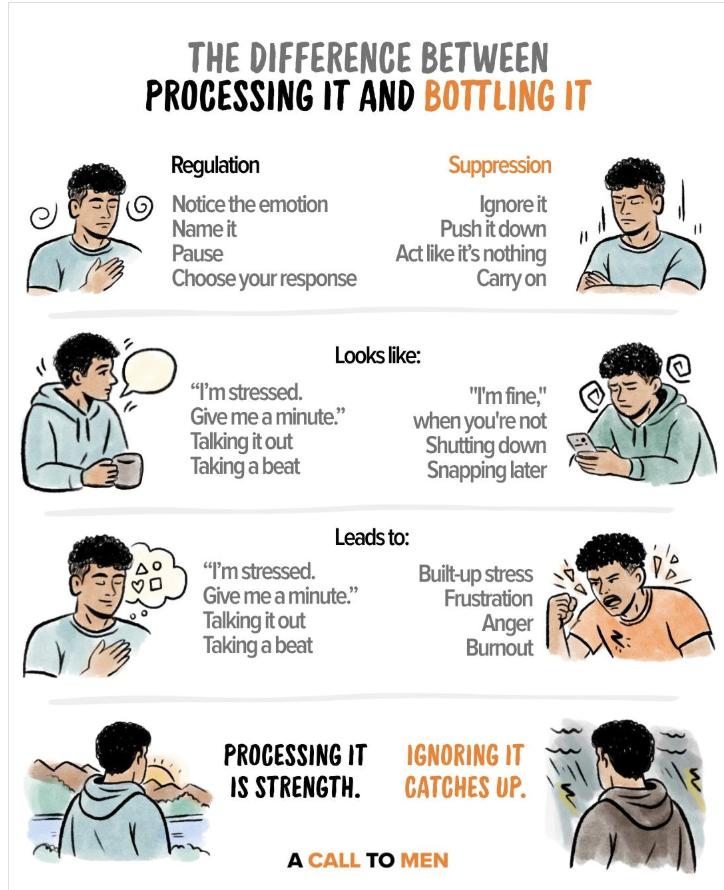
I’m hoping today’s graphic share (from a post by industry leader @acalltomen) is an easy to share graphic that a large range of ages in your team room can understand. I’ve run many a session on emotional fluency using the concept of overflowing water bottles and the visual is a powerful connector for male athletes.
I was also drawn to the side by side (shoulder to shoulder) nature of the graphic because I think the flow for your players eyes will be an easy “this INSTEAD OF that” action. Whether it's a defensive read, a passing progression, or a late-game decision, we simplify choices all the time because clarity helps execution, so why not deploy some of that same shaping in our building of their emotional fluency.
Finally, I think the “PAUSE” inclusion on the first section of the graphic is vital. It leads to a “CHOOSE YOU RESPONSE” which I think returns agency to young men during emotional roller coaster moments. It’s not as easy, obviously as a graphic makes it out to be BUT the pause (preferably with a deep breath) can head off a number of reactions with our words and bodies that we would otherwise regret.
And that's probably the one adjustment I'd make if I were presenting this to a team.
I wouldn't tell them the goal is to "process your emotions." I'd tell them the goal is to become the kind of teammate who doesn't make a bad moment worse.
Most male athletes already know what it feels like to have a teammate spiral after a turnover, a bad call, a missed shot, or a tense conversation with a coach. They know what it looks like when someone says, "I'm fine," only to snap five minutes later.
This graphic gives them something much more practical than "be emotional." It gives them a sequence.
Notice.
Pause.
Choose.
That's a skill worth practicing just like a closeout, a free throw routine, or a defensive rotation.
Coaches Prompts
When do your players most struggle to pause before reacting?
What does emotional regulation look like during a practice, not just in life?
How could you reinforce "the pause" the same way you reinforce effort?
Players Prompts
What's usually happening right before you say or do something you regret?
What does "I'm fine" actually mean when you're not?
What would change if your first response wasn't your final response?