What Elite Athletes Can’t Outsource
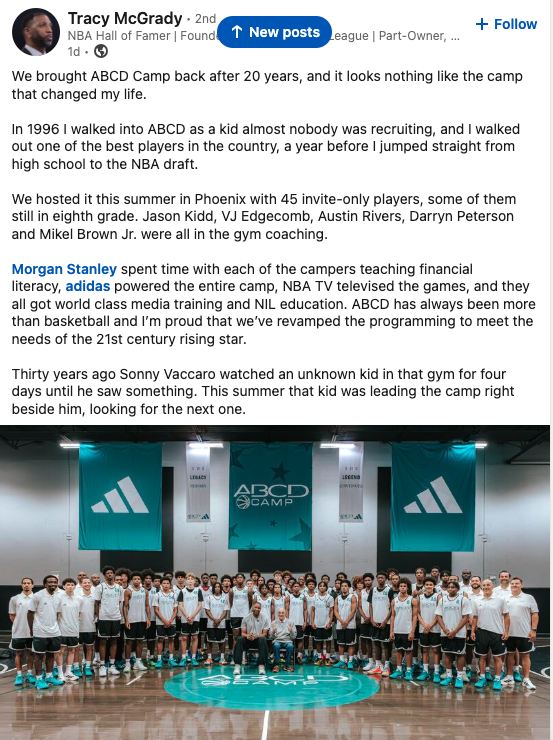
So, yes, I was as surprised as you are to learn Tracy McGrady is on LinkedIn and actually posts.
Not as a judgment of T-Mac, but overall, someone with that level of celebrity rarely shows up on here. (And yes, I know it could literally be a paid employee doing it for him.)
Either way, it was really cool to see the work he has done with the rebranding and rebirth of ABCD Camp. For those unfamiliar, ABCD was a legendary basketball camp that McGrady himself attended in 1996, before eventually jumping from high school straight to the NBA.
Twenty years after the camp disappeared, McGrady brought it back this summer with 45 invite-only players, some as young as eighth grade.
And look at what they've intentionally built around the basketball.
Financial literacy. NIL education. Media training. Access to current and former NBA players. All alongside high-level basketball instruction.
That's awesome.
More importantly, it acknowledges something I wish more athletic spaces would acknowledge: if we're going to put young people into environments that can dramatically change their lives, preparing them athletically isn't enough.
Why, then, did I leave this comment on what was otherwise a post I really liked?
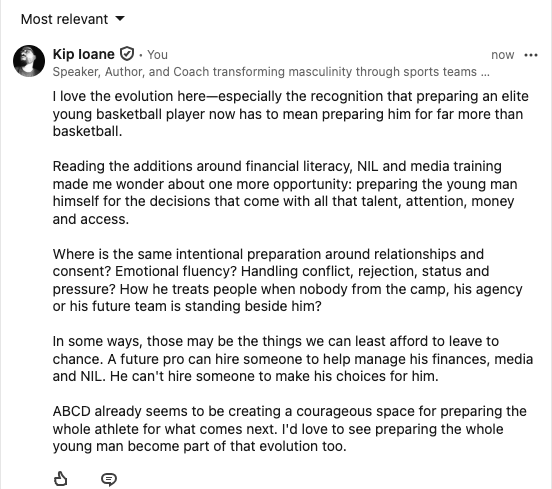
Because I think all too frequently well-intentioned folks creep right up to the starting blocks of what TeamsOfMen believes in, and then—whether from fear, naivety or intentional avoidance—don't go further.
There is absolutely a need for what McGrady and ABCD Camp put these 45 invite-only, high-level, and in some cases likely future professional basketball players through.
My issue is twofold.
First, if some of these young men eventually sign NBA contracts, they're probably going to hire people to help them with many of the things they're currently being taught.
Someone will manage their money. Someone will negotiate their endorsements and NIL opportunities. Someone will help prepare them for media appearances. There will be agents, financial advisors, publicists, team personnel and an entire infrastructure surrounding the professional athlete.
But there's one really important job nobody can be hired to do for them:
Make their choices.
And that's my second issue.
Because some of the most challenging things these young men may eventually navigate won't happen during a television interview or while looking at an investment portfolio.
They'll happen when they're navigating relationships and sex. Rejection and jealousy. Alcohol and parties. Conflict with a partner. The behavior of teammates. Anger. Loneliness. Ego. Social media. Suddenly having enormous amounts of money, fame, attention and access.
Their character may be tested in ways it never has been before.
Where are the reps for THAT at camp?
My comment gets into this in more detail, but it's also the question I have for so many people and organizations inside athletic ecosystems that proudly tell us they are teaching young people "life lessons" through sport:
Why do those life lessons so conveniently manage to dodge some of the hardest conversations they'll actually face?
I'm not suggesting ABCD Camp needs to become a week-long seminar on masculinity, consent and healthy relationships. Nor am I suggesting financial literacy, NIL education or media training aren't incredibly valuable.
I'm asking why those subjects qualify so easily as player development, while the decisions that determine how a young man treats another human being so often don't.
If we're courageous enough to prepare an eighth grader for the possibility that basketball might someday make him rich and famous, shouldn't we also be courageous enough to prepare him for who he will need to be when it does?
Coach Prompts
Look at everything you intentionally teach your athletes away from the X's and O's. Which parts prepare them to perform and succeed, and which parts prepare them to make difficult decisions as young men?
What difficult situations involving relationships, consent, rejection, alcohol, anger, social media, teammates or status are your athletes likely to encounter? Where do they get reps preparing for those situations in your program?
When you say your program “teaches life lessons,” which of those lessons require you to have conversations that are actually uncomfortable?
Player Prompts
Think about the adults helping prepare you for basketball, school, work, money and your future. Who is helping prepare you for the difficult decisions you'll have to make when none of those adults are around?
What situations outside of basketball do you feel least prepared to handle well right now?
When have you had to make a decision involving relationships, friends, anger, pressure or social media where you wished you'd had a chance to think through it beforehand?
Your program probably says it teaches life lessons. But which ones are you intentionally preparing your athletes for—and which ones are you hoping they figure out on their own?
The Decision Confidence Analysis™ (DeCA) helps coaches examine the actual prevention and decision-making infrastructure inside their program—not what they hope they're teaching, but what they've intentionally put in place.