What This Research Should Make Coaches Question
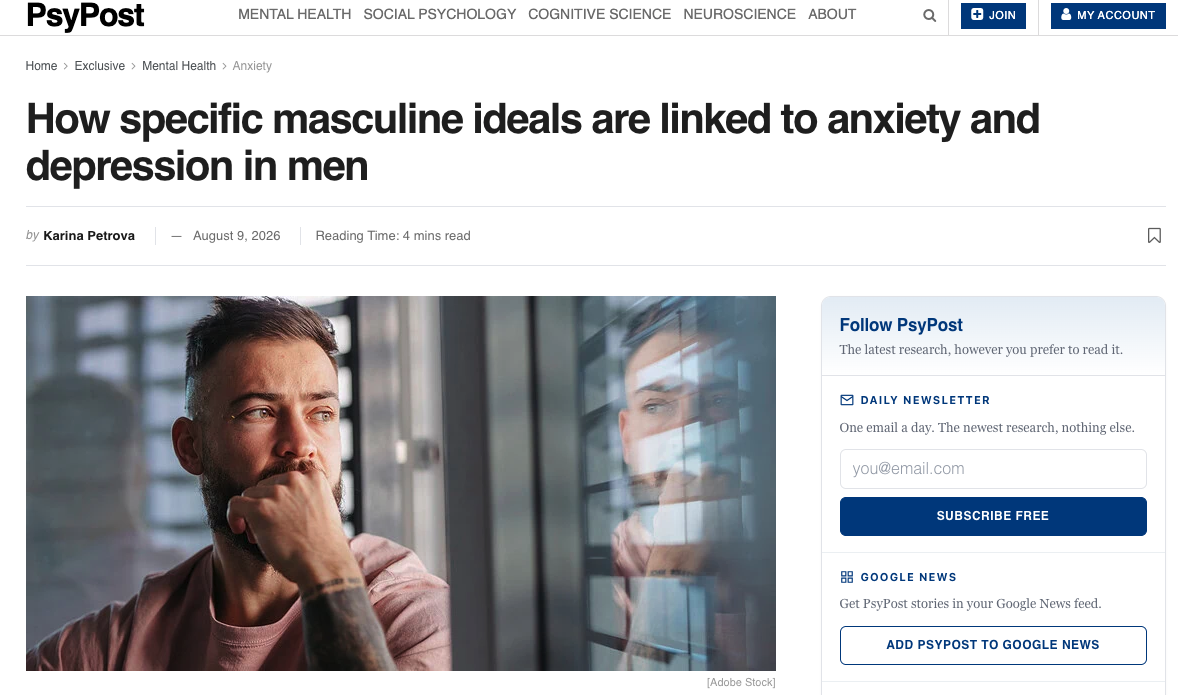
It’s been awhile since I shared one of his links, but Professor Michael G Flood on X is a must follow. In the early days of TeamsOfMen, I would wager he was one of our most retweeted and shared researchers on men, masculinities, gender, and violence prevention. The article screen grab above links to one of those “If Professor Flood shared this, it’s worth reading” moments.
As always, I don’t want to help you be lazy, so PLEASE go read the entire article. But, what the two bullet points I believe are vital for you, your staff and your players are below:
“…a recent survey reveals that specific norms—namely emotional suppression and extreme self-reliance—are uniquely linked to higher rates of anxiety and depression.”
“Men also face high rates of internalizing symptoms. Internalizing symptoms refer to mental health conditions where individuals direct psychological distress inward, rather than acting it out aggressively, with common examples including depression and anxiety disorders.”
Those two statements hold tremendous insight and ramifications for your program and players. If you accept, as TeamsOfMen believes, that your sport can be a driver of point number one (“hey man, you gotta be a dawg, you gotta handle your business out there on the field”) then we have to recognize that our spaces can reinforce some of the exact norms this research associates with higher rates of anxiety and depression.
And then, when distress does show up, how often does sport reinforce the silence described in point number two?(“we don’t got time for p***ies here man, get your -ish right and go ball out”). Now we’ve potentially reinforced the suppression AND made it harder for a young man to tell us what’s actually going on.
This is not to say “men can’t have stress in their lives.” To the contrary, I’m saying you need a plan for helping them process and move forward despite it. And that plan cannot be “drive it down and ignore it via gritting your teeth harder.” The research points to another option “Additionally, the authors suggest that school programs focusing on emotion labeling could help boys develop healthier emotional functioning long before they reach adulthood.”
I recognize not everyone is moved by fancy studies and scientific terminology (hell, in the article I first learned that “Alexithymia describes a personality trait characterized by a severe difficulty in identifying and describing one’s own emotions”) but think about the coaching implication of that for a second: How can a young man regulate an emotion he can’t even identify?
We don’t need coaches to become psychologists. But unfamiliar terminology can’t stop us from using every resource available to help our young men grow while in our care and playing our sport.
Coach Prompts
What messages do your athletes hear from your staff about what they should do when they're stressed, scared, overwhelmed or struggling?
Does your program teach athletes how to process difficult emotions, or mostly reward their ability to conceal them?
If a player couldn't identify what he was feeling beyond "good," "bad," "pissed" or "fine," what opportunities does your program currently give him to build that skill?
Player Prompts
What's the difference between controlling an emotion and pretending you aren't experiencing it?
When something is bothering you, what makes it easier—or harder—to tell someone else what's actually going on?
How good are you at identifying what you're feeling before it affects how you play, communicate or make decisions?
If today's post made you wonder whether your program actually teaches young men how to recognize and navigate difficult emotions—or simply expects them to figure it out—don't guess.
Click here to run the free Decision Confidence Analysis™ and discover where your program is reinforcing healthy decision-making—and where hidden gaps may still exist.