
Who's Making Money Off Your Player’s Insecurity?
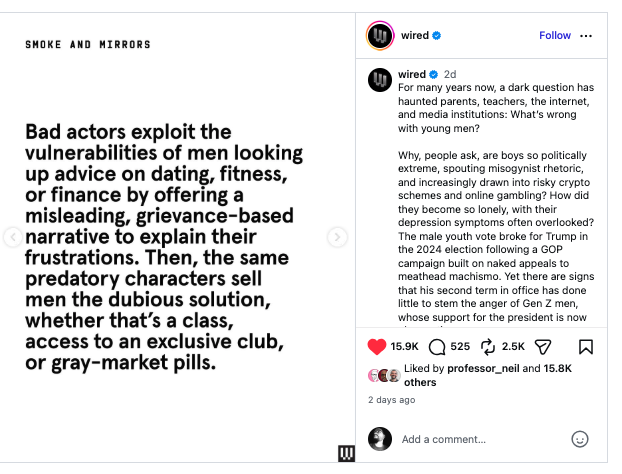
Despite 15 years and counting in the ecosystem that is “positive masculinity and the fight against the manosphere” I still find myself shocked by the appeal of the manbox. I still find myself shocked at how any person could land on ideas and beliefs that are harmful to themselves, to the people in their vicinity and to the community they live in.
Like, it literally makes no sense.
But leading with “WTF is wrong with you man” rarely moves anyone towards outcomes I would like to see so I’m always looking for entry points to the mindset in order to hopefully better position myself to help people find the exit sign. That being said, this framing (as laid out in a long IG carousel by @wired) is new and could be a break through.
I’ve never seen the economic “pyramid scheme” lens taken in our work but it absolutely makes sense. We know our society is full of opportunities to grift, and there is no shortage of folks willing to make a buck off the backs of someone’s suffering elsewhere. So of course, as the post lays out, it stands to reason that if manbox thinking has men (especially the 18-29 year old crowd) second guessing their looks, their body types, their dating life, of course there would be people offering phony ass solutions for a special “$49 today only” rate.
I won’t spoil the entire post (but will link to the study it cites by Equimundo here) because I think it warrants a read from you, a bullet break down for your staff AND ultimately a convo with your guys.
And imagine the power of presenting this to them—and, if you're a high school coach, their parents—not initially as a conversation about misogyny or masculinity, but about the financial shell game some online "gurus" are running on young men.
Who benefits financially from you believing you're not muscular enough? Not rich enough? Not getting enough women? Not "alpha" enough?
What happens to their business model if you actually become comfortable with yourself?
Coach Prompts
What online personalities are your athletes learning from about money, fitness, dating and masculinity—and which of those people are also selling them something?
How could financial literacy become an entry point for discussing manosphere content without immediately putting athletes on the defensive?
When an influencer identifies a problem young men supposedly have, how often are we teaching athletes to ask who benefits from them believing that problem exists?
Player Prompts
Think about someone online who regularly gives men advice: what does that person eventually want their audience to buy?
How can you tell the difference between someone helping you solve an insecurity and someone who financially benefits from keeping you insecure?
What would happen to an influencer's business if his followers eventually decided they were already good enough?
If today's post made you wonder whether your program is actually preparing young men to question the messages—and messengers—competing for their attention, don't guess.
Click here to run the free Decision Confidence Analysis™ and discover where your program is reinforcing healthy decision-making—and where hidden gaps may still exist.