
What Women See That Men Don’t
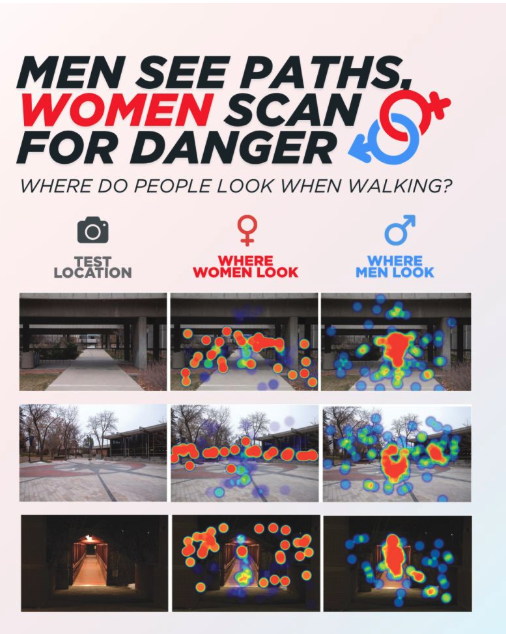
What you’re looking at in the title image here is a study tracking where men and women’s eyes and gaze tended to go while walking through outdoor city environments. Dark red spots represent heavier concentrations of visual attention while blue spots represent less focus. As you can see, the way the two groups move through these spaces is drastically different.
In short, men generally look straight ahead, focused on destination and movement, almost as if the path itself is assumed to be safe. Meanwhile, women scan. They look around, paying particular attention to areas with low light, limited visibility, or difficult escape routes. That’s not coincidental. It’s a reflection of something many women instinctively know from lived experience: the possibility of danger changes how they move through the world.
The study’s conclusion is difficult to ignore: gendered violence shapes how women experience cities, influencing the way they navigate even routine moments like walking to a car, crossing a campus, or heading home at night.
So how is this applicable to your team of male athletes?
First, we talk in almost every sport about the need for clear, accurate, and timely vision. We can’t make decisions on a pass, shot, read, or pitch if our eyes aren’t clear. I think that idea extends well beyond sport. Seeing where you want to go, who you want to become, and how you want to move through life becomes harder when fear, distraction, or self-protection constantly takes up bandwidth.
Second — and this is the harder conversation — women are often scanning these spaces because of MEN.
And before the defensiveness rises up with “I would never” or “not all men,” I’d simply offer this: until women no longer feel the need to move through the world this way, then all men still have work to do.
What are we doing in our spaces to make sure our boys are not becoming part of the problem?
What kind of inner healing, emotional fluency, and accountability are we modeling ourselves so we are less likely to lash out, control, intimidate, or cause harm?
And where, specifically, can we point in our lives that would allow some of these mental hot spots of danger in a woman’s mind to slowly dissipate? Because if the women in our lives are navigating the world with one eye on safety, that should matter deeply to the men we claim we are trying to develop.
Coach Prompts
What conversations are coaches avoiding about the ways women experience public spaces differently?
How do we teach boys accountability without immediately triggering defensiveness?
What behaviors in sports spaces unintentionally reinforce entitlement, intimidation, or control?
Player Prompts
Why do you think women often experience public spaces differently than men?
What role do boys and men have in helping people feel safer?
What would it look like to be the kind of man who lowers fear instead of increasing it?