When "We'll Wait and See" Isn't Enough
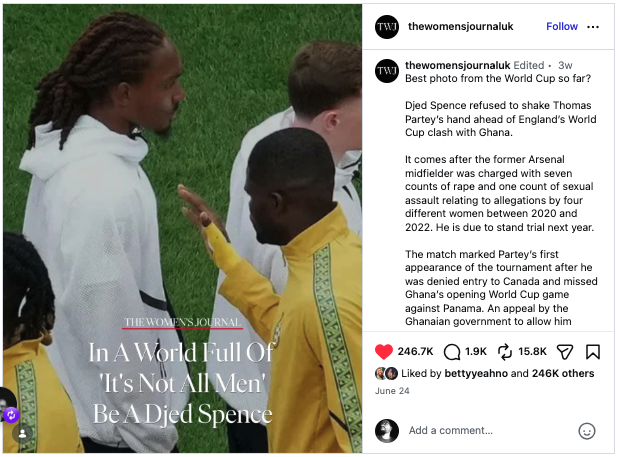
Even without the record setting number of viewers for the final match (I believe north of 60 million), the World Cup captured the attention of the world these past 5 weeks. I can admit I am a casual soccer (futbol) fan at best, but I absolutely watched a ton of games and found myself finding new nations to cheer for alongside Team USA. But the post above (originally on IG from @thewomensjournaluk) caught my attention, as it spoke to not just a TeamsOfMen of lens (aka believe survivors) but also to something I’ve seen young men struggle greatly with:
How do I honor a commitment to believe survivors in a world where I also respect the principle of “innocent until proven guilty”?
I LOVE what England defender Djed Spence did here. He made a statement by simply not shaking hands with Thomas Partey (who has been accused of seven counts of rape and is awaiting trial) post match. He didn’t make a declarative “You did it” but he also didn’t bro hug him and pretend being on the pitch was a magic elixir that removes all credibility of Partey’s accuser. He walked past him. Simple. Not a declaration of guilt, but also not a blind naivete to the serious accusations against his former teammate.
At worst, if Partey didn’t commit the crime, Spence will later have to say “Hey, I didn’t shake your hand” but also if Partey IS found responsible, Spence did not cosign him and some sort of escape to the world of soccer. So often, I believe, coaches and teammates get twisted in knots over “well, I gotta see the evidence”…sure you can say that, but in the meantime, while we’re all waiting on the “evidence” this person doesn’t need to be playing a sport. They don’t need to be locked up either, but they damn sure shouldn’t be getting the glory of scoring touchdowns or goals.
People have asked me over the years how I could comfortably coach with a policy that said, "If you're accused of certain forms of harmful behavior, you won't compete until the matter is resolved."
My answer has always been simple. I understand there is risk in that decision. I also understand there is risk in the opposite decision. If you tell me that false allegations are uncommon, I'm willing to accept the possibility that I may occasionally hold an innocent player out rather than repeatedly create an environment where survivors learn our program defaults to skepticism. Coaches make decisions under uncertainty every single day. We call plays that don't always work. We foul at the end of games. We press knowing someone will eventually beat it. Leadership is often about deciding which risk you're willing to live with.
In fact, along these lines, I would have a serious conversation with yourself, with your admin and with your staff (all BEFORE you roll something out to your guys): As we navigate claims of harmful behavior against our guys, what level of participation in our program are we comfortable with? The answers you land on will speak volumes to your belief systems.
Coach Prompts
Before an allegation ever reaches your program, what principles do you want guiding your response?
What's the difference between determining criminal guilt and deciding who represents your team?
How would you explain your program's approach to both the accused athlete and the person making the allegation?
Player Prompts
Is there a difference between saying, "I know he did it," and saying, "I'm going to take these allegations seriously"? Why?
What responsibilities come with representing a team, school, or community beyond simply following the law?
How should teammates balance loyalty to one another with accountability when serious allegations arise?