
Wield It On Yourself
Listen, I’m the TeamsOfMen guy.
I’m the “Hey, when you use your platform as a coach of young men, you can change the world via the men you help mold” guy.
I believe that.
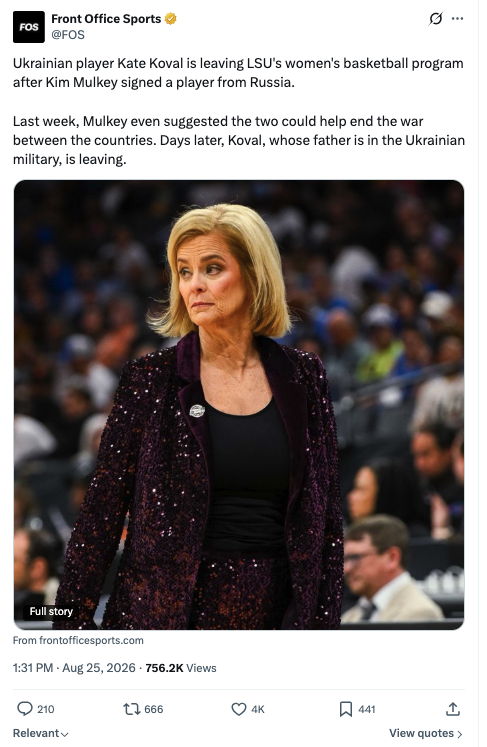
But, this from @frontofficesports on X alleging famous LSU WBB Head Coach Kim Mulkey thought it was a good idea to have Ukrainian player Kate Koval and a Russian player on the same team in the middle of their countries mired in a 4 year war (12 years if you start from the annexation of Crimea) is peak coach delusion.
Seriously, what we do is NOT THAT IMPORTANT.
Even for someone as well compensated as Mulkey (reportedly $3.6 million/year), at a place as big as LSU, on a stage as national as SEC basketball, this is a SPORT and your “team room” is most likely incapable of solving world conflict.
Coach, the girl’s FATHER is literally a soldier fighting in this war every day.
You’re asking her to box out and then shake hands with someone who, at best, is from a country who is actively trying to kill her dad.
This is beyond a misstep. This is a complete break from reality.
I think in this profession the best you can hope for is a progression from where you mandate actions to a player…who grows in their ability to act independently enough to the point you can simply witness their choices in the game. I do believe you have a responsibility to try and use the learning design you deploy for that progress with the athlete with the human being too.
But notice in there, it was very much an individual growth proposition.
And maybe that's where we coaches need to develop some humility around this whole “use your platform” thing.
Your team room can be an incredible place for individual growth. You can help a young person examine what he believes. You can expose him to people different from himself. You can give him reps navigating conflict, empathy, curiosity and disagreement. You can create conditions where he leaves your program a more thoughtful human being than when he entered it.
That's a hell of a platform.
It is also still just a basketball team.
There are experiences your players bring into your room that are bigger than you. Bigger than your program. Bigger than whatever lesson you've designed for Tuesday afternoon.
A player's father fighting a war against the country her new teammate comes from qualifies.
Maybe the growth opportunity in those moments isn't for the athlete. Maybe it's for the coach to recognize the limits of his or her own influence.
Sometimes using your platform responsibly means knowing where the platform ends.
And this is where I think Mulkey, who reportedly told Koval she couldn’t pass on recruiting the Russian player because she could help LSU win, needs to take some of that considerable influence and power coaches like us love talking about and WIELD IT ON HERSELF.
Look in the mirror and say:
“I'm Kim Mulkey, dammit. I run this program. If I sense this is going to be an issue for either of these young women, I can and HAVE found talent everywhere. I can find somebody else.”
That's an option too. In fact, that's probably the place where Mulkey had the MOST power in this entire situation.
Not to make two young women ambassadors for peace.
Not to see if basketball could somehow bridge a war.
To make a different recruiting decision.
Sometimes we coaches get so enamored with the idea that our influence can change the people in our room that we forget we also have the power to change OUR OWN DECISIONS.
Coach Prompts
Where are you asking your players to grow when the decision that actually needs reconsidering might be YOURS?
What problems are legitimately within the reach of your platform—and which ones require the humility to admit they aren't?
When you identify a difficult “growth opportunity” for a player, do you first ask whether there's a decision YOU could make that changes what you're asking them to carry?
Player Prompts
What parts of your life should a coach understand aren't theirs to fix?
Can teammates respect one another without being responsible for resolving everything that exists between them?
Have you ever had an adult frame something as a “growth opportunity” for you when you wished they would simply make a different decision?
We talk a lot about preparing athletes to reconsider their decisions. But what happens when the decision that needs reconsidering belongs to the coach?
Coach Readiness requires more than having the tools to develop the people in your program. It requires the ability to turn those same tools inward.
Your Decision System has to apply to you too.