Update the Playbook
I know you've heard of the “Love Languages.”
Words of Affirmation
Quality Time
Receiving Gifts
Acts of Service
Physical Touch
I know you and/or your wife/spouse/partner have probably even had at least a cursory discussion of which one is yours and which is theirs, etc.
And, yes, I'm writing about this today in a space that hopefully gets read by coaches of male athletes because your players have heard of them too.
(Pssst: They might have heard YOU mention them as well.)
And I want you to STOP using them, talking about them, mentioning them at all.
Why?
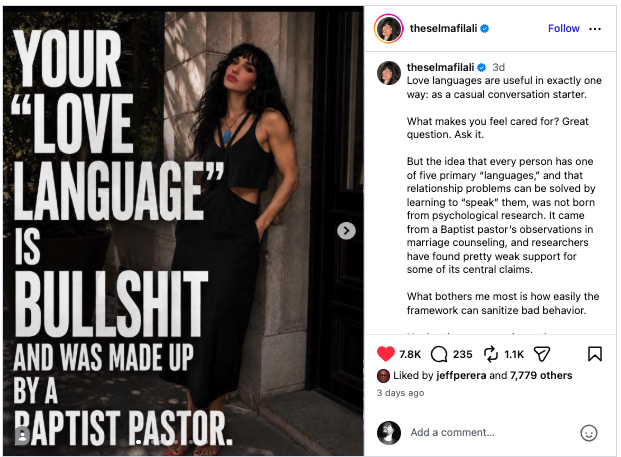
First, because of what I learned on [IG from @theselmafilali] about the origin and fake science behind their creation (just click on the image above for more insight on that). READ her entire post and scroll every slide.
And there is research backing up the larger criticism here: the Love Languages framework didn't originate from psychological research, and subsequent research has failed to provide strong empirical support for its central claims—that everyone has one primary Love Language, that there are exactly five of them, and that relationships are better when partners “speak” one another's primary language.
But, also, because your players look to you as a model of manhood.
They take cues from how you and your staff navigate the world as men (regardless of age), and if you constantly reinforce—via talking about and acting according to—these “languages,” you are going to encourage them to do the same.
And if you are living out these fake ideals that ultimately lead to unbalanced asks of women in relationships and cater to ridiculous manbox-cliched ideas of men's “needs,” they will be more likely to do the same.
Think about how easily:
“Physical Touch is my Love Language.”
can become:
“This is what I NEED from you.”
Or:
“Acts of Service is my Love Language.”
can become:
“This is how you need to show me you love me.”
Or how any of these supposedly fixed “languages” can become an explanation for why the other person needs to change their behavior to accommodate you.
And maybe THAT'S the part I most want our guys thinking about.
NOTE: I’m writing more about this in today’s HuMANiTEAM Report—including what ditching “Love Languages” might actually look like when we talk with young men about relationships.
Coach Prompts
Have you ever talked about “Love Languages” with your players as though they're established psychological categories?
How are you helping your players distinguish between identifying something they value in a relationship and believing they're entitled to receive it?
What other relationship ideas have become so culturally normal that you've never stopped to ask where they came from or whether they're actually supported?
Player Prompts
What's something that makes you feel cared for—and does valuing it mean somebody else owes it to you?
What happens when something you want from a relationship conflicts with a boundary your partner has?
What's the difference between telling someone what you appreciate and telling them what they're responsible for providing you?