
Accountability or Excuses? What This Schefter Clip Teaches Us
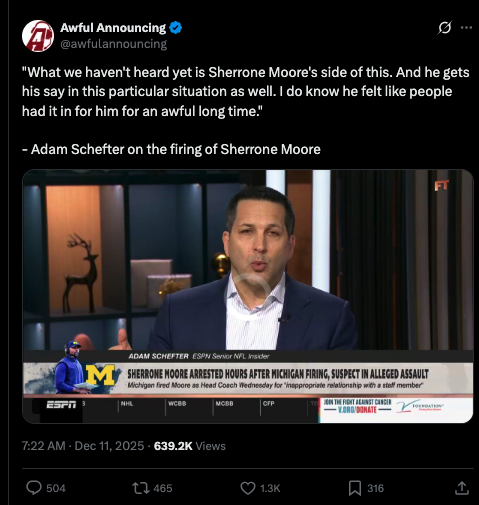
Today’s blog sits at the crossroads of two things happening at once:
• The firing of Sherrone Moore as Michigan’s head football coach after an extramarital affair with a staff member
• The ESPN clip of Adam Schefter trying to frame the fallout in a way that softens Moore’s responsibility
Let’s start with Moore.
This is one of the oldest man-box scripts in existence: success, fame, and high-status roles come packaged with access — including access to women’s bodies. Nobody says the quiet part out loud, but boys absorb it early, and men in power often act on it later. Even in consensual situations like this one appears to be, it still fits the pattern: a partner who supported you through your lowest, through the climb, through the dream becoming real… and then, once you hit the peak, you betray them with someone newer, younger, and far less likely (or able) to look you in the eye and say NO.
That alone is worth its own team discussion:
“If I ever reach the level I dream of… how will I keep my integrity intact?”
But here’s the part that needs urgent attention inside programs:
Schefter’s framing is straight out of the DARVO playbook.
If you’re not familiar, DARVO =
Deny. Attack. Reverse Victim and Offender.
It’s one of the most common strategies men use when accused of harm — especially in sexual misconduct cases — and here you can watch Schefter attempt a media version of it. He downplays Moore’s agency, paints him as someone targeted by mysterious forces, and subtly positions him as the real victim.
This, by the way, from a Michigan alum and fan who absolutely should have recused himself from commentary.
What Schefter is doing is not objective reporting. It’s narrative laundering — remaking a man’s harmful choice into a sympathy case, and shifting attention away from the actual breach of trust, power, and professionalism.
Your players need to see this clearly.
Because DARVO doesn’t only show up on ESPN.
It shows up in locker rooms.
In group chats.
In breakups.
In disciplinary meetings.
In Title IX cases.
In how boys talk about girls behind closed doors.
In how men excuse each other’s behavior.
Teach them the pattern now so they can recognize it later — in others, and in themselves.
Accountability isn’t cruelty.
Accountability is care.
And when we avoid it, young men pay the price.
COACH PROMPTS
How often do your players see powerful men avoid responsibility through narrative spin?
Have you ever explicitly taught your team about DARVO and how to spot it?
What expectations do you set for integrity when your players imagine their future success?
PLAYER PROMPTS
When you make a harmful choice, what’s your first instinct — own it, or explain it away?
How would you want someone to talk about you if you harmed someone else?
What safeguards do you need to put in place now so success never becomes a license to betray anyone?