
Are You Coaching—or Performing Coaching?
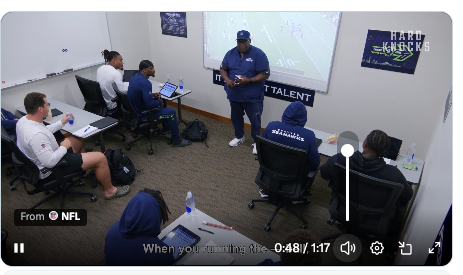
I’m a Notre Dame Football fan.
I have loved the Irish since my godfather first introduced them to me during the Tony Rice hey day of Lou Holtz era.
The fight song. Touchdown Jesus. NBC. The alternate green uniforms. I was and am still all in.
I lead with that because the Seahawks RB coach above, Coach Thomas Hammock, was previously the Head Coach at Northern Illinois and he defeated Notre Dame (in Head Coach Marcus Freeman’s debut) in 2024. So when I saw him on HBO’s Hard Knocks in the clip above it triggered a memory of “Hey I know this guy.”
However, I don’t share it here in our TeamsOfMen blog space to get you to like Notre Dame. I share it because I think this is one of those moments where the term “performative” is appropriate. I know you are probably used to hearing that term in the world of social justice, as it means “actions, allyship, or activism done primarily to increase social capital, protect a reputation, or signal virtue, rather than out of deep devotion to a cause.” But performance happens in coaching too.
I don’t know Coach Hammock so I won’t blanket his career or individual integrity with claim beyond THIS SPEECH he gave his RB room reeked of coaching performance.
Count the bleeped eff bombs. Feel the cringe at the timing and usage of all of them. Look at the players faces as they are delivered. At least from what we can see in this edited clip, NONE of them land, none of them move anyone. If our goal as coaches is to use our platform to teach and inspire change in behavior (both on and off the field), this was a not a tool that delivered.
Hard Knocks is, of course, a hard environment for anyone to coach in. Where are the cameras, when are they rolling, what is the level of clipping and out of context of each scene we see. I get all that.
But, if you’re being honest, you have been in spaces where a coach fell flat like this. Where a coach tried to be someone he isn’t and you know the players FELT IT. Hell, I would argue Coach Hammock would watch this and cringe himself and navigate thoughts of “Who in the hell is that guy up there? That ain’t me.”
Because how many of us have a version of “Coach” that we put on? The voice gets deeper. The profanity increases. The anger gets manufactured. The speech gets louder. We perform toughness because somewhere along the way we learned that this is what leadership in men's sports is supposed to look and sound like.
Maybe that's what happened here. Maybe it isn't. I don't know Coach Hammock well enough to make that claim about him. But I damn sure know I've seen it happen in coaching.
I’ve seen Coach Hammock’s pressers as a college coach (albeit never behind the scenes cutups from any Hard Knocks type production) and he was NOT this guy in those public settings.
It’s worthy of both a reflection and #MirrorTraining by him, but also as an example for you and your own staff to navigate as well. Go find film of yourself coaching this week. Not game film. YOU film. A timeout. A practice huddle. A pregame speech. Something where you're doing the talking. Turn off the sound first and watch your players.
Are they with you?
Then turn the sound back on and listen to yourself.
Is that actually you talking—or are you performing what you think a coach is supposed to sound like?
Coach Prompts
When you turn the sound off on film of yourself coaching, what do your players' faces tell you?
What parts of your coaching personality are authentically yours—and what parts did you inherit because you thought that's what a coach was supposed to look like?
When do you find yourself getting louder, tougher or more profane than you naturally are? What are you trying to accomplish in those moments?
Player Prompts
How can you tell when a coach is genuinely fired up versus trying to manufacture intensity?
What makes something a coach says actually stick with you?
Does yelling or profanity make a coaching message more powerful to you? When does it make you tune out instead?
One of the things DeCA asks us to examine is Coach Readiness. And readiness isn't just knowing what you want your athletes to learn. It's being able to communicate it in a way they can actually receive.
Your athletes can't make decisions aligned with lessons that never got through.
The Decision Confidence Analysis™ gives coaches a way to examine whether the teaching they believe they're doing is actually supported by the systems they've built around their athletes.