
Let the Team Die
I don’t do “captains” in my HS hoops program. Long story short (and this blog isn’t really about captainship) I used to spend an inordinate amount of time trying to create a “leadership” plan for our captains and then inevitably in season you find yourself lagging on it once the season started.
In addition, to be honest, I believe as the coaching staff it’s your job to lead and too often we scapegoat young people with a “captains” label as a last bastion of desperation when a year isn’t going well (you know you’ve done it, the “well, we need better internal player leadership”).
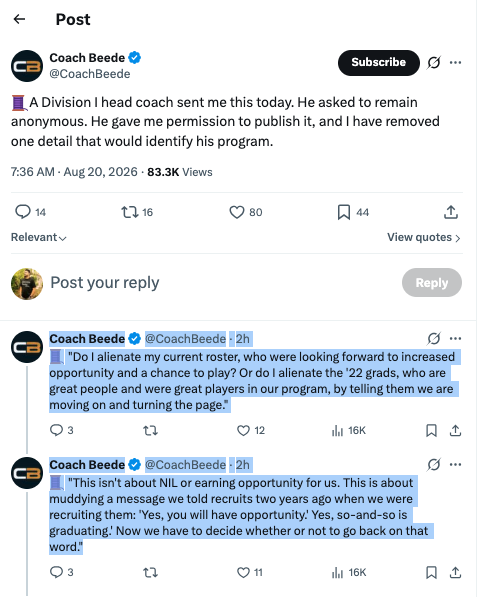
Anyway, I start there because my commentary on the above post this morning from X stems from something I read during one of those long rabbit hole investigations trying to find captains material.
Namely, something written by Bruce Tuckman called the Stages of Group Development. I will let you deep dive the entire theory, but one of my main takeaways that I’ve held onto since then AND I think applies here to the sheer panic gripping college sports (especially football) after a recent court ruling granted the possibility of eligibility to guys who were already graduated and gone, is that you MUST LET THE LIFE CYCLE OF A TEAM HAPPEN…and that includes LETTING IT DIE (years after his original work, Mary Ann Jensen helped add “Adjourning” to the stages).
Seriously coaches…let them go.
Let’s avoid the banter back and forth about the legality of the ruling, and just address the question here in the screengrab that allegedly comes from a D1 Head Coach. He is asking what to do with the promises made to kids who are “of age” now in the program vs letting back “great guys and great players” and while I understand the stress involved, I think the answer is actually really simple:
Let. Them. Go.
I think the idea of “more time: or “run it back” or “one last ride” is getting overplayed here. These young men, let’s say, were “screwed” out of a year of CFB because of a worldwide pandemic. Sure. Yes. They were. It happened. It was unjust.
But life is full of injustice. Life is full of “dammit, I wish that would have gone better.” Coaches preach that all the time. “Adversity builds character” am I right?
So we can’t pretend these guys didn’t live out a “last year” “last ride” with your program. At the time, everyone believed it was over. He finished and did his senior day spectacle, lived through the senior day emotions, and grieved through the “this was my last time in the uniform” process.
He’s done it. You’ve done it together. That team LIVED its cycle.
It “died” honorably.
It is over.
Let it go.
And in terms of direct TeamsOfMen teaching points? This is for you as a staff. You can’t hold on to something too tight, you can’t prevent TIME from taking its toll. And I’m not convinced we should always want to.
There is something developmentally important about endings.
A senior plays his last game. He takes the uniform off. He cries with his teammates. He walks out of the locker room. Eventually somebody else gets his locker. Somebody else takes his minutes. The team becomes something new without him.
And he has to become something new without the team.
When in your calendar is the natural process of death to mourning to acceptance to rebirth of a new team?
Because learning how to let something you love end—and discovering that you are still somebody after it does—is a life lesson too.
That is a life lesson your team calendar should embrace.
Coach Prompts
Where in your annual calendar do you intentionally acknowledge that one version of your team has ended before beginning to build the next one?
Have you ever tried to hold onto a player, team or season longer than was healthy because YOU weren't ready for it to end?
What are your athletes learning from you about mourning something meaningful, accepting its ending and moving forward?
Player Prompts
What was hardest about the last team, season or role you had to leave behind?
When something important to you ends, what helps you move from wishing you still had it toward accepting what's next?
Who are you when the thing you've spent years identifying yourself by is no longer yours?
We spend enormous energy intentionally bringing teams together.
Tryouts. Retreats. Team dinners. Standards meetings. Leadership exercises. Preseason practices.
How intentionally do you take them apart?
DeCA asks whether development is actually designed into the rhythms and systems of your program rather than left to chance. The ending of a season belongs in that design too.
If your players are supposed to learn how to navigate transition, loss, identity and what's next, where exactly have you built the rep?