
Geno, Dawn and a Temper Tantrum In Prime Time
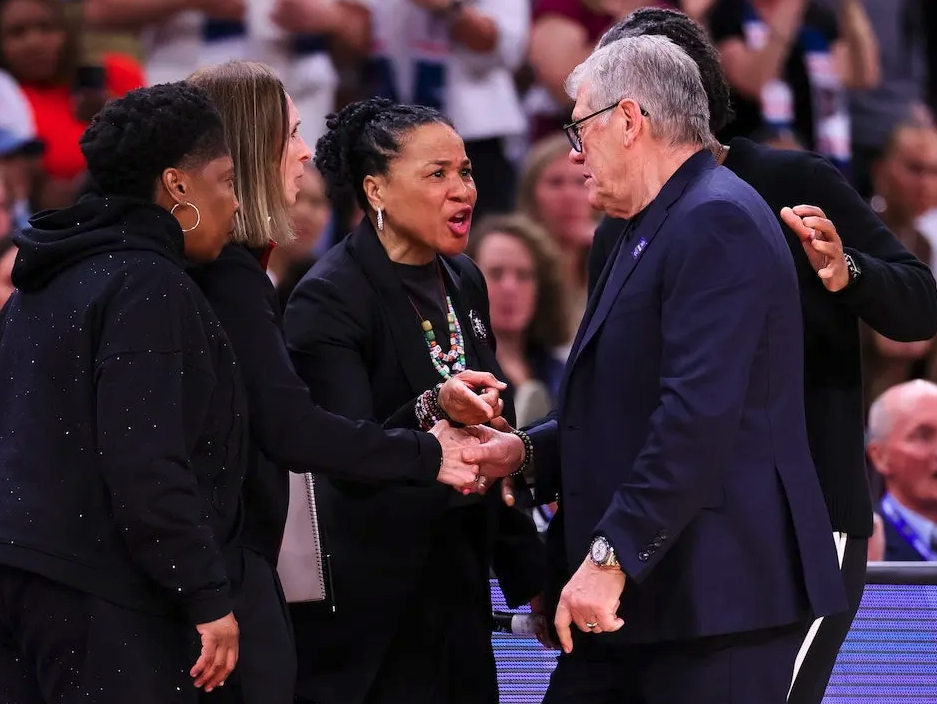
I don’t usually write 30 Second Timeout blogs on the weekend, but what Geno Auriemma did Friday night at the Women’s Final Four — and maybe even more infuriating, the subsequent coverage of it — left me needing a place to vent.
Aside from Chiney Ogwumike and Andraya Carter rightfully taking Auriemma to task, so much of the framing around his postgame antics with Dawn Staley has followed a script we see over and over when men try to escape consequence for causing harm: DARVO — deny, attack, and reverse victim and offender.
What Geno did, in my view, was throw a hissy fit after getting his ass whipped and then immediately try to create the illusion that he was actually the one who had been wronged. He claimed he was left waiting a “whopping three minutes” for a pregame handshake, even though video showed Staley greeting him and his entire staff during warmups. He then tried to wrap his ranting in the blanket of “tradition,” as if invoking this is how it’s always been somehow transforms bad behavior into justified behavior.
And then came the apologists.
Almost immediately, people began assigning him tactical-genius foresight, claiming he had somehow “sacrificed himself” to take pressure off stars like Azzi Fudd and Sarah Strong after the loss. If that sounds eerily similar to the 4D chess narratives people use to explain away harmful behavior from powerful men elsewhere (paging the White House), you’re picking up what I’m putting down.
No. Make no mistake. Geno was a sore loser Friday night.
He threw a temper tantrum in front of the world.
This is the same man who is always ready with a quote about bad body language, about how soft the world is becoming, about standards and toughness — and yet when his own team got dominated for forty minutes, suddenly all that accountability language disappeared.
The irony is staggering.
This is also not isolated behavior. The man has undeniably won at a level few ever will, and yet he has repeatedly found himself in conflict with his female peers — from Pat Summitt to Muffet McGraw and now Dawn Staley.
On Friday, when his juggernaut was on life support, his response was to rant about officiating, portray Dawn Staley as the unhinged one, and manufacture grievance. Part of that included his comments about “the language she gets to use with officials,” which lands in a much deeper and far more dangerous historical script. Too often, language like that is deployed to dehumanize Black people — and Black women in particular — by casting their passion, advocacy, or frustration as threatening, irrational, or out of control.
In this moment, it felt less like a neutral observation and more like an attempt to paint Staley as the volatile one while he positioned himself as the wronged party. That framing matters. It taps into a long-standing cultural reflex to read Black emotion as aggression and white male emotion as intensity or competitiveness. He wanted sympathy over a “ripped jersey” that replays appeared to show his own player had done to herself. He stormed off instead of walking the handshake line after the buzzer. His players stayed. They did what leaders in their own right do: they honored the moment and the people who beat them.
Then, somehow, he still positioned himself in the postgame as the steadying presence, the shoulder-rubber, the paternal figure beside Fudd as she struggled to process the loss publicly.
Why does this belong in a TeamsOfMen blog?
Because it is a case study in what lengths men deeply rooted in the manbox will go to in order to excuse behavior they willingly chose. It shows how quickly a culture built on old myths and tropes bends reality to preserve the image of a powerful man as misunderstood hero rather than accountable adult.
And, as Chiney Ogwumike so eloquently pointed out, it once again shows how our ecosystem so often requires women — and especially Black women — to stand ten toes down in their dignity while simultaneously rescuing men from their own emotional illiteracy.
That, too, is part of the script.
Coach Prompts
How do you respond publicly when things don’t go your way?
What accountability standards do you apply to yourself after a loss?
Where have you seen DARVO show up in coaching culture?
Player Prompts
What does respectful losing look like?
How do you react when you feel embarrassed or exposed?
Have you ever seen someone reverse blame after doing harm?