
Winning Is Not Behavioral Proof
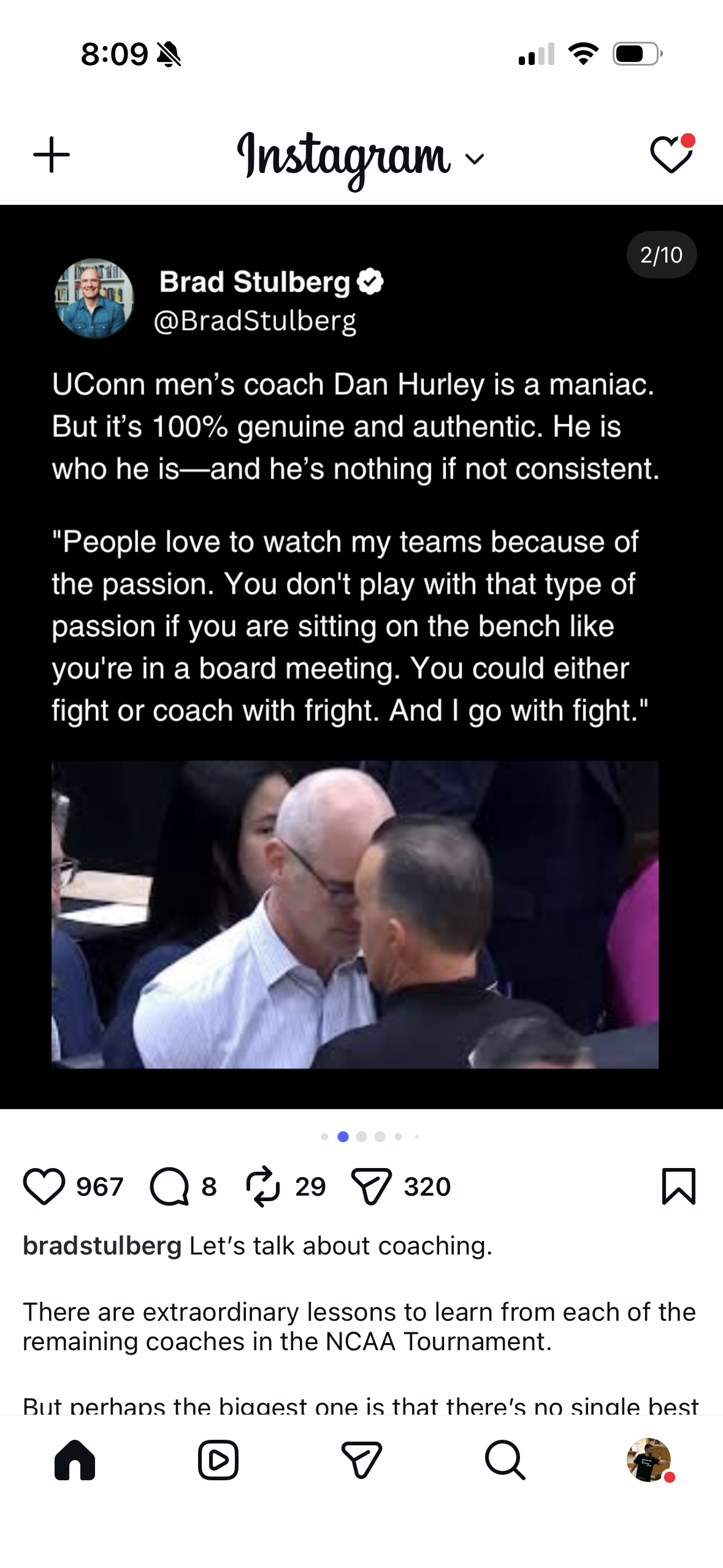
At this point in the blog, and with this being the fourth or fifth post featuring something Dan Hurley did, we should almost require everyone reading to ask themselves one question:
Is Dan Hurley’s on-court success something I would be willing to experience in exchange for behaving like him?
That, to me, is the actual reflection point here. Winning cannot become an automatic eraser of everything attached to how it was achieved.
There are so many false equivalencies wrapped into this statement — and I should probably tag this as allegedly by Dan Hurley, because in today’s internet culture quotes are often cleaned up, paraphrased, or outright misattributed — that it is honestly hard to know where to begin. The first one is the “100% genuine and authentic” line. On its face, that sounds admirable. Of course we want coaches and men to be genuine. But authenticity becomes a problem the moment it is used as a shield against growth. The phrase “that’s just who I am” has too often become permission for men to stop evolving. If someone is quick to rage, emotionally illiterate, or verbally abusive, labeling it as authenticity does not suddenly make it healthy. Authenticity without evolution is just stagnation with better branding.
The second false equivalency is the leap from Hurley’s sideline demeanor to the idea that this is why his teams play hard. That part is where I recoil most. I do not have the accolades Coach Hurley has. I can acknowledge that without hesitation. But I have coached teams that have been repeatedly complimented on how hard they compete, how fiercely they defend, and how relentlessly they play for one another — and I do not conduct myself like a raging lunatic on the sideline. The idea that hard play must be born from hard conduct by the coach is lazy thinking. Sometimes teams play hard because they are talented, deeply connected, accountable to one another, and bought into a shared standard. To reduce that to “they only play this way because coach acts like a maniac” is an easy narrative, but it is not proof.
Then there is the “fight or fright” framing, which really loses me. Beyond being a false binary for coaching conduct, it also badly misuses the language of trauma response. Fight and fright are not motivational styles a person consciously selects in the moment. Trauma responses are involuntary nervous system reactions under perceived threat, and there are more than just two. We know the broader framework includes fight, flight, freeze, fawn, and flock. These are not coaching identities to choose from. They are human responses that require awareness and processing. To casually turn that into a coaching philosophy gives far too much cover to outdated tropes about domination, aggression, and intimidation.
Honestly, this kind of quote becomes fuel for coaches who already want permission to double down on old methods because one highly visible coach won banners with it. That is the danger. One coach, one system, one roster, one set of circumstances gets elevated into doctrine. We have to stop treating every successful coach’s public comment as if it were testimony from on high on how to coach young men. Winning is not moral proof. Success is not behavioral validation. And one coach’s path to championships does not need to become the blueprint for how all coaches treat people.
Coach Prompts
What parts of your coaching style do you defend as “just who I am” that may actually need growth?
Where have you mistaken intensity for effectiveness?
Do your players compete hard because of fear, connection, clarity, or culture? How do you know?
Player Prompts
What kind of coaching helps you compete at your highest level?
Is there a difference between being pushed and being disrespected? What is it?
When does intensity from a coach help you, and when does it shut you down?