
Help Isn't Weakness
ITFDB.
If you don't know that stands for "It's Time For Dodger Baseball," then you probably can't relate to my Dodgers fandom. Next to the Cowboys, they're the team most likely to make me act like an irrational lunatic.
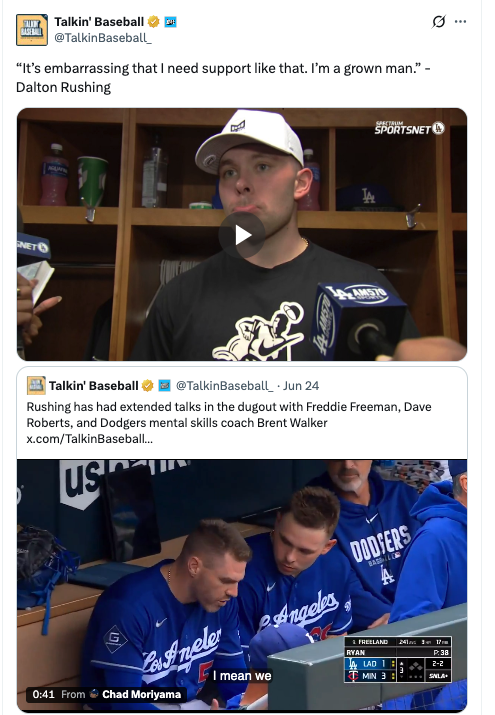
Having said that, I was disappointed this past week to hear Dodgers catcher Dalton Rushing say this after teammates and coaches tried to support him through an emotional stretch:
"It's embarrassing that I need support like that. I'm a grown man."
As we know, being able to play—or coach—a professional sport never guarantees someone has developed emotional fluency, compassion, or the ability to recognize and escape the Manbox.
Rushing, one of the organization's young talents, has had several emotional overflow moments recently: arguments behind the plate, visible frustration at the plate, broken bats, and interactions with teammates and coaches that suggest he's struggling to regulate those moments. This quote came after veterans and coaches intentionally sat shoulder-to-shoulder with him in the dugout to help him process what was happening.
What struck me wasn't simply that he resisted the support.
It was why.
"I'm a grown man."
That's a hell of a statement, though unfortunately not an unusual one, for a 25-year-old to make. Hopefully you've got another 50 or 60 years of growing left in front of you, my guy.
"It's embarrassing that I need support like that."
That's the sentence that keeps echoing in my head.
Because somewhere along the way, too many boys become convinced that maturity means needing less help instead of becoming better at receiving it. That's the Manbox talking.
I'd imagine every one of us has coached one or two players like this. Maybe you reached them. Maybe you didn't.
And that's the rub.
Some young men need another shoulder-to-shoulder conversation. Others need someone they respect to look them in the eye and say, "Yo, wake the eff up." The hardest part of coaching isn't knowing how to do either. It's knowing which one the young man in front of you needs today.
Coach Discussion Prompts
How do your players typically respond when you offer support during an emotional moment?
What messages about masculinity make it difficult for boys to receive help?
When do you choose a shoulder-to-shoulder conversation instead of a direct confrontation?
Player Discussion Prompts
Why do some guys feel embarrassed when someone tries to help them?
What's the difference between needing support and being dependent on someone?
Does becoming a man mean needing less help—or becoming more willing to use the help available?