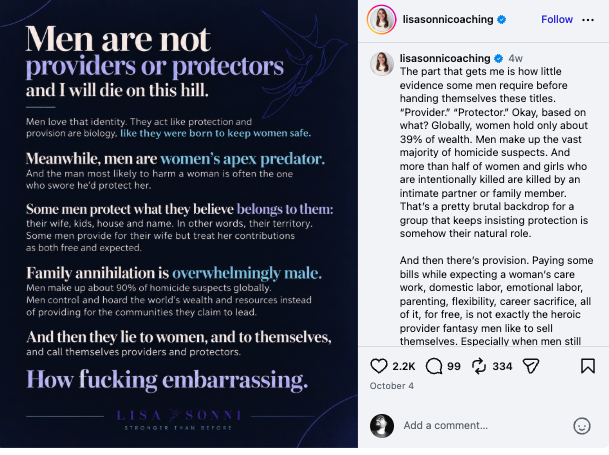
This is a seething post (originally on IG by @lisasonnicoaching) that takes on a cliché you and your players have grown up engulfed by.
"Men are protectors."
I think this is a PERFECT post to show your guys, but with a caveat: You had better be ready for the way it lands. It is going to challenge them, put them on the defensive, and cause some emotional spikes and walls to go up in your space. And that's not necessarily a bad thing, provided you're prepared to help them work through those reactions rather than retreat from the conversation.
Everything that has been ingrained in them about WHY they "need muscles," "must present as stoic," or "be the man of the house" is going to feel under siege. Not just because of the argument Lisa makes, but because of the very intentional word choices she deploys AND the statistics she uses to challenge that old cliché of men as protectors. At best, it's an identity worthy of serious reexamination. At worst, it's a story we've told ourselves that doesn't hold up particularly well when we look at who is actually causing harm.
I'm not going to sit here and write that I haven't (and maybe even still do) hold on to the idea that men are supposed to protect their families. But I'm also very open to the idea that HUMAN BEINGS, in general, should protect each other. And here's the part that requires some honest Mirror Training on my end: When I imagine needing to protect my family, even in my most Manbox-infused moments, who am I imagining I need to protect them FROM?
Another man.
That's worth sitting with, isn't it? We've built an entire masculine identity around being the protector, but so much of what we imagine protecting people from is the behavior of other men. And when we start examining the difference between protecting someone and believing we have some inherent authority OVER them because we're men, the conversation gets even more uncomfortable.
I think the statistics Lisa shares are important for your guys to be exposed to. I think the wording of the post should be preserved in its ENTIRETY. You don't need to protect them from this critique, including the language that might make them uncomfortable or angry. You need to expose them to it and ask them to navigate it with their current worldview.
And then, if necessary, ask them what a NEW idea on the subject would look like for them. Can protection be something we do for each other rather than something men claim as their biological assignment? Can we care for someone without claiming authority over them? Can we imagine a version of manhood where being strong has less to do with our ability to fight another man and more to do with our willingness to interrupt the behaviors that make someone need protection in the first place?
I don't think the goal of this conversation is to get every player to abandon the word "protector." I think it's to get them to examine what they've attached to it, where those ideas came from, and whether those beliefs actually serve the people they claim to care about.
You don't have to protect your players from ideas that challenge their understanding of manhood. You have to prepare them to examine those ideas.
That's the work.
Coach Prompts
What did you learn growing up about a man's responsibility to protect others? How have those beliefs influenced the way you coach boys and young men?
How would you respond if a player became visibly defensive or angry while discussing this post? What would it look like to keep him engaged without allowing his discomfort to shut down the conversation?
Where in your team culture might you be reinforcing the idea that physical strength, emotional stoicism or dominance are necessary qualities of manhood? What alternative behaviors could you intentionally recognize and reward?
Player Prompts
Agree, Disagree or Unsure: Men have a greater responsibility than women to protect their families.
When you imagine yourself protecting someone you care about, who or what are you imagining protecting them from? What does your answer tell you about how you've learned to understand manhood?
Can someone be a protector without being physically strong, intimidating or willing to fight? What would protection look like if it were defined by care, respect and accountability instead?