
Sometimes The Answer Is The Answer
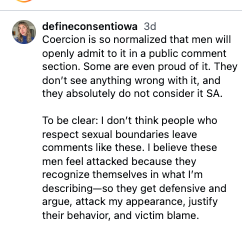
Before I show you the screen grabs of the comments men made that @defineconsentiowa is referring to (after she posted a simple “I believe if you pressure someone into sex after they repeatedly said no, that is SA”), I want you, as coaches of male athletes, to ask yourselves the following:
“Do my guys REALLY understand that no means no the first time?”
I ask you this because in today’s athletics “grind” and “chase your dreams” culture, I think you have witnessed your guys (and their parents) blowing past BOUNDARIES YOU SET first hand. What do I mean by this? Think to yourself about that conversation you had with a player about the role you foresaw for him on the team, and not a week later, he was asking you for another meeting to reassess. Or that time you explained to a player that his snap count was going to be lower that game, and then a day later he asked you for a meeting to talk about how he could get more?
Are these signals of a predator? NO. But they do show that young men today (who are emboldened and encouraged by the content they consume and the clichés their parents and adult influences peddle) rarely take the truth of their ability to be real. They embrace a “Mamba” mentality and think, “If I just push more, I can change his mind about me.”
And this is where NUANCE in coaching and life matters. Yes, you need him to embrace the idea of improvement and growth, but you also need him to understand that there are limits to this thing. He will most likely never be able to work hard enough to change your evaluation of him this season and his role (let alone magically become Messi overnight on the pitch). He won’t be able to grind into a 96 mph fastball if, as a senior, he is at 74 mph.
It’s not in the cards.
Now, hopefully you can see the through line here to the mindset of the awful takes below (when it comes to women saying no and trying to set a physical boundary)


You can feel the rage here. You can read the lack of respect in the first NO. You also, if you’re being honest with yourself, can SEE in your mind that same kid who was wanting to lash out at you when you cut him, told him he wasn’t a starter, he wasn’t going to get carries in the red zone, or he wasn’t going to pitch this weekend.
The situations are obviously not equivalent. But the underlying mindset deserves our attention.
The belief that if I want something badly enough, my boundary is negotiable. The belief that your answer is merely temporary resistance. The belief that my desire matters more than your decision.
This IS a team room conversation.
And if we don't help young men understand the difference between persistence and boundary violation, someone else eventually will.
Coach Prompts
How often do we unintentionally celebrate "never take no for an answer" thinking in our athletes?
What is the difference between persistence and disrespect?
How can coaches teach boundary-respect without discouraging ambition and growth?
Player Prompts
When have you struggled to accept an answer you didn't want to hear from a coach?
What's the difference between advocating for yourself and refusing to respect someone's decision?
Can you think of situations where persistence is a strength and situations where persistence becomes a problem?