The Coaching Phrase I'm Reconsidering
Don’t be fooled, Coach.
That urge you have right now, that feeling telling you “I don’t want to read this one, Kip. You got little kid graphics on here,” is your own Manbox conditioning popping up and trying to steer your behavior. Stick with me for at least another paragraph.
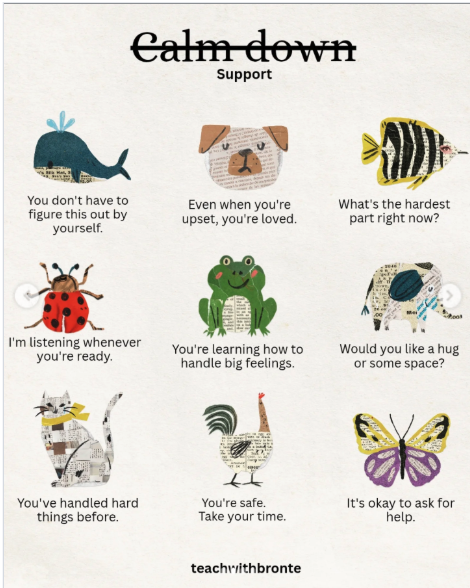
What you see is the first of three slides of alternative phrases for us to use in place of “Calm Down” (or, as I know I’ve been saying a lot to my guys this past year, “No crash-outs”). Just because they are part of a 3-graphic production from @teachwithbronte on Instagram, and she happens to be a kindergarten teacher in Australia, doesn’t make this “soft” or “too cute” for your male athletes. To the contrary, I think it’s worth figuring out which ones might be better language tools for you and your staff, and if not directly applicable, how you would swap in your words for similar usage to bring your player down from an emotionally charged reaction IN GAME?
I’m thinking of myself last weekend. I’m remembering a player furious with what he FELT like was both a poor call on a rebound by an official and his feeling that “no one is effing helping me on the boards”.
I pulled him.
I said, “NO, we aren’t going to start pointing fingers, dammit. I saw 4 other guys working with you. The call just didn’t go your way. Calm down.”
With these phrases, I think I would absolutely still PULL HIM, but I would lead with “What are you feeling the most? Because it looks like you're pissed at your teammates, but I bet you’re more upset with the ref,” and see where that takes us (either way the convo takes place right next to me on the bench).
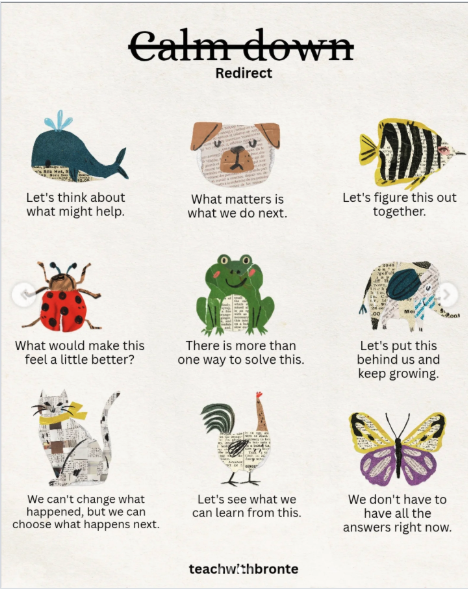
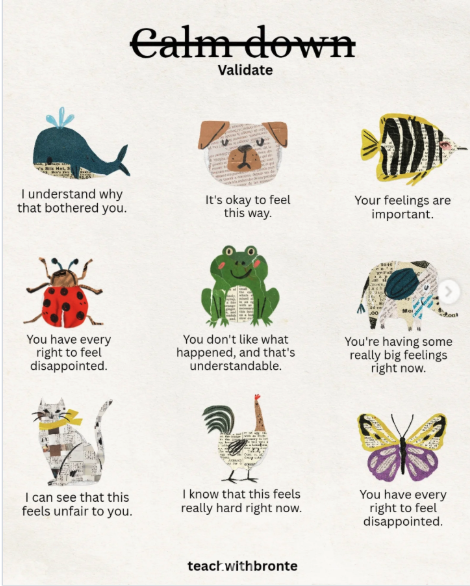
I’ll put the other two graphics below after our usual prompts, so you and your staff can have a chance to work through the same “this instead of that” exercise I just modeled.
I’ll leave you with something poignant from the author herself: “Our words can either dismiss a feeling or help a child feel safe enough to move through it. Sometimes the most powerful response isn't telling a child to calm down—it's helping them feel understood.”
Coach Prompts
What phrases do you use most often when a player is emotionally escalating during a game?
How often do you lead with correction versus curiosity in those moments?
Which phrase from the graphics could realistically become part of your coaching vocabulary this season?
Player Prompts
When you're frustrated during a game, what responses from coaches help you regain control fastest?
Is there a difference between someone telling you to calm down and someone trying to understand why you're upset?
When have your emotions caused you to misidentify what you were actually angry about?