Sweat Equity Isn't Character Development
Coach Hurley returns to the blog!!! I say that a bit tongue in cheek because if you have been here often, you know Dan Hurley has provided us with a few moments worth a TeamsOfMen lens deep dive. Now, he is nowhere near the number of appearances by Mick Cronin, but he is back. As always, there is no denying his acumen on the scoreboard, as his back-to-back National Championships attest. But, once again, I think his words here are at best a misunderstanding of definitions or at worst a blatant bastardizing of them.
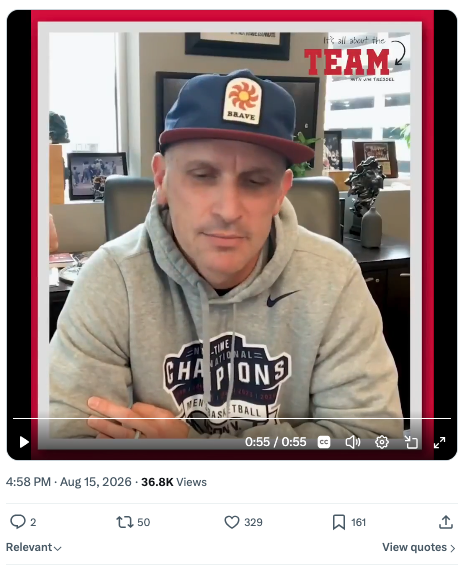
The post, originally put up on X by @coachajkings, is supposedly cueing the viewer to watch the video where “Dan Hurley shares the difference between transactional and transformational coaching.” But as you watch the video, you realize that YES, Coach Hurley says that he is a transformational coach, not a transactional coach…but then proceeds to simply describe an environment of physical and mental challenge.
He describes hard work. He describes seeking discomfort. And he describes a payoff the includes a lot of winning.
That’s sweat equity and a culture of effort. Absolutely fine. No issue there.
But transformation doesn’t happen during rigorous physical exertion simply by osmosis. Muscles and cardio systems are improved for sure. Work capacity can improve. Perseverance can be practiced.
But when I hear transformation, I think of human qualities and character. I think of (as we’ve talked about in the past) character of HEART, not simply perseverance.
I can run a lot of lines. I can do defensive slides for hours. That can get me in phenomenal shape.
I can be yelled at for hours. I can bite my tongue and learn to deal with it. That probably makes me at least PATIENT, maybe?
But I’m not sure you can claim TRANSFORMATION simply from enduring hard work. I think that requires exactly what we’ve learned about “virtue translation” lately and that is framing and reflection time on what happened, what I thought, what I felt, and WHY and HOW it applies to my future life.
Otherwise, we’re making the same assumption sport has made forever: because an athlete EXPERIENCED something hard, they automatically LEARNED the lesson associated with it.
I appreciate the outlining of what a day in the life of UCONN MBB looks like here (it sounds like a grueling physically challenging environment). Great.
But I don’t think this blurb (at least) showed us WHAT was transformed, WHY it was transformed, or HOW that transformation transfers beyond basketball.
Coach Prompts
What do you call “transformational” in your program, and what evidence tells you an actual transformation occurred?
When athletes experience something difficult in your program, where does the framing and reflection happen that helps them understand what they learned?
Which qualities developed in your program could your athletes identify, explain, and intentionally apply somewhere outside their sport?
Player Prompts
Think of something difficult you’ve endured in your sport. What did it actually teach you about yourself?
What is something you’ve learned through your team that you know how to use somewhere outside of sports?
When you’ve changed because of a difficult experience, what helped turn the experience into an actual lesson?