
The Manbox Loves Military Metaphors
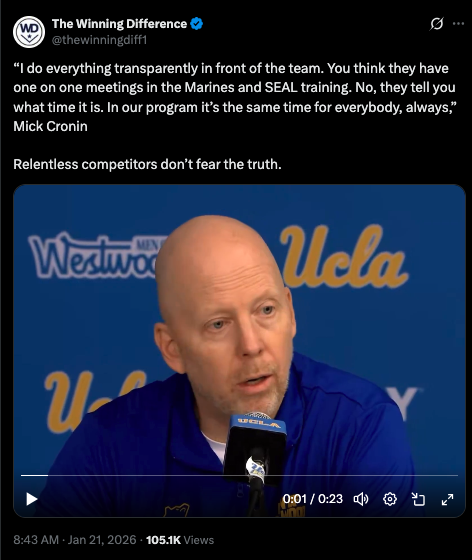
Today’s blog is in response to this rant from UCLA coach Mick Cronin — and really, to the larger pattern of coaches using military jargon and “warrior” aspiration as both a media persona and a coaching philosophy.
In this clip, Coach Cronin explains he doesn’t do 1-on-1 meetings with players because “the Marines and SEAL training” doesn’t.
What?
No, seriously.
I know Coach Cronin has won hundreds more games than me and he coaches at one of the meccas of college hoops… but this reeks of either (1) a deliberate attempt to avoid authentic dialogue with his guys, or (2) a grown man immersed in a fantasy he’s using to justify his worldview.
We don’t coach soldiering.
We are not in the business of training men to kill, to deploy, or to defend strategic assets.
We coach a game.
Yes — we want guys who are hard-nosed, competitive, resilient. Of course. But we don’t “take on armed adversaries.” We trap ball screens. We guard actions. We finish through contact.
And avoiding calm, respectful, one-on-one communication with players isn’t suddenly excusable because you borrowed a drill-sergeant script.
Also… if you’ve never served, how are you so certain what is or isn’t done? Because you read a David Goggins book? (Or more likely: saw a quote graphic on Instagram attributed to “a Marine” once?)
We have to escape this line of thinking — both as men and as coaches.
Coach Prompts
Where do you borrow “war” language to justify behavior you wouldn’t defend in plain English?
What do you gain by avoiding 1-on-1 conversations with players — and what does your team lose?
Do your athletes experience you as “hard” or as “unsafe to talk to”? Be honest.
What’s one “toughness” script you’ve inherited that you’re ready to retire?
Player Prompts
When a coach talks like you’re in combat, what does it make you feel: motivated… or disconnected?
If you needed to say something real to a coach, would you feel safe doing it? Why or why not?
Where do you use “toughness” as a mask to avoid honest communication?