
What Kind Of Fine?
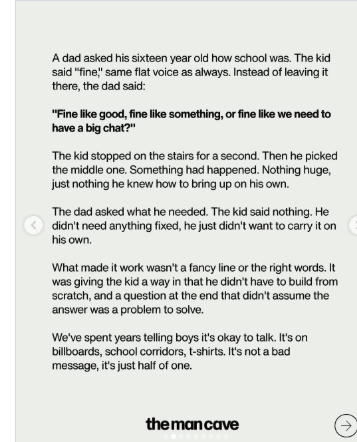
I haven’t spent a ton of time exploring the author of the post above (@themancav_aus) so I can’t really say “go follow this account.” However, this slide on this post DOES land with me as something for both the coach of male athletes in you and, for those of you it applies to, the father in you.
I know I ask my 19-year-old son some version of "Yo, how was your day? Class? Work?" on a regular basis, and I often get back "fine," "good," or "the same." Like a lot of parents, I then find myself talking with my wife about whether he's really sharing much of anything with us and wondering if there is a better way to get beyond the surface. That's why this framing stuck with me. "Fine like good, fine like something, or fine like we need to have a big chat?" is a simple device, but it's one that invites a young person to clarify what they actually mean rather than allowing the conversation to end where it usually does.
The coach in me immediately went somewhere else. I started thinking about those first few players who trickle into the gym or onto the field before practice. You ask, "How was your day, Kev?" and 70-80% of the time you probably get some version of "Fine, Coach." Most of us accept the answer and move on. Sometimes that's perfectly appropriate. But I wonder what would happen if every coach in a program committed to asking one follow-up question like this for one athlete each day. Not every kid every day. Not some impossible relationship-building marathon. Just enough intentionality that every player in your program gets a moment once or twice a month where someone pauses and asks, "What kind of fine are we talking about?"
Would that take a lot of planning? Yep.
Would that take a lot of follow up? Yep.
Would you have days where you didn’t feel like doing it? Yep.
But, we ask our players to do hard things that take up time even when they don’t “feel like it". We ask our guys to embrace “the grind.” We tell ourselves that our program will leave “no stone unturned” in the pursuit of our goals. Well, consider this a pretty important stone for each kid to see what’s underneath.
Because the power of the example above isn't really the phrase. It's the willingness to stay in the conversation for thirty more seconds after most adults would have moved on. And sometimes that's all it takes for a young man to decide whether he's carrying something alone or sharing it with someone who can help.
Coach Prompts
How often do you accept "fine" as an answer when you know it probably isn't the whole story?
What follow-up questions have helped you build stronger relationships with athletes?
If every player in your program got one meaningful check-in per month, what impact might that have?
Player Prompts
When an adult asks how you're doing, what makes you decide whether to give the real answer or the easy answer?
Has a coach, teacher, or parent ever asked a follow-up question that made you feel genuinely seen?
What are some words people use when they're struggling but don't want to say they're struggling?