
What We Laugh At Matters

A former assistant coach of mine is now a stand-up comic. He’s hilarious and I scroll his stuff enough, it seems, for the Instagram algorithm to populate my feed with other comics as well. THIS post showed up over the weekend and I had to read the entire scroll and share with you all here. Long story short, the comedian @amybethberry tracked 10 nights of stand up shows in Austin and took notes on joke topics from male comics. Her takeaways are a window into not only what boys/men laugh at, but what we are still (even in the vulnerability laced space that is stand up comedy) scared to stay with emotionally.
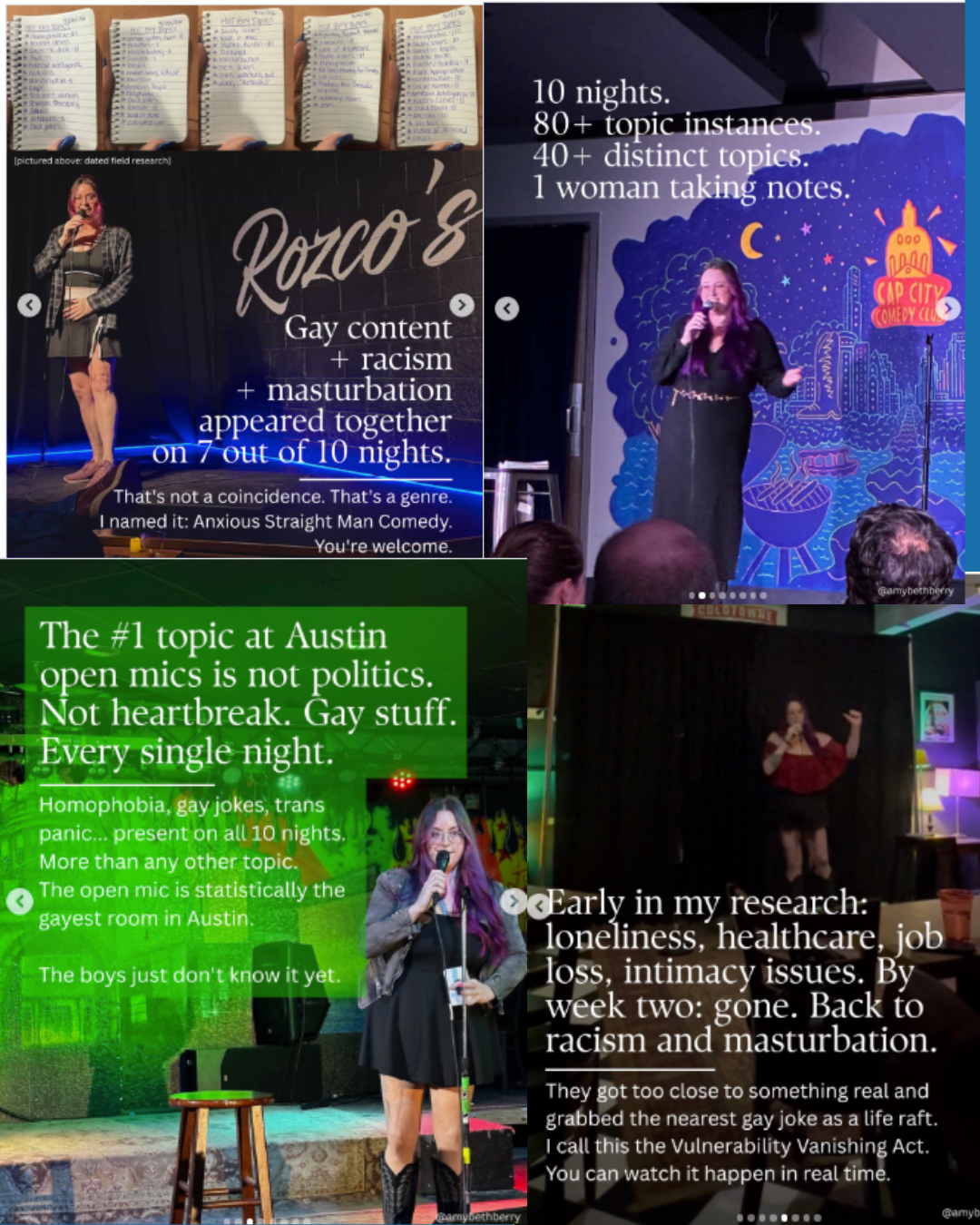
Even in a space that markets itself as honest and vulnerable, there’s a pattern. When a joke gets close to something personal—loneliness, relationships, health, anything that requires sitting with discomfort—it often gets abandoned. Something safer takes its place. A gay joke. A racist punchline. Something sexual that pulls the room back to familiar territory.
She calls it a “Vulnerability Vanishing Act.” That phrase stuck with me.
Because I don’t just see comedy clubs when I read that. I see team rooms. I see staff offices. I hear the same words—“dick,” “faggot,” “pussy,” “jerking off”—and I see the same reaction. The room erupts, everyone piles on, and whatever was about to be said gets buried.
I’ve been part of that. I’ve contributed to it. I can land a joke when I want to, and for a long time a lot of those laughs came at the expense of someone else not measuring up to whatever standard of masculinity was floating around in the room. That realization didn’t come quickly, and it wasn’t comfortable when it did.
Humor can be a release. It can bring people together. It can make hard environments feel lighter for a moment. But it also redirects. It can shut something down just as quickly as it opens a room up. That’s the part I keep coming back to. Not whether humor belongs, but what we’re doing with it.
When jokes consistently land on the same targets, it tells you something about the culture. It shows what’s easy, what’s accepted, and what gets avoided. So the question becomes whether that foundation is actually helping us build anything we’re proud of.
I don’t think the answer is to eliminate humor. That’s not realistic, and it probably misses the point.
But I do think it’s fair to look at the patterns.
If certain topics always get laughs, and others consistently disappear, that’s worth noticing. And if we’re serious about changing how young men show up, then we have to be willing to examine what we reward in those moments.
Even if it’s something as small as a joke.
Coach Prompts
What kinds of jokes get the biggest reactions in your team space?
What topics tend to disappear when things start to get real?
How do you respond when humor shifts toward targeting someone?
What does your team’s humor say about what’s accepted?
Player Prompts
What do you and your teammates usually joke about?
Have you noticed certain topics get avoided or shut down?
How do you react when someone becomes the target of a joke?
What kind of environment do you want to be part of?