Who Gets Erased When Men Spiral
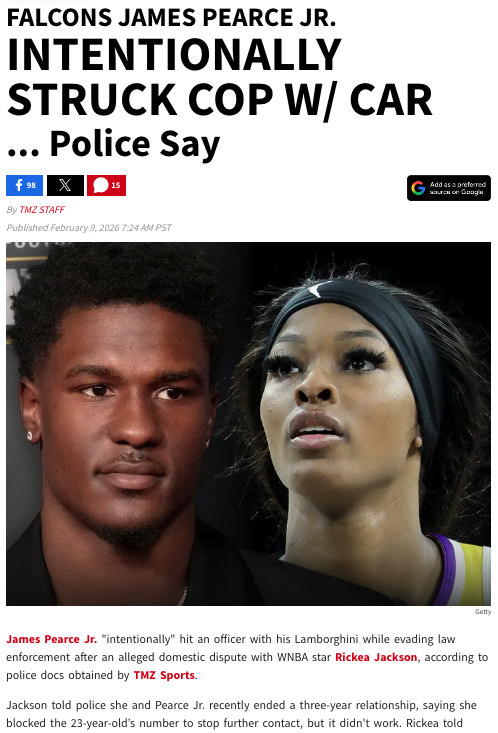
Why use this photo—and this TMZ headline—for today’s blog?
Because it perfectly illustrates how survivors of domestic violence and unhealthy relationships—most often women—are routinely erased in the coverage of men’s public “crash outs.”
To be clear: I will use alleged throughout this post. Not because I don’t believe WNBA star Rickea Jackson—but because writing responsibly about third-party reporting requires legal care.
That said, look at the framing.
The headline centers Falcons rookie James Pearce Jr. and the police car he allegedly rammed. What it buries is why the situation escalated in the first place: Rickea Jackson had ended their relationship, blocked his access to her, and asserted a boundary.
According to reports, his response wasn’t acceptance. It was rage.
The alleged behavior didn’t stop at emotional volatility—it spiraled into dangerous actions directed at her and then outward, as he attempted to evade accountability for what he was doing. The violence is framed as spectacle. The survivor is reduced to a footnote.
And this pattern isn’t accidental.
We routinely narrate men’s loss of control as an isolated “incident,” while stripping away the relational context that explains it. We focus on the dramatic end point—the crash, the arrest, the headline—while ignoring the entitlement, possessiveness, and refusal to accept “no” that often precede it.
Here’s the uncomfortable part:
The entire NFL was aware of Pearce’s history of unstable decision-making and violent turns. And yet, because he might get a sack on third down, the Falcons drafted him anyway.
Talent keeps getting the benefit of the doubt.
Women keep getting erased.
This matters especially right now.
It’s Valentine’s Day weekend. If you coach male athletes, you have players who are navigating relationships—some healthy, some not. You have young men who are either learning partnership rooted in affection, consent, and mutual trust…or reenacting manipulative scripts that say:
“I bought you this.”
“I showed up.”
“You owe me.”
This headline analysis can be a gateway conversation.
Not about shaming.
Not about fear tactics.
But about helping young men ask themselves a real question:
What kind of partner do I want to be when I don’t get what I want?
Coach Prompts
How often do media narratives center male behavior while erasing the harm done to women?
What conversations are you not having with your players about rejection, boundaries, and entitlement?
If talent keeps excusing behavior at the top, what standards are you setting at the team level?
Player Prompts
How do you react internally when someone sets a boundary you don’t like?
What’s the difference between affection and entitlement?
If a relationship ends, what does respect look like—especially when it hurts?