

Would You Let Pornhub Install Your Offense?

Fight The New Drug posted this article (link) today and my TeamsOfMen framing mechanism kicked into high gear.
For context: I first came across FTND late in my college coaching career (see their FAST FACTS) and started using their scripts and info with both my players and my own kids at home (Let’s Talk About Porn activity). I found their material digestible, ACCURATE, and written in a way that actually resonates with young men.
Fast forward to today’s article—I decided to decode the lengthy piece and present it in both the graph at the end of this writing and in the following words:
You’re a coach of a 100-man football roster or a 30-man basketball program. Let’s apply the percentages and stats directly to your locker room:
32 of your guys are INTENTIONALLY using porn every day.
8 of your guys are treating Pornhub like their PROFESSOR on sexual experiences.
33 of your players got sexts last night, and 20 of them sent sexts back.
50 of your guys went on a “slutpage” last night (or your entire JV roster of 15 did).
You don’t think that AFFECTS the climate and culture of your team—the words they use, the things they listen to, the way they interact with women on campus? Of course it does.
Even worse, coach, let me reframe it:
What if I told you 25 of your football players sat through a 30-minute lecture on your 3rd-down blitz package that installed THE WRONG sequence and keys?
Or that 10 of your basketball players were intentionally watching videos after practice that taught them the WRONG read in ball screen offense?
You’d lose your mind—because you know that means they won’t execute in games. So why are we settling for the WRONG teachers influencing the WRONG reads for our guys in their intimate relationships?

Coach Prompts
How would I respond if a third of my players were learning the WRONG scheme in practice?
Do I apply the same urgency to correcting harmful “lessons” my players are learning about relationships and intimacy?
Where in my program can I insert short but intentional conversations to combat this influence?
Player Prompts
Who are the “teachers” shaping the way I think about sex and relationships right now?
If I found out my basketball playbook was wrong, I’d fix it—so why am I okay with getting the wrong information about intimacy?
How does what I watch, share, or joke about in the locker room affect the way I treat people on campus?
If You Preach Courage, Can You Model It?

I came across this clip the other day on TikTok and it cemented a couple of things for me.
First: I can’t imagine the podcast without Dr. Marc Lamont Hill. He has leveled up the conversations, challenged the thinking on the show in ways no one could have predicted, and is really the only reason I still tune in.
Second: I wonder how his question lands with coaches. If I reframed it to: “What flag are you willing to plant in the ground—what issue are you willing to be fired for?” —would I get more answers like his cohosts, or like Marc’s?
Every coach in America parrots the cliché: “You take the job knowing you’ll be fired one day.” But then we make decisions rooted in fear of being fired—whether it’s scheme choices, player personnel, or, most importantly, staying silent on things that actually matter. We “play it safe,” we “don’t rock the boat,” because employment feels more important than integrity.
And yet, this runs in direct contradiction to the mantras we feed our teams: play with courage, persevere through adversity, stand strong under pressure.
Being fired is awful (I know, I’ve lived it). But once you’ve gone through it and come out the other side, the freedom it brings—to act fully aligned with your convictions—is immense.
If we can’t model what it looks like to take a stand knowing there’s risk attached, how can we ever expect our players to?
Coach Prompts
What issue or principle would you be willing to lose your job for? Do you know your answer right now?
Are your day-to-day coaching decisions guided more by conviction or by fear of consequences?
How do you model courage for your players outside of game situations?
Player Prompts
Think of a time you stayed silent when you should’ve spoken up—what stopped you?
Who on your team has shown courage recently, even at personal risk? How did that impact you?
If your coach asks you to “play with courage,” what does that actually mean to you?
Fun Isn’t a Distraction—It’s a Weapon: Lessons From Oregon’s “Shout” Tradition
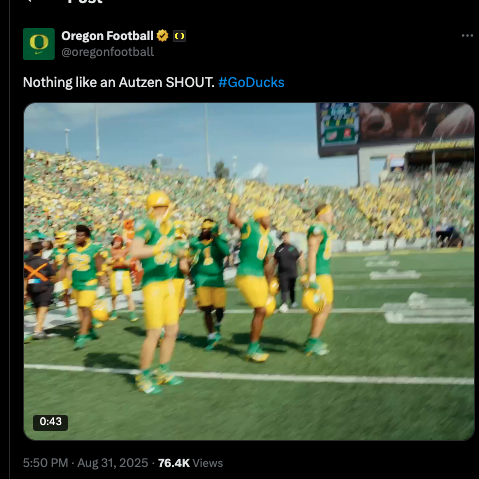
I went to State College, PA this past weekend to watch my brother’s Nevada team take on Penn State. I met up with a group of long-time friends (we’ve known each other since junior high), drove over, and spent the weekend together.
I set that stage not just because Penn State tried playing Shout in the first quarter—and I laughed at their attempt compared to Autzen’s tradition—but also because of the concept of JOY.
My friends and I had fun together. We laughed. We debated. We argued silly topics through serious worldviews. We hugged. We talked. It was revitalizing—not just for our friendship, but as proof that there is community for men. We just have to make space for it.
That’s why the Oregon clip (linked here: Oregon Football “Shout” clip) hit me. The staff at Oregon isn’t shutting down their guys’ joy in dancing and singing. And remember—this is the FOURTH QUARTER.
Most places aren’t letting their guys dance and sing. They’re throwing up 4s and screaming “lock in.” Yes, Oregon was up 40 on an FCS opponent here, but I’ve seen them do the same when down 6 to Boise State, tied with Washington, or leading Ohio State.
You can win with FUN. You can succeed while making room for a smile that acknowledges “holy shit, look what I get to do with this game!”
Whether it’s intentional from their staff or just part of their culture, I found both my weekend with old friends and this Oregon moment to be refreshing and hope-restoring.
Coach Prompts
When was the last time you allowed joy in your program without curtailing it under “focus” or “discipline”?
Do you equate fun with losing focus? What if joy is actually what gives your team energy to finish strong?
Could you intentionally create more moments like Oregon’s “Shout” tradition in your team culture?
Player Prompts
Do you feel like your team makes space for joy, or does it always get shut down in the name of “focus”?
Think of the last time your team had fun together—did it make you play better, or worse? Why?
How do you personally balance being locked in and keeping the game joyful?
Stop Calling It “Hard Coaching”

We’ve all heard it (maybe even said it ourselves): “I needed hard coaching. That’s what pushed me.”
But what if we’ve been giving credit to the wrong thing all along?
I’ve been wrestling with this idea after a conversation with a fellow coach this summer. He was sure that what shaped him was being yelled at, cursed at, and “coached hard.”
My question: Was it really the tirades? Or was it something else entirely that made the difference?
I don’t think the answer is what most of us assume.
I break it down in my latest Medium article. You can read it here:
Coach’s Prompt
What parts of your own coaching style are you crediting to “hard coaching”…and are they really about toughness, or about precision?
Player’s Prompt
Think about the coaches who made the biggest impact on you. Was it their intensity—or their exactness—that actually helped you improve?
The Coaching Hack You’re Probably Overlooking: Take a Walk

If you’re a basketball coach, you’ve most likely seen the ESPN Gameday bit where analyst Jay Bilas does 90 Feet with Bilas—a pregame interview with a star player while walking the length of the court.
Th Instagram post screenshot above (link: 3 Things I’ve Learned While Walking And Talking With Men) reminded me of that. The author highlights three powerful reasons why walking can open men up to sharing real feelings—and it validated something I stumbled into during my own coaching.
In the final three years of my college career (and still today at the high school level), I shifted how I did player check-ins. Instead of blowing the whistle, yelling out a name, and summoning a kid into the power imbalance of a stare-down, I started walking laps with them. Shoulder to shoulder. No eye contact required. No pressure of the coach’s gaze.
The conversations ranged from playing time frustrations to family drama. But every single time, the “walk the court with Coach” felt lighter, more human, and never a waste of time. Walking stripped away some of the barriers—and opened a path to honesty.
Coach Prompt
Instead of calling a player over for a “check-in,” what would shift if you took a lap with them shoulder-to-shoulder before practice? What tension might dissolve?
Player Prompt
Think back to the last real conversation you had with a coach. Did the setting make it easier—or harder—to be honest?
Dating ≠ Debt Collection: Why Coaches Must Ask the Hard Questions

One of the tools we’ve used to better meet teams where they are during onboarding is an Agree / Disagree / Unsure survey. We pose 15 questions for coaches to ask their players (across 3 categories we know we can help them grow in), and then launch work in the spots where the answers expose a need.
I bring that up because one of the questions directly confronts the toxic idea in the X post above (30 million views!) that a man should expect physical intimacy based on dollars spent on a date.
I would HOPE your locker room would answer DISAGREE when shown this image with the caption “She owes me because I spent $450 on her.” But the likes and comments tell us too many men actually hold this view.
What might be worse? The top comment below it: “That’s tuition, not a loss… you just paid to learn the difference between investment and waste. Spend money on women who value your presence not your wallet.”
That’s pseudo-intellectual nonsense. A woman only values you if she submits to your sexual desires on the spot? That’s the message these guys are running with.
And here’s the hard truth: if you’re afraid to bring this image into your team room this season, you’re probably afraid of the level of AGREEMENT you’d see from your own players. Which means you have work to do.
Coach Prompt
Would your team answer Disagree if shown this post in a survey? Or would you be surprised by how many say Agree? How do you plan to challenge that?
Player Prompt
Does spending money on a date mean someone “owes” you intimacy? If your answer is “yes,” where did you learn that—and what do you think it says about how you see women?
It’s Not a Limitation Problem. It’s a Choice.
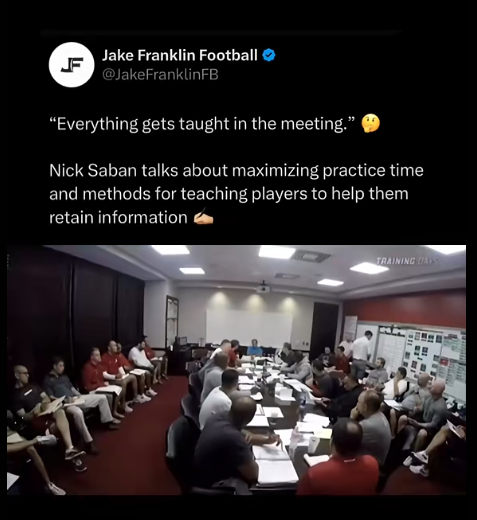
I was doing the usual For You Page scroll on TikTok when this clip flashed. I stopped, of course, because I enjoy hearing Nick Saban talk football — but there were two “can’t stop thinking about it” takeaways.
First: the sheer size of this staff. It isn’t shocking (my brother has been a D1 football coach for almost two decades, so I know the numbers), but it is disappointing from a TeamsOfMen perspective. How can there be this many human beings in one program and not a single one tasked with character development? The resource allocation of time and money here feels wildly inefficient if five coaches are watching the same clip of the same position group every day. (Yes, that’s my Business Econ degree talking: diminishing returns, anyone?)
Second: Saban’s teaching mastery is undeniable. The sequencing, the repetitions, the layers of exposure he demands for players to fully learn a concept — it’s the craft of education at its peak. Coaches clearly know how to design for deep learning.
So why don’t we apply that same urgency and detail to reimagining manhood, teaching emotional fluency, or preventing gender violence? With this many people on staff, one 30-minute block per week could change lives. The truth is, this isn’t a limitation problem. It’s a choice. And right now, most programs are choosing not to.
We can — and must — be better.
Coach Prompt
If you’re already sequencing five exposures for a football skill, why not apply the same model to a life skill? What would your weekly progression look like if emotional fluency or respect were “installed” with the same detail?
Player Prompt
Think about the last time your coaches broke something down step by step until you mastered it. What “life skill” do you wish they’d taught you the same way — one you’ll need off the field?
Airport Beer In The Midst Of Disappointment

NFL journeyman QB Ben DiNucci went viral this weekend after being released by the Atlanta Falcons and posting his post-cut beer at the airport (see image above).
Why share that here? Because it contains vital lessons for YOUR athletes that go beyond the cliché takes.
To be clear, I don’t claim to know exactly what Ben was thinking when he hit “post.” That’s a futile exercise. What I do think is fair: this was an attempt at vulnerability, but a guarded one. Why? Because in the manbox, it’s acceptable to drink heavily when you’re sad. It’s not acceptable to post a picture of your own grief-stricken face, or to share a caption about fear, loss, or hurt. So he posted the beer.
Just as telling are the replies under his post. Scroll through them and you’ll see men trying to soothe, but only fluent in doing so through sarcasm, banter, and side jokes. That’s the currency we’ve been taught to trade in.
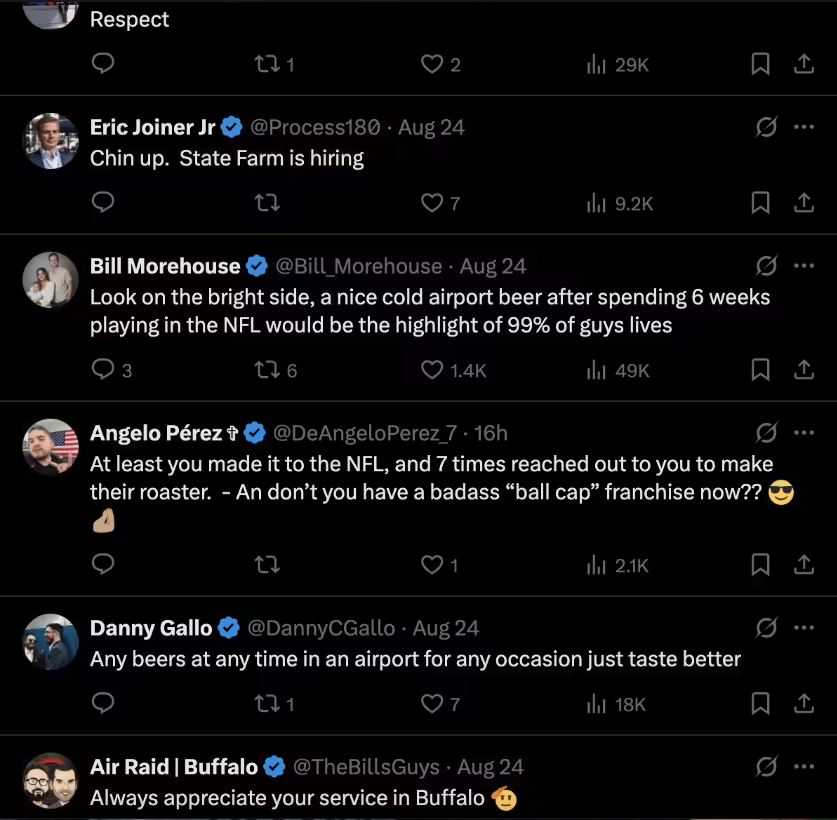
Why does this matter for your team? Because disappointment is guaranteed this season. Your players cannot escape it. Someone won’t get the snaps, won’t make the cut, won’t live up to their own expectation. The question is: what’s their outlet? Do they internalize it, numb it, or joke it away—or do they have people to reach out to and the language to do it?
That’s the coaching opportunity here. Use this post as an example. Then ask your players: Instead of the beer alone, who would you want to tell you got cut? What would you hope they’d say? What would you want to hear?
DiNucci’s post might look like just another beer pic, but it’s also a mirror. Are we helping our players build the capacity to process failure out loud? Or just training them to drink, laugh, and move on in silence?
Coach Prompt:
When your players face disappointment, what outlets have you prepared them for besides alcohol, silence, or sarcasm?
Player Prompt:
If you failed today—got cut, lost a role, missed a penalty kick, dropped a pass—who’s the first person you’d want to tell, and what would you hope they’d say back?
If They Don’t See It, You Haven’t Taught It
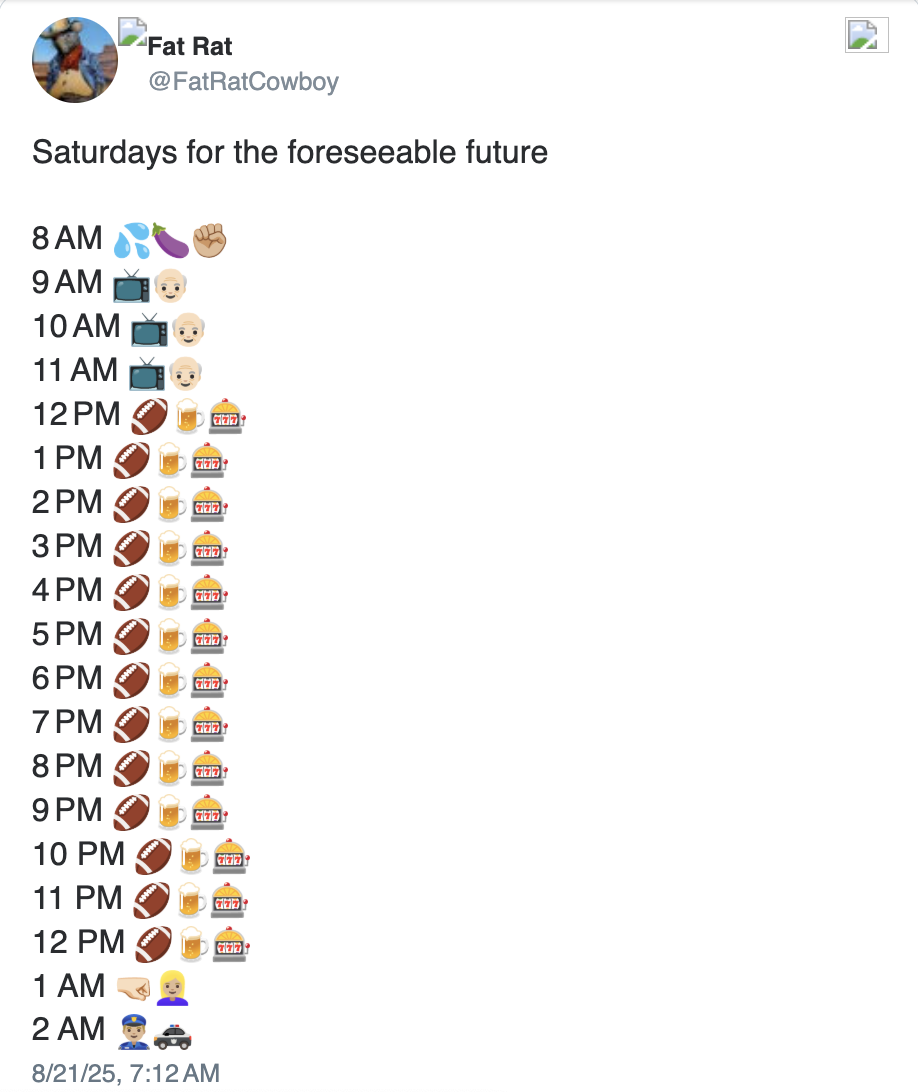
We’ve all preached “details matter.” Winning lives in the little things. We’re trying to build athletes who notice—who read a safety’s leverage on 3rd down or the low-man rotating to protect the rim and act.
One of the most impactful TeamsOfMen sessions we run is Power of Noticing (h/t Kate Mangino’s work). So if you demand noticing every day, here’s a quick test of whether it sticks beyond Xs & Os.
Put the post screenshotted above (4.4M views on X) up to start your next film session.
If your guys don’t notice and don’t react to what shows up at 1 AM—and what follows at 2 AM—can we really claim we’ve built “detail guys”? The meaning isn’t subtle. The schedule slides from sex jokes at 8 AM to football + booze all day… then, at 1 AM, a gender violence based turn, and by 2 AM the cops. That’s a script. That’s normalization.
Sure, some players might not want to say it out loud because you’re in the room. If that’s true, that’s its own culture check. Do they feel safe naming what they see? Can they say, “Coach, that 1 AM line—looks like domestic violence. That’s not funny.”
Run the exercise. Test your work. If we only notice the curl-flat defender but miss the harm right in front of us, we’re not done coaching.
Coach Prompts
Put the post on screen. Stay silent for 10 seconds: What did you notice—and when?
Who names the 1 AM–2 AM shift? If no one does, why not in our culture?
What do we normalize with our laughs, reposts, and silence?
What’s our plan to practice “notice → name → nudge” the same way we rep reads and reactions?
Player Prompts
What was the first thing your eyes went to? What did you feel at 1 AM?
If this showed up in the team group chat, what would you do—co-sign, ignore, or challenge it? Why?
What’s one “detail” you’re going to start calling out in real life the same way you call out a coverage or rotation?
What the Laugh Track Reveals
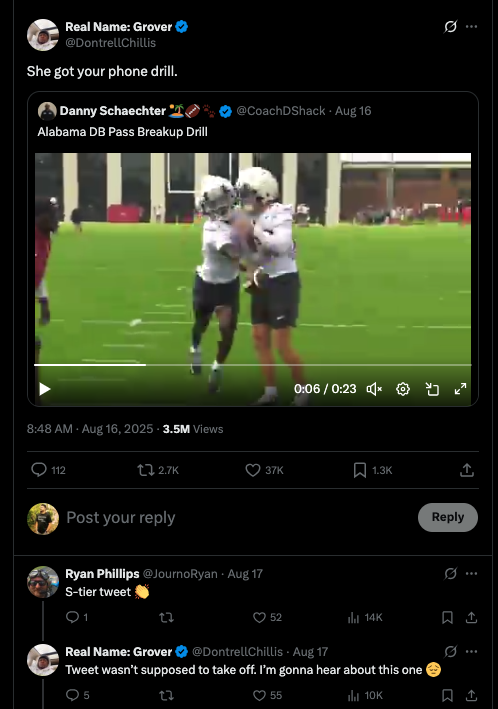
"Every joke can be an admission." That’s my reax to this X post.
Listen, I loathe Elon Musk and I don’t post on X anymore (TeamsOfMen’s account is gone), but I still use it to grab content and keep up on breaking news. It’s 75% bots now, but every once in a while something grabs me.
This one did because I could hear it. Not just the words—“She got your phone drill”—but the laughter that would follow. I’ve been in locker rooms where that line would land, and I can already picture the group chat where it would circulate with emojis and inside jokes.
And here’s where people say: “It’s not that serious, Kip.” Actually, it is. Because the meaning is clear.
This isn’t just a throwaway joke. It’s rooted in the Man Box idea that:
Men can’t be faithful partners.
Men must constantly pursue multiple partners.
Any girlfriend who checks your phone will inevitably find “evidence” of cheating.
The “joke” is an admission of belief.
And because TeamsOfMen is right—sports are either a breeding ground for reimagining new norms OR a reinforcement of the same old ones—this 23-second practice clip, paired with a Man Box laugh line, has millions of views.
That matters.
Coach Prompt
How often do you stop and ask: What messages are hidden in the jokes my guys are laughing at? Am I willing to call them out—not just the big, obvious issues, but the “little” ones that quietly shape their beliefs?
Player Prompt
When you laugh at a joke about relationships, women, or trust—ask yourself: What belief is this joke admitting to? Do I actually agree with it, or am I just going along with the laugh track?
The Hourglass Runs for Coaches Too
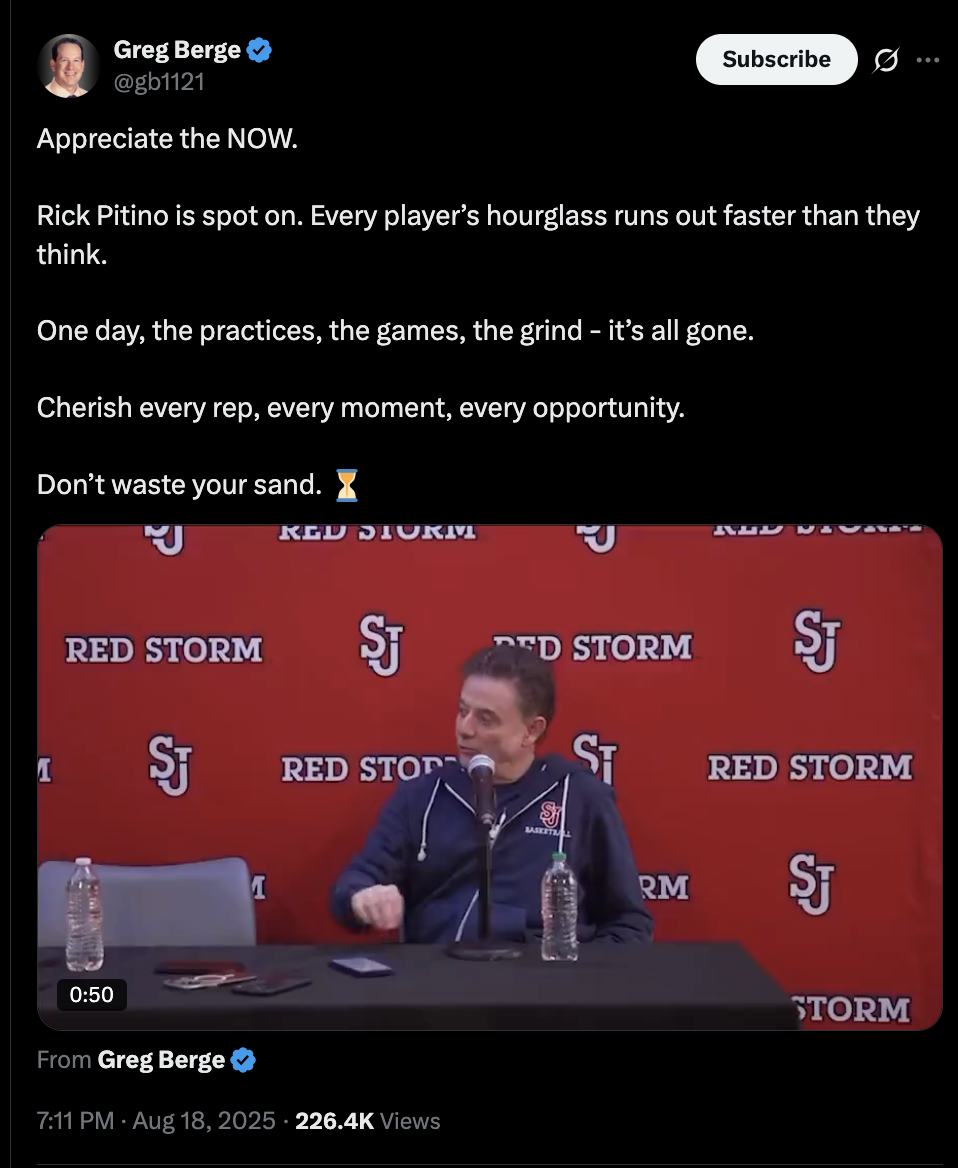
Watch video by clicking image above
Today’s post isn’t a full-throated critique of the X post (see below) or Coach Pitino’s statement. There’s validity in what he’s saying, and part of me wants to believe every player looks back fondly on their experience (and YES, the 46-year-old me would absolutely love another season with 21-year-old legs and energy, competing with my guys). Sharing these stories with his current roster isn’t a bad thing.
But here’s what I want to highlight:
First, if we buy into the hourglass metaphor—that opportunities are slipping away—then we also have to embrace that the clock is running on us as coaches too. Our time to influence our players is just as limited. We only get so many meetings, so many eye-to-eye conversations, so many months of shaping how their decision making paradigms. Time applies to everyone, not just the players’ careers. So we can’t afford to waste it either.
Second, the way Pitino framed it—“every player I’ve ever coached that’s had great success wanted one more year”—is telling. I can’t help but wonder: are those guys longing for the glory and status, not the grind of practices or the yelling from coaches? And why didn’t he say “all my players, from walk-ons to All-Americans”? Maybe because the ninth man on the bench isn’t so eager to relive the experience. And that’s the real question: why not? Shouldn’t we want every player, not just the stars, to want to come back? Exploring why some wouldn’t might be the clearest path to leveling up our programs.
Coach Prompt(s):
When you hear Pitino’s hourglass metaphor, flip it back on yourself:
How many meaningful conversations do I have left with this group?
Am I wasting chances to shape their decision-making beyond the court?
If one of my players looked back on this season, would they want to repeat it—or just escape it?
Player Prompt(s):
Every career ends, whether it’s after high school, college, or pros:
What are you doing today to make sure you don’t regret the reps you wasted?
Beyond the wins, what lessons will you carry when the clock hits zero?
If given one more year, what would you do differently—and why aren’t you doing it now?
Vice, Victimhood, and the Need to STFU

The following blog post is best read AFTER watching the clips below:
I tell people often that I’m usually a willing messenger, but that doesn’t always make me the right messenger. A lifetime of coaching and speaking has stripped away the fear of stepping on a stage and sharing my opinions, my journey, my failures. But I’ve also learned—sometimes painfully—that just because I want to speak doesn’t mean I should. Sometimes, like many men, I need to learn how to take up less space and be quiet.
That lesson feels relevant here with Michael Porter Jr.
One generous reading of his recent now viral podcast clips is that he’s trying vulnerability—sharing his struggles with faith, women, and self-discipline. But the way he frames it exposes how unprepared he is to communicate without reinforcing the very tropes that got him stuck in the first place. A harsher, and maybe more accurate, reading: this is a privileged athlete leaning into toxic ideology—objectifying women as “vices,” excusing himself as a “victim,” and even using Andrew Tate as some kind of filter-test for women.
That isn’t growth; that’s harm dressed up as honesty.
Even more concerning than MPJ’s words are the reactions—the podcast hosts sanitizing his takes, the comment sections praising him, the fans treating his perspective as gospel. Sometimes the bravest, most mature move a man can make isn’t doubling down on his half-formed takes. It’s learning when to stop talking.
Sometimes, fellas, we need to STFU.
Coach’s Prompt:
When have you felt like you weren’t the right messenger for a topic or moment with your team? How do you decide when to speak and when to hold back?
Player’s Prompt:
Think about someone you look up to. How do you filter what they say—deciding what’s worth learning from versus what might be harmful, incomplete, or flat-out wrong?
Show Me the Lessons, Not Just the Lecture

CONTEXT NOTE: If you haven’t seen it yet, you can watch Northern Illinois Head Football Coach Thomas Hammock full comments here: Video of Hammock’s rant and read the Sports Illustrated coverage here: SI article.
I understand where Coach Hammock is coming from. There’s real value in reminding people of the original intent of sport and the collegiate experience — growth in the individual, on and off the field. But in 2025, when athletes can rightfully be compensated for their abilities, it’s naïve (or willful ignorance) to chastise kids for leaving for better money elsewhere. And it’s a stretch to assume that the better-paying options don’t also come with life lessons.
The bigger problem for me is the assumption that any football program — and, from my TeamsOfMen perspective, all male athletics programs — automatically dispense lessons that “make them better husbands and fathers.” Let’s be honest: they spend 12-hour days on football scheme, body prep, and film study. Show me the areas in his program (and so many others) where there is intentional time devoted to character development — not just wishful hoping that through osmosis a young man will become a caretaker for his kids while being dog-cussed during a conditioning run.
If programs were actually investing in these “life lessons,” then the schools with bigger budgets should be better choices, because they could put more money and staff toward sessions that teach them. I know they don’t — they spend it on another film analyst, a run-game coordinator, or a nutrition expert.
And this is not a direct shot at Coach Hammock, but at coaches in general: if your program is truly a better place for young people to take on strife, learn resilience, and onboard father skills, then why didn’t this press conference include a clear outline of the specific programming and time allocated to those things? Most likely because it doesn’t exist. You simply have less money and are frustrated by that fact. Don’t sell me on altruistic sacrifice if there’s no actual different training happening. Otherwise, it’s the same old dictatorship coaching and football-only grind — only now the player gets less money to endure it.
Coach Prompts
If you say your program builds better husbands, fathers, and workers — where is that in the actual schedule?
How much intentional time per week is devoted to character development vs. football?
Are your “life lessons” measurable, or are they just assumed to happen through the sport?
If NIL programs aren’t teaching life skills, what makes yours different in a tangible way?
Player Prompts
Outside of football, what specific skills are you being taught to prepare for life after sport?
Are you being coached into manhood intentionally, or are you expected to figure it out on your own?
Your Acronym Might Not Mean What You Think It Does

I’ve seen it in my own coaching career — you fall in love with an acronym.
It’s catchy. It fits your vision. It looks great on a t-shirt or a locker room wall.
But here’s the problem: just because you say it doesn’t mean your program is living it. Without intentional teaching, without connecting it to real-life scenarios, that acronym can quietly undercut the very culture you’re trying to build.
That’s what my newest Medium article digs into: the hidden flaws in our beloved motivational acronyms and how to make sure they’re building — not breaking — your team’s culture.
Coach’s Prompt:
Pick one acronym you use in your program. Ask yourself: “Would my players live this out if there was no scoreboard?”
Player’s Prompt:
Think about the words your team uses to define itself. Which one actually shows up in your actions — and which one is just on the poster?
When ‘Watch Out for Women’ Becomes Manbox Training

I don’t think I’m breaking news here when I say:
A) This is the common perception of all professional male sports leagues — the “look at the b**ches they get” storyline.
B) For many young men, this is a common goal in chasing their sports dream — the manbox-fed belief that the reward for achievement is access to women’s bodies.
But what’s more alarming isn’t whether this stereotype is statistically accurate — it’s that so many in a male athlete’s ecosystem treat it as the norm. And even when we think we’re protecting our guys by saying “watch out,” we’re reinforcing a worldview that dehumanizes women.
Think about it — if I’m always saying, “Don’t put the pu**y on a pedestal” or “These h**s be plotting” — I’m teaching young men that:
Sex is a conquest without connection
Women are always “down for it” (erasing the concept of consent)
It’s a game to be won, not a relationship to be respected
Yes, there are people who seek to capitalize on athletes for financial gain. But if that’s the concern, then the advice isn’t to demonize all women — it’s to tell our guys:
Don’t look for intimacy on Instagram
Know yourself well enough to define what you want in a partner
Respect your body — don’t view it as something to give to anyone, anytime
When we treat fantasies as facts and inevitable truths, we strip players of agency in their decision-making. And if you need proof of how deep this narrative runs, just read the comments under that post — coaches, parents, and fans all chiming in like it’s gospel truth.
Coach Prompt:
How do you talk to your players about relationships and attraction without resorting to stereotypes or scare tactics about women? What’s a healthier framework you could use instead?
Player Prompt:
Think about your own goals beyond the game. What qualities would you want in a partner that have nothing to do with appearance or social media clout?
Friendship Is a Skill, Not a Biological Advantage

I was driving while listening to the podcast episode above, and after calming myself down from Simmons dropping my guy Dak Prescott into the third tier of his QB pyramid, I was excited to hear an actual (though probably unintentional) dive into a Man Box topic on a podcast that gets millions of listeners.
Things I resonated with:
NOT finding ways to align my friends’ schedules with mine more than 1–2 times per year (true whether it’s buddies from across the country or guys in the same city).
Remembering that in our 20s and early 30s, we were together in person a lot more.
Things I immediately wanted to “call in” and say, “No, guys—you’re presenting these as biological truths, when you’ve actually been socialized by the Man Box to believe and limit yourself with them”:
“Women are better at maintaining friendships” – No. Women have simply been allowed to cultivate in their souls the importance of friendship. We have the same tools; we just put them down to maintain some awful idea of alphaness.
“Is this guy trying to fight me if he looks at me” + “men don’t like sitting in a circle” – Horsesh*t. We’re uncomfortable because we haven’t repped it enough to see its benefits and the connection potential it creates.
Finally, I appreciated Simmons’ (again, probably unintentional) honesty:
“Yeah, you’re like, ‘Hey, I’m in town, can I come over?’ I was delighted.”
We do like seeing one another. We do like personal connection. And it’s OKAY to admit that.
🎧 Listen here at the 1:01 mark
Coach Prompts
When was the last time you reached out to a coaching peer just to connect—not for scouting or scheduling?
How might your coaching staff’s culture shift if in-person connection between staff members was as regular as your practice schedule?
What’s one “Man Box” belief about male friendship you’ve caught yourself reinforcing with your athletes?
Player Prompts
Who’s a teammate you like but haven’t hung out with outside of practice or games? Why not?
What would it look like if your friend group made connection a priority instead of an afterthought?
How do you feel when you’re in a “circle conversation” vs. watching something side-by-side? Which do you avoid, and why?
Cookies, Credit, and the Bare Minimum of Fatherhood

Today’s blog starts with a little trip back in time before we get to the now-viral image of Tim Tebow holding his newborn.
If you’re my age (46), you probably remember Chris Rock in his prime. On his (I think) 1995 Bring the Pain tour, Rock went on a rant about how you don’t get credit for doing things you are supposed to do. (In his voice: “What you want, a cookie? You’re not supposed to go to jail. You’re SUPPOSED to take care of your kids.”) Here’s the clip.
This Tebow picture SCREAMS that to me. And to be fair — he didn’t add the caption gushing about “humanizing fatherhood” or telling everyone to “get married, have kids.” But the way this is framed is the same tone I hear from a lot of MRA (men’s rights activist) circles: Look at this man doing something “unmanly” like holding his child — what a hero!
Tim Tebow is a dad. The least he can do is hold his damn child for a bit each day. And yes, shockingly (tongue firmly in cheek), he can look at a laptop screen at the same time.
As coaches, this image can be a conversation starter. Cover up the tweet caption, show just the picture, and ask: “What do you see?” Let players talk about the positives — loving your child, being present — while also surfacing and dismantling the manbox tropes that might come up: “Where’s his wife?” or “He should be out making money.”
Sometimes the most valuable conversation is the one that reveals which parts of the “default” narrative still need unlearning.
Coach Prompt:
Show your players the photo without the caption. Ask, “What do you see?” Listen for the full range of responses — both affirmations of fatherhood and any manbox-driven takes. Then unpack where those perceptions come from and what they reinforce.
Player Prompt:
When you picture being a father in the future, what’s something you want to be known for that isn’t about making money or physical strength? Why would that matter to your kids?
More Than Merch: How a Shirt Starts the Work

We just revamped our store on the TeamsOfMen site — and while yes, there’s a business side to that (TeamsOfMen is still a business), the bigger reason is that I wanted it to be easier for coaches to find the mantra T-shirt that truly fits them.
We’ve also rolled out bundles for coaches to use as awards for their players or campers — tied to the saying that best matches the trait they displayed. In my own program, I use Change Starts With Me to recognize our “effort champions” each month at every program level.
But this isn’t just about awards. I know some coaches are just dipping their toes into the water with us — and into the self-reflection work around their own masculinity. That first step takes courage, and I want to reward it. We have 11 designs, and I can almost guarantee one of them will speak to you. Grab it. Wear it to school. Wear it to the grocery store. Then wear it to practice. Someone’s going to ask you about it — and when they do, you’ll have to explain why it matters to you. That’s the launch point for raising your comfort level in having these conversations.
That’s the work. One T-shirt at a time. One conversation at a time. One vulnerable moment at a time.
And as a coach heading into my 24th season, I know the importance of repping us. On your order form, let us know if you want your team’s mascot or logo printed on the back neckline — we’ll make sure it’s there.
Coach Prompt:
Which mantra speaks to you right now — and why would you want your players to see you wearing it?
Player Prompt:
If your coach wore a shirt with a bold statement about values, what would you hope it says — and why?
Stop Handing Down Harm and Calling It Coaching

I saw this quote and the father in me — and the coach in me — both went straight into self-reflection mode.
It took me back to moments I’d love a do-over on. Moments where I know I defaulted to what I saw modeled for me — the raised voice, the intimidation, the “scare you straight” version of parenting I saw growing up. And on the court? Just as many. I can remember the times I went full rage mode on a player in a huddle or at halftime, thinking somehow that anger was the key to flipping a scoreboard.
Those moments are tough to sit with now. Embarrassing. Disappointing. But this quote didn’t let me off the hook — it lit a fire.
This isn’t about saying “I have demons, so it’s not my fault.” This is about doing the work. Naming the demons. Processing them. Owning what you’ve carried… so your children — and your players — don’t inherit it.
Just because old Coach Smith went scorched earth in the 90s doesn’t mean you get to do it in 2025. That dad, that coach, needs to be fired.
You are responsible for making sure your best self is the one that calls kids UP — not breaks them down.
Coach Prompt
What coaching behaviors do I excuse as “old school toughness” that are actually unhealed habits from someone else’s playbook?
Player Prompt
Can I name a moment when someone’s reaction to me felt way bigger than the situation — and what might’ve been underneath it?
No Time To Plan? We've Got You.

Let’s be real — if you’re coaching right now, your plate isn’t just full... it’s stacked like a Vegas buffet.
Game prep. Roster drama. Parents emailing about playing time. “And oh yeah, apparently Kip said I’m also supposed to build character?”
I hear it all the time:
"I want to build something deeper with my team... I just don’t have time to plan it all out."
You’re not lazy. You’re stretched.
So we built something that meets you where you are.
For the next two weeks only, you can grab a 3-Session Character Bundle from the TeamsOfMen system — designed to be:
-Plug-and-play
-Powerful
-On your clipboard this week
Here’s what’s inside:
*See It to Escape It
Help players name the invisible rules of the Man Box and take their first steps toward healthier masculinity.
*I Could / I Should / I Will
Get players owning their choices — and understanding how “I didn’t know” isn’t a valid excuse anymore.
*Words Matter
Teach the real origins behind the violent language we normalize in locker rooms — and show players how to rewrite the script.
These aren’t lectures. They’re team-building moments.
They’re the same sessions I use in-season with my own squad.
Coach Prompt:
What would it feel like to have 3 powerful sessions ready to run without losing hours to planning?
What might change in your team if we stopped saying “someday” and just started with three?
Player Prompt:
Where have you seen the Man Box show up in your life lately?
What’s one moment this week where “I Could... I Should... I Will” could help you lead with your values — not just follow the crowd?