

When Caring Sounds Messy, But Still Matters

This post, capturing a desperate plea from a coach to a young man thinking about quitting his program, has my mind (and heart) pulled in a lot of directions.
Most of them are gratitude-based. Like the original poster, I’m thankful for coaches who care enough about their players’ real lives to reach out like this — the emotion and authenticity in his voice are things many of us have probably felt.
Do I wish he hadn’t said, “Be a man,” in the middle of his plea? Sure.
Do I not relate to ending it with, “I’m praying for you over everyone”? No — I get that.
But I don’t think I want to litigate the how here as much as praise the why. A coach using his platform to say, “I love you,” and “I care about what’s in front of you in life,” deserves recognition.
I’d encourage everyone to watch the clip for themselves and sit with the #MirrorTraining it provokes. [https://t.co/uWy7jrI7mT]
Coach Prompts
When’s the last time you told one of your players “I love you” — out loud?
How do you balance accountability and empathy when a player wants to walk away?
Are there moments where your emotion might cloud — or clarify — your message?
What would your staff say is the difference between coaching hard and showing heart?
Player Prompts
What would it mean to you if your coach reached out like this?
Have you ever walked away from something because you didn’t feel understood?
How do you want the adults in your life to respond when you’re struggling?
What kind of “love” from a coach actually helps you grow?
Authenticity Without Reflection Is Just Stagnation

This post from @isaiahfrizzelle stopped my scroll today, and I think not only should you play it for your guys, but you should also use it to reflect on the mechanisms you and your staff have in place for your players when they make poor decisions as human beings.
I’ve often wondered myself: If I’m the “find your authentic self / be your authentic self” guy, what does that mean if my true self causes harm?
That’s where I think we have to base identity in fluidity, not rigidity.
I am someone who is chasing better always. That means allowing myself room to grow, to unlearn, to drop bad habits, and to evolve.
If we want our programs to embrace that same mindset, then we can — and must — hold our guys accountable for their actions without confusing that with rejection. That’s not punishment; that’s coaching for growth.
When you translate this to the court or field, the analogy writes itself: We would never let a player say, “Coach, I can’t learn that new skill — I’ve got to stay being me.” So why would we ever accept that logic in their character?
Grace doesn’t mean enabling. Accountability doesn’t mean condemnation.
Both are essential if we’re truly building men who can live out what they learn with us.
Coach Prompts
When a player makes a mistake, does your first instinct lean toward protection or accountability?
How do you model “chasing better” for your staff and players — not just talking about it?
What mechanisms do you have for helping players reflect after causing harm instead of just serving consequences?
Are you offering grace that leads to growth or grace that allows stagnation?
Player Prompts
When you make a mistake, do you take ownership — or hope it’ll fade away?
What’s one area of your character you’ve outgrown because someone held you accountable?
How do you know when you’re being shown grace… and when you’re being enabled?
If being “yourself” is causing harm, what part of yourself might need unlearning?
Obedience Isn’t Development

I don’t think Coach Winegar is alone in his thinking here. There are a lot of coaches—maybe most—who would see his list and nod along. Whether it’s out of deep respect for the coaches who shaped them, or a sense of duty to uphold “standards,” there’s comfort in repeating what we were taught.
I’ve had a dress code for game days. I’ve had guys tuck in jerseys. My teams track charges.
But here’s where I start to push back: Coach Winegar’s response to Coach McCormick’s question.

He says, “We are teaching more than basketball… our goal is to develop people first, players second.” That sounds great on the surface, and you might assume I’d agree. But here’s the problem—developing people requires talking about life, not just enforcing obedience and calling it “life skills.”
If we say, “we have a responsibility beyond ball,” then we have to live that. Talk about consent. Talk about relationships. Talk about mental health.
I don’t know how to tie a Windsor knot, and I’ve been a coach for 25 years and run my own business just fine. I’ve also let my teams pick their own dress themes—hoodies, throwbacks, whatever—and those teams still found ways to be successful.
We get in trouble as coaches when we start equating wins to rituals that can’t be measured.
There’s no way to prove a tied tie helped you beat your rival—or made your players better people. All it really proves is how comfortable we are reinforcing power instead of reimagining it.
Coach Prompts
When was the last time you questioned a “program standard” you inherited instead of created?
Do your team rules teach life lessons—or just compliance?
What life conversations have you avoided this season under the guise of “we’ll talk about that later”?
Are your standards serving your players—or serving your comfort?
Player Prompts
What’s one team rule that makes sense to you—and one that doesn’t? Why?
Does your coach ever explain why certain traditions exist, or just tell you to follow them?
How do you define respect: obedience or understanding?
If you could set one new “standard” for your team culture, what would it be and why?
Stop Trying to Scream Manhood Into Young Men

I hadn’t heard of @thedearsonpodcast before, but this clip came through my algorithm today, and I’m really thankful it did. Not just for the line in the caption—“You’re too ready to take your son out, but not ready to bring him in”—but also for what he says in the clip itself:
“You can’t bully your son into manhood.”
That’s a powerful reframing for dads… and for coaches. Because we’re often guilty of trying to mandate good behavior or strong character out of the young men we lead, using the very same tools we claim to be fighting against: screaming, intimidation, and public shaming.
With my own oldest son (he’s 18 and at community college now), I wrestle with this all the time—what parts of me do I want him to have and act on, and what parts do I not want him to carry forward?
Our programs work the same way. There are traits we use as competitors that absolutely serve our players once the game starts. But if we’re going to double down on those, we’d better also own the traits that don’t serve them—and make sure they know which ones they should leave behind.
That’s real coaching. That’s real fatherhood.
Coach Prompts
Do you ever use the same tone or tactics with your players that you wouldn’t tolerate them using on others?
Which parts of your own competitive drive serve your athletes—and which parts harm them?
When’s the last time you showed your players strength through calm, not control?
How do you “bring your players in” instead of “taking them out” when they make mistakes?
Player Prompts
How do you respond when someone tries to “toughen you up” through yelling or intimidation?
Who in your life models manhood in a way you actually want to follow?
What’s one “dad move” or “coach move” that you’ve promised yourself you won’t repeat?
What does real strength look like to you—control or compassion?
Warm Feet, Cold Hearts: Coaching and the Manbox

I don’t know the full context of this post. It could be a joke — but if that’s the case, you make that offhand attempt at humor directly to the player, behind closed doors. You don’t post it and then try to hide behind the cliché excuse of “it was just a joke.”
At best, if this was poor humor, this coach needs to evaluate his communication methods and timing. But if it’s what I think it is — another Manbox-bathed critique of “today’s kids” — then it’s exactly why coaches remain the focus of TeamsOfMen.
Because we have mandated platforms with young men every day of a season (and often beyond), what we believe—and how those beliefs shape our words and actions—matters. If, as in this example, a coach believes toughness equals mocking a player for wanting warm feet, he spreads that message both online and in the locker room.
Instead of thinking, “Why don’t we have extra socks or warmers for this exact situation?” he defaults to ridicule. And that ridicule either forces players to stomach the disrespect and keep quiet—or worse, teaches them to pass that same distorted version of manhood down the line.
His feet matter. His comfort matters. His humanity matters.
We have to be better.
Coach Prompts
What kind of toughness are you modeling—resilience or ridicule?
When a player shows vulnerability (physical or emotional), how do you respond in front of others?
Would your players describe your leadership as empowering or performative?
Does your staff have shared language for distinguishing softness from self-care?
Player Prompts
Have you ever stayed quiet while a teammate got mocked—what stopped you from stepping in?
How do you personally define “toughness”?
Can comfort and competitiveness coexist for you?
What would it look like to call out a “joke” that actually hurts someone on your team?
When an NFL QB Cries, Every Coach Should Pay Attention.

While I was watching the lowlights from my Cowboys blowout loss to the Broncos last night, clips from the Jets’ first win of the season came on. Afterwards, I caught QB Justin Fields’ postgame press conference and wanted to share a few of his words here (you can click the screengrab above to watch it yourself, maybe even with your players):
“It’s been a lot for me emotionally, spiritually. When I was on the field, I was damn near about to start crying — not because we won, but because of the goodness of God.
I’m going to get pretty vulnerable right here. This week I found myself in my closet crying on the ground, lying down. Not because of the hardships, not because of the troubles — I felt like I was built to handle that. I was praying over and over… just one win.”
For context: Fields had been benched the week before, the Jets were winless, and owner Woody Johnson had publicly criticized his play, putting much of the team’s failure on his shoulders.
I’m not overly religious, so the God aspect of his quote isn’t my main focus (though maybe it is for you). What I do want to highlight is vulnerability — and not just in words, but in visibility.
Here’s a high-profile male athlete naming the emotional weight he’s been carrying. Admitting he cried. Acknowledging the heaviness of his week.
That’s not weakness — that’s connection.
We talk all the time about “winning the locker room,” “building trust,” or “showing leadership,” but this kind of transparency is the foundation of all three.
It’s rare for male athletes to see this level of honesty modeled publicly, and it’s exactly what our “Vulnerability Is a Connection Point” shirt is about: link.
We all know lessons are easier to upload after wins than losses — but this one feels scoreboard-proof. It’s okay to admit something was hard. It’s okay to share your struggles. It’s okay to be honest about feelings that have felt inescapable.
Bravo, Justin.
Coach Prompts
When’s the last time you modeled vulnerability in front of your team instead of just asking them for it?
What spaces in your program allow players to admit, “This week has been heavy”?
Do you treat emotional honesty like a skill worth coaching — or just hope it shows up on its own?
Player Prompts
What’s something that’s felt heavy lately — and who in your circle actually knows that about you?
When was the last time you let yourself feel something instead of hiding it behind jokes or silence?
Why do you think male athletes so often connect vulnerability to weakness instead of strength?
You’ve Never Heard of It. Your Players Might Be Living It.

I came across this piece by Daniel Kolitz titled “The Goon Squad” — and while it’s beautifully written (and I urge coaches and parents of young men to read it, though fair warning: it’s long and graphic) — it sparked a conversation with my oldest son that opened my eyes.
I literally ran down the hallway and asked him, “Dawg, have you heard of gooners?!” His response: “Yeah dad, that’s been around for a couple years.” My jaw hit the floor.
I consider myself pretty in tune with cultural trends among guys aged 16-23, yet I had never heard of “gooning” until reading this article on X. I’m not going to waste words trying to explain what “gooning” entails (partly because Kolitz does a brilliant job; partly because I can’t do it justice). But what I do want coaches to take away is this:
Learn the terminology. Be on high alert.
Words like
wankbattle
goonfuel
gooning,
gooncaves
Discord
should set off alarms in your team room. Seeing or hearing those should trigger a response — not a shrug. Because this is part of a digital culture of young men that often drifts into isolation, shame, and destructive habits. We’re in a moment where algorithms deliver more than memes—they deliver identity and community to young men who feel unseen. If we’re serious about building healthy cultures for our teams, this is our work too.
Coach Prompts
What new vocabulary are your players introducing behind closed doors that you haven’t paused to ask about?
Do you have a system for surfacing what your players are watching, doing, or saying online when you’re not in the room?
How do you respond when you learn there’s a language or community your players engage with that you don’t fully understand?
Player Prompts
What’s a term or phrase you’ve heard recently that you don’t fully understand—but everyone else uses?
When you’re alone with your screen late at night—what are you really looking for? Connection or escape?
How would you describe the difference between being part of a community and being trapped in a loop?
The Game Is Neutral—It’s the People Who Give It Meaning.

I’ve seen a few content creators I follow post different parts of a quote from Hall of Fame coach Pete Carril’s book The Smart Take from the Strong:
“I can check the level of your honesty and commitment by the quality of your effort on the court. You cannot separate sports from your life, no matter how hard you try. Your personality shows up on the court: greed, indifference, whatever—it all shows up. You cannot hide it.”
On the surface, that reads clean and powerful. And coming from someone as successful as Coach Carril—who almost knocked off #1 Georgetown in 1989 and actually did beat #4 UCLA in 1996—most coaches are going to nod their heads in agreement.
But here are my pushbacks:
First, if we really believe “you cannot separate sports from life,” then all the coaches who’ve said to me, “It’s not my job to coach their life choices,” need to swing their belief system. You can’t claim that quote and refuse to engage in the real-life behaviors and pressures your players bring into your gym.
And for every coach who says, “Leave your worries at the door,” this quote would actually mean the opposite—you now need to make space for kids who bring their life right to your doorstep.
Second, I wonder why we keep needing sport to reveal character traits like honesty and commitment. Yes, they surface through how you play—but they’re visible all day, in how someone walks, talks, treats others, and handles discomfort. Basketball might add a layer of insight, but it’s not the only lens that tells the truth.
Finally, let’s not pretend sport is the great moral equalizer. History is full of examples of elite performers who were awful people. The game itself doesn’t care about your values—it’s neutral. It’s the people you play for and with who create meaning, and it’s the framing by coaches that determines whether lessons from sport actually reach life.
Sport doesn’t teach character. Coaches do. Or they don’t.
Coach Prompts
How often do you use the language of “life lessons” but stop short of teaching them directly?
Do your players know you care about who they are beyond practice and performance?
If you say “sports reveal character,” what are you doing to ensure they reveal growth too?
Player Prompts
When does your honesty or commitment show up most clearly—only when you’re being watched, or when no one’s keeping score?
What part of your real life leaks onto the court the most?
Do you believe your sport reflects who you are—or who your coach is teaching you to become?
The Behaviors We Don’t Name Are the Ones That Spread

This post from @prodigyathletics.hockey came across my feed the other day, and I sent it straight to my “respond to later” file.
I don’t have huge issues with what’s in the list — it includes things like:
Blaming others after mistakes
Skipping team lifts or meetings
Talking bigger than you play
Half-effort in practice
Always making it about you
Neglecting off-ice work
All fair points. But my real question is about what’s missing.
There are some positive traits implied here — trust, accountability, commitment — all good. But where are the things that actually get young men removed from the respect of their peers?
Where’s lying?
Where’s constantly degrading others?
Where’s saying offensive things?
Where’s treating women poorly?
I’m not suggesting the author doesn’t see those as wrong — I’m sure he does. But the fact that we rarely name them publicly, or assume our audience of coaches “already knows,” says a lot.
We can’t say we’re building brave spaces or molding better men if we won’t explicitly call out the behaviors that break both.
If the worst sin in your program is “missing lifts,” but not misogyny or cruelty, then the work isn’t as complete as we think.
Coach Prompts
When was the last time your team explicitly discussed what respect looks like off the field?
How often do you name the behaviors that truly damage trust, not just the ones that affect performance?
Would your players know where you stand on issues like misogyny, slurs, or lying — or are they guessing?
Player Prompts
What’s one thing you’ve seen a teammate do that made you lose respect for them — and did you ever tell them?
Which matters more to you — being known as a hard worker or being known as someone people can trust?
How does your behavior outside practice reflect on the kind of teammate you are inside it?
The Most Important Line Missing From This Coach’s Weekly Plan

I intentionally blurred the top identifying information in this post by a football coach because I don’t think the intent behind it was wrong. He posted his weekly “to-do list” and captioned it with: “There’s always something you can do as a coach! Find work!”
And to be clear—most of us nod at that. We pride ourselves on work ethic, attention to detail, and doing whatever it takes to prepare our players.
But here’s my pushback: Seven categories of “work found.” Twenty-six bullet points of tasks.
Not a single one dedicated to relationship-building, trust-building, or space for player conversations—on anything beyond the game itself.
Maybe this particular coach doesn’t handle that piece of the program. Fair. But this list represents what so many staffs across sports think “the work” is.
And if we continue to spend our free hours searching for more scheme instead of more connection, we’re lying to ourselves when we say:
“Relationships are everything.”
“Our team is a family.”
“Sports build character.”
Those aren’t culture statements. They’re convenient slogans—until we back them up with intentional time and presence.
The real work isn’t just finding something to do. It’s finding someone to connect with.
Coach Prompts
When’s the last time you wrote “check in with ___” on your own weekly to-do list?
If a staff member shadowed you for a week, how much of your “coaching time” would they see spent on relationships rather than tactics?
What’s your plan to make emotional fluency part of your program calendar, not just an off-season talking point?
Player Prompts
Who’s a teammate you haven’t really checked in on this season—but should?
How would your coach describe your connection to the team beyond what happens in games or practice?
What does “being a great teammate” look like when no one’s keeping score?
We Keep Asking Women to Be the Adults…While Letting The Men Slide

Step one for today’s blog: click on the screengrab above and actually watch the video.
You’ll see KEZI 9 News reporter Olivia Cleary having to engage every professional fiber in her body to deal with a group of drunk college men clowning around her live hit from the Oregon State football game this weekend.
Now—you could argue with me: “Kip, you only care because you know her parents.”
And you’d be half-right. Yes, I know Olivia’s mom, Valerie Johnson, who was my AD when I was a college basketball coach (and one of the best I’ve ever worked for). And I coached against her dad, Tim Cleary, for years.
But the rest of why I’m in my feelings? That’s about yet another example of our collective dipshittery as men whenever we get together in groups.
You’re telling me that a group of 5–6 dudes—who might have been drinking, but clearly weren’t too far gone to know what they were doing—thought it was funny to hijack a woman’s job and embarrass her on live TV? That’s not just “immaturity.” That’s entitlement in action.
And the people laughing behind them? They’re cosigning it.
The excuses—“boys will be boys,” “they were just drunk,” “she handled it like a pro”—only make it worse. Of course she handled it like a pro. She had to. Because we’ve built a world that expects women to manage our bullshit gracefully.
So no, she doesn’t need me—or anyone—to “save her.” What she needs is for coaches, mentors, and male leaders to interrupt the men doing this and the ones laughing along with them.
My team—and your team—should be full of dudes who, at minimum, step in when they see this happen, and ideally, never think to act like this in the first place.
That’s not overreaction. That’s accountability.
Coach Prompts
What’s your staff’s plan when your athletes cross lines with language or behavior toward women—on campus, in the stands, or online?
How often do you reinforce that “locker room talk” and public behavior are connected?
If you showed this clip to your team, what percentage would recognize something wrong vs. just laugh?
Are you building a program where your players would step in—or join in?
Player Prompts
When someone around you starts crossing the line, do you have the courage to say something—or do you laugh it off?
What message do you send to women around you through your words and reactions?
What does “being a man” look like in moments like this—silence or interruption?
What kind of teammate are you when nobody’s keeping score?
Coaches Who Reflect Together, Evolve Together
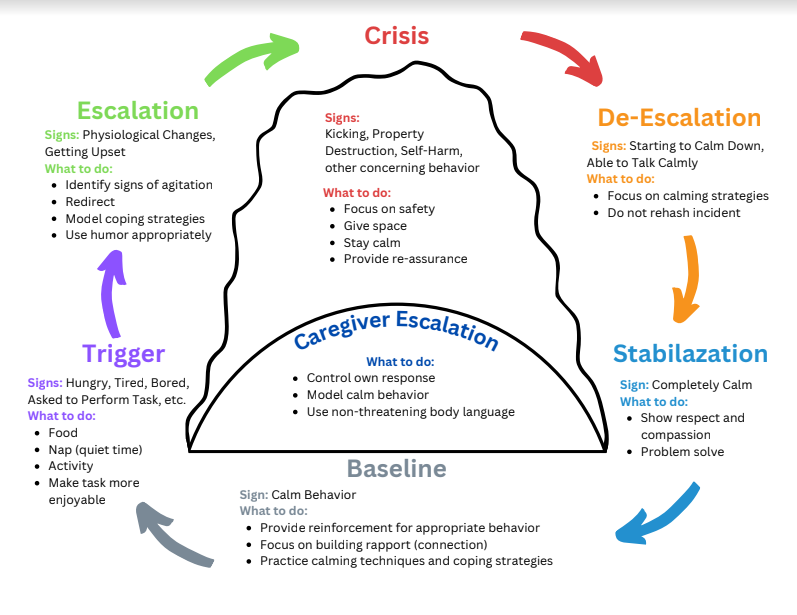
I’m fortunate that my varsity assistant, Kyle McNally, not only possesses a high-level hoops IQ but also played for me in college. He’s been invaluable—not just in scheme and culture creation—but in helping me reflect on the why of me (seeing as he’s experienced it both as a player and now as a staff member).
Yesterday, he brought something to me from a district training he attended: the Crisis Cycle (the image above). Our conversation about it—and the action plan that followed—was another example of why I think TeamsOfMen work has to be embraced by staffs across the country.
While I’m sharing the graphic, I won’t try to teach it here (hopefully, your own curiosity leads you to dig deeper). What I will share is that between the two of us asking questions and brainstorming application, we came up with at least three things we wish we’d handled better a season ago—and with the knowledge we have now, three things we’re ready to implement this year.
None of those had anything to do with X’s and O’s. All had to do with the young men we serve—what they’re most likely carrying into practice or games, and what we can do to meet them where they are and show them real paths to growth.
We probably said “I should have” or “Wish we would have” four or five times each.That’s the Self Reflection + Self Interrogation = Self Awareness cycle (we even have a shirt for it).
I didn’t initiate that conversation—my staff did.
And that’s a huge sign to me that we’ve got the right people in place.
Coach Prompts
When was the last time your staff reflected collectively on how you respond to players in moments of crisis?
Which phase of the Crisis Cycle do your team’s systems—and your own reactions—tend to fall apart in?
Are you modeling calm behavior for your players… or matching their escalation with your own?
What would it look like if “practice planning” included time for emotional regulation and staff reflection?
How often do you and your assistants use I should have or we should have as growth language, not guilt language?
Player Prompts
When you start to feel frustration or embarrassment in practice, what does your version of the “Crisis Cycle” look like?
Which phase are you usually in before someone else notices?
What would it take for you to ask for space before things boil over?
How do you want your coaches or teammates to respond when you’re escalating?
What’s one way you can practice returning yourself to baseline before a mistake defines your next play?
Patriarchy’s Greatest Trick—and Why Coaches Must Call It Out
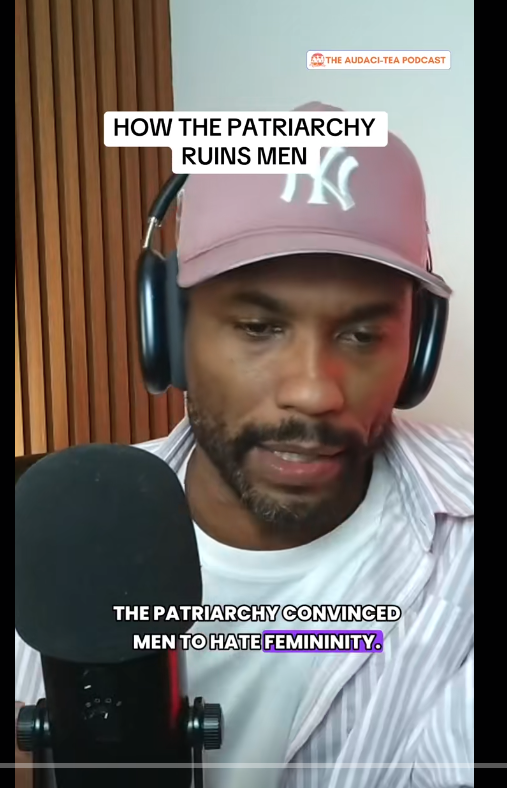
You know how much time we all spend as coaches watching film—the endless quest for more insight, more knowledge, and ultimately, the “cheat code” that’ll put our guys in the best position to succeed. Think back to that moment when you said, “There it is. That play. That clip. That’s what we need to beat next week’s opponent.” That feeling of discovery? That hit of clarity? It’s electric.
I think this clip from the AudaciTea Podcast (link) offers that same kind of moment—but for the way we coach men, not just how we coach the game.
It perfectly lays out the exact formula we’re fighting to unlearn in male spaces: patriarchy convinces men to hate femininity—and then attaches everything decent, empathetic, and emotionally fluent to that same femininity. Once that lie sets in, our young men don’t just reject women—they start rejecting their own potential for decency, patience, and compassion.
If you’ve ever asked, “Where do I even start with this TeamsOfMen work?” — start here.
This clip is film. It’s a breakdown of the system we’re up against. And if we want our guys to play the game of life with integrity and awareness, this has to be the film we study.
Coach Prompts
When was the last time you taught your players that patience, empathy, and self-control were signs of strength—not weakness?
How might your own discomfort with “feminine” traits show up in your coaching language?
What messages about “being a man” are reinforced in your locker room without you realizing it?
Do your players ever see you model emotional fluency—or only emotional control?
Player Prompts
What’s something you’ve been told “real men don’t do”—and how has that belief shaped you?
When you hear someone call empathy or vulnerability “soft,” what comes up for you?
How do you know when a teammate is being real vs. performing toughness?
If being decent and patient were considered signs of power, what would change in how you act?
Stop Searching for the Work. You’re Already Doing It.
I found myself frantically scrolling through my various platforms today looking for inspiration for this blog (and as you know, it’s rare that I can’t find an example of something online that speaks to the need for the TeamsOfMen framework in team rooms of male athletes).
But then it hit me:
“Kip, you fool — the time you spent with your guys around that circular table yesterday was the work in action.”
Let me explain (without naming names or quoting directly — the trust my guys give me deserves protection).
Yesterday, a few of my older players helped me work a booth at a school-wide event. In between conversations with students and staff who came by, the downtime turned into something deeper. We started sharing some of the very questions and prompts I post here — and then, I just listened.
They bounced ideas off one another, challenged each other, shared their own experiences. Real talk. Real growth.
That’s the essence of TeamsOfMen. We can spend all day talking about frameworks, shirts, or session plans, but the work itself? It’s when we create intentional space for our players to wrestle with things that matter — right now and in the future.
So, while there’s no viral clip or sports controversy for today’s blog, there’s something better: proof.
Proof that when we create space for the work, the work shows up.
Coach Prompts
When’s the last time you just listened to your players talk about real life—not the game?
How do you intentionally create space for your players to talk about things that don’t show up in a stat sheet?
What’s one moment from this week where the “work” (your character, trust, or connection goals) actually showed up—and did you stop to notice it?
How could you make those moments more consistent, not accidental?
Player Prompts
What’s one thing you said or heard in our team conversations lately that stuck with you? Why?
What’s a topic you think guys our age need to talk about more—but usually don’t?
When conversations in this room get real, how do you usually react—lean in or pull back? Why?
They Didn’t Ask for It—But It’s Finding Them Anyway
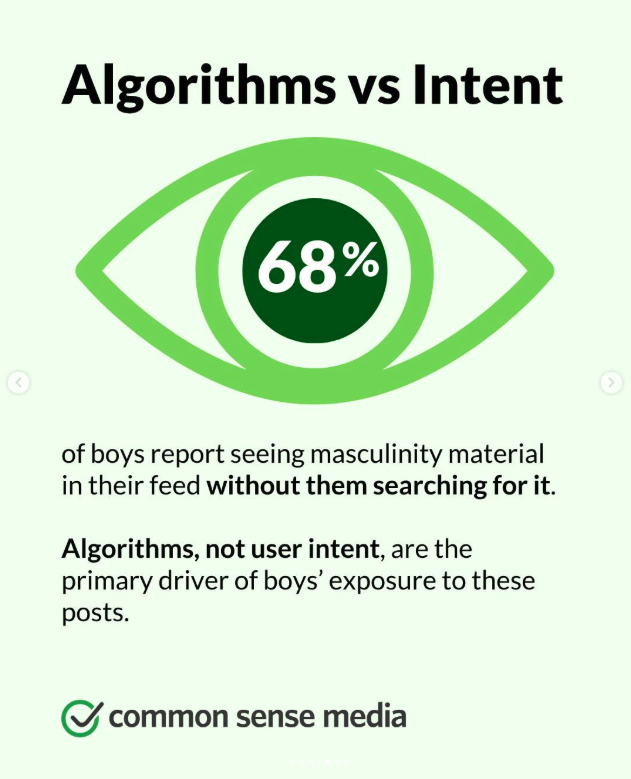
This report from Common Sense Media was first brought to my attention by my colleague Christopher Pepper, and later again by my friend Dennis Barbour in his Partnership for Male Youth newsletter.
But this slide right here stopped me cold.
68% of boys report seeing masculinity content in their feeds without searching for it.
Algorithms—not curiosity—are driving the exposure.
That stat hit me because it exposes something I know I forget sometimes: Our young people are living in an environment of constant, unfiltered input. They’re being taught—by feeds, not by mentors—what it means to be a man.
Think about that number in your world. If you’ve got 20 in your locker room, 80 on your football field, or 12 on your bench, how many of them are getting masculinity messaging every single day that they didn’t choose?
Now imagine if seven out of ten of your players were being fed clips that taught them to run a pick-off play the exact wrong way. You’d be panicking, right? You’d immediately feel the urgency to reteach and correct before it destroyed your system.
That same urgency should apply here.
Because while we can’t control the algorithms, we can compete with them. We can fill our own team rooms, our own feeds, and our own conversations with stronger, healthier, more grounded messages about manhood.
If you’re serious about your players learning how to win in life—not just on the court—then this report isn’t optional reading. It’s required.
📘 Full Common Sense Media Report →
Coach Prompts
How are you addressing what your players see online when you’re not in the room?
What’s your system for teaching them how to question and filter that input?
If their feeds are forming their definitions of manhood, how are you countering it?
Player Prompts
When you scroll, who’s really in control—you or the algorithm?
What kind of content about “manhood” shows up in your feed—and how does it make you feel?
When’s the last time you stopped scrolling to ask, “Who benefits from me believing this?”
The Manosphere Is Teaching the Opposite of Everything Good Coaches Believe.
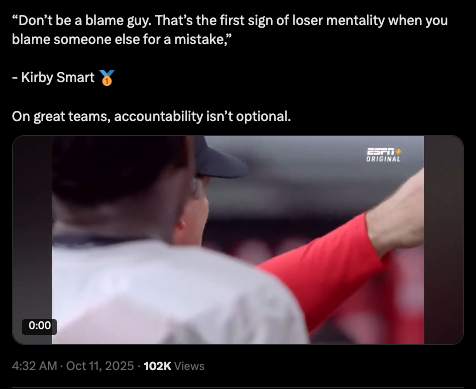
I don’t have any issues with Kirby Smart’s quote on the surface. It makes perfect sense when trying to get young men to embrace accountability. And I’d wager Kirby isn’t the first coach to ever say it.
Most of us have some version of that line in our own practice huddles. But that’s what I really want to hammer home — this idea is known. We all know accountability is a foundational trait for success. We know blame kills culture. So why, outside our team rooms, are so many of us silent while our players are being fed an entire online ideology—the Manosphere—that teaches them to do the exact opposite?
These guys are being told that their pain, failures, and frustrations aren’t their responsibility. That women, minorities, and the LGBTQ+ community are to blame for the lives they don’t have.
And too many coaches stay quiet about it.
If you’re reading this, you already know TeamsOfMen exists to take on Manbox thinking—to push back against a 2025 culture weaponizing male struggle and transforming it into hate.
We’d never let that mindset show up in a locker room. We’d shut it down immediately if a player started blaming teammates for a loss. So why aren’t we just as forceful when it shows up in the world our players live in?
Coaching accountability means all accountability. On the field, off the field, and in the feeds shaping their worldview.
Coach Prompts
How are you teaching accountability beyond the scoreboard?
When’s the last time you challenged your team to identify who they blame—and why?
Are you correcting blame in the locker room but ignoring it online?
Player Prompts
When things go wrong, who do you blame first—and why?
What’s harder for you: admitting a mistake, or apologizing for one?
If “accountability” was a stat we tracked this week, how would you grade yourself?
Flip This Script To Ourselves

Let’s start with this: today’s blog isn’t a takedown of Phil Beckner’s post — it’s solid. But if we’re honest, most of us coaches saw it and immediately started diagnosing our players.
So here’s the flip: what happens if we apply that same formulaic approach to ourselves?
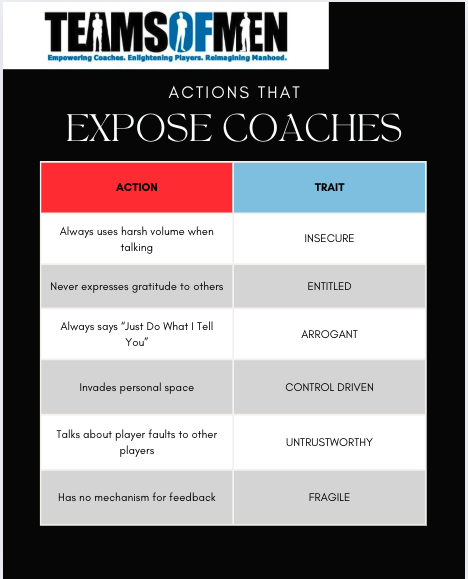
What if our version — ACTIONS THAT EXPRESS COACH CHARACTERISTICS — looked something like this:
Always uses harsh volume when talking
Never expresses gratitude to others
Always says “Just do what I told you”
Invades personal space
Talks about player faults to other players
Has no mechanism for feedback about his approach
If those were the actions, what would the character traits be?
Below is where I landed after taking a hard look in the mirror. But this isn’t meant to be my list — it’s an exercise. Print it. Bring it to your next staff meeting. Or better yet, do it with your players. See how they fill in the blanks.
The goal isn’t shame — it’s awareness.
Because the real win might not be another practice drill, but a shared agreement on the kind of coaches we refuse to be.
Coach Prompt:
When was the last time you looked at your own coaching behaviors the way you study film of your players? Which of these actions have crept into your habits — and what might that be saying about the state of your own emotional fluency?
Player Prompt:
If your coaches filled out this list together, what trait would you want to describe them? And what behaviors from your side could help them live up to that version of themselves?
Auriemma’s Epiphany—and the Question He Didn’t Ask

There’s a window here to an all-time coach getting so close to a TeamsOfMen framework statement.
In this clip, Geno Auriemma reflects on his later-career realization that—despite all the national championships—he doesn’t actually have much to do with winning and losing after tipoff. He says his real impact comes from the intentional preparation he builds day in and day out for the women in his program: “to learn how to win.”
That’s an incredible insight. And yet… I can’t help but wonder what happens if we push it one step further.
What if we swap out the word game for life?
Would as many coaches still nod along if Geno said:
“I can’t control what they do in their lives; all I can do is put them in position every day to practice how to live as their best selves.”
Would that clip still go viral? Would the comments still read “facts” and “this is coaching”?
I doubt it—because the word life makes it real. It moves us from the comfort of “sport” to the mess of human growth. And that’s where the real coaching starts.
Coach Prompts
What would change in your daily approach if you saw every drill as a life rehearsal, not a game rehearsal?
How much of your “preparation” teaches skill—and how much teaches stability?
Do you ever check in with your players on how they’re practicing life outside your gym?
Player Prompts
Where in your day do you practice being your best self—outside of practice?
What lessons from your sport actually translate when you leave the court?
Who’s teaching you how to win at life, not just win the game?
Coaching Reflection: What We Miss When We Worship “Masterclass Lists”
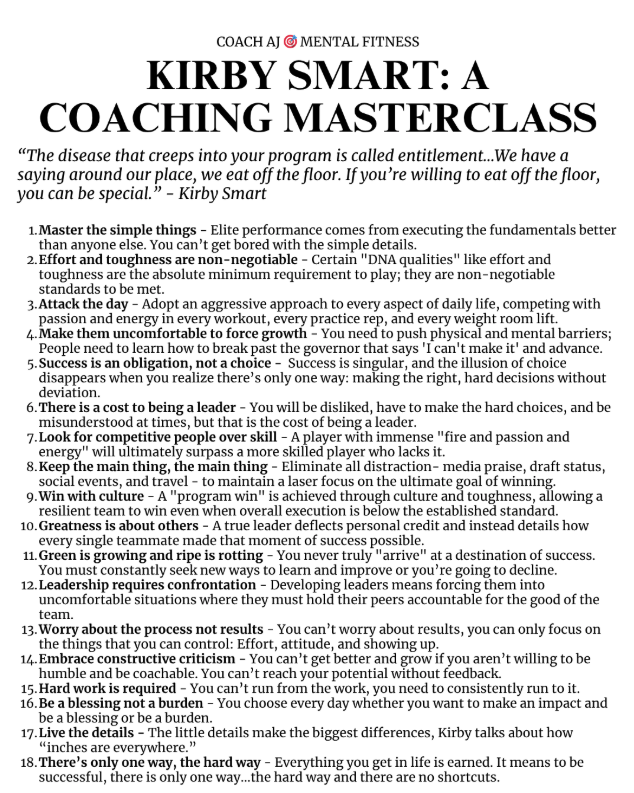
Let’s start here: Kirby Smart has enjoyed a ton of success as Georgia’s head football coach. That’s just fact.
And let’s also add that he may have said these things in a clinic somewhere, and the person who posted this list on X may have been there to accurately write them all down. I don’t know. So to be clear — this isn’t a critique of Coach Smart personally, because I can’t guarantee these are his actual words or beliefs.
What I do think, though, is that a lot of coaches would analyze this list and take it as some version of gospel. And that’s where I start to pause.
I don’t disagree with the whole list. In fact, some parts align with how I approach leading young men. But I’d challenge any coach reading it to take a critical eye to each phrase, not just a highlighter.
In my own deep dive, I think there are three main categories where lists like this—if unexamined—can actually make us worse at our jobs:
The Language of Dominance
The Myth of Grind Culture
The Misunderstanding of Leadership & Growth
I know which bullet point I think fist into each category, and how a single word swap or sentence reframe could completely change my level of alignment. Because words matter. What we say in front of players shapes how they define toughness, leadership, and even self-worth.
And honestly, I also think 18-point lists are too damn long. Even if they’re all gold, you lose your audience after three to five.
If you’re in season right now — don’t take this on yet. File it away and schedule time in the offseason to dig into it with your staff. If you’re not in season, I think this exercise is worth your time.
Coach Prompt:
Pick three statements from the Kirby Smart list that you’ve said — or could easily see yourself saying — out loud to your players.
Now ask:
What feeling does that sentence create in a young man hearing it for the first time?
Does it invite curiosity or compliance?
Does it demand toughness or develop it?
The goal isn’t to cancel the statement — it’s to refine it so the message builds men, not myths.
Staff Prompt:
In your next staff meeting, divide the 18 bullets into the three categories I listed:
The Language of Dominance
The Myth of Grind Culture
Misunderstood Leadership & Growth
Debate where each belongs. You’ll find where your program’s unspoken beliefs live — and whether those beliefs are helping or harming your players’ development.
Don’t Let Your Passion Turn Into Performance Theatre

Let’s be clear—Coach Campanile (shown above when he was the Dolphins LB coach) is having a great year coordinating Jacksonville’s defense. He’s clearly a sharp football mind who knows how to build and call a defense.
My issue isn’t with him. It’s with the framing of moments like this speech, and what they teach younger coaches watching. The message becomes: “The more f-bombs I drop, the more violent imagery I use, the harder my guys will play.”
That’s the fallacy—one fueled by the glorification of violence in our coaching spaces. Clips like this get labeled as “fire” or “old-school juice,” but what’s missing is acknowledgment of what actually makes his defense elite: detail, film study, teaching, technique, and intelligence.
I’d even wager that the laughter from his players in the room had less to do with being inspired and more to do with being entertained. The delivery was wild. The language was loud. But did it teach anything?
And if we’re being honest—the goal of a defensive coordinator is to prevent an offense from running away from you in the first place. So even the Lombardi quote about chasing down someone who “stole your family” doesn’t hold up. If we’re sticking with the metaphor, what failed defense did you call that let the intruder in to begin with?
I don’t begrudge his passion—it’s real. But I’ll always bet that the value of his detail and design outweighs the power of his decibels.
If we’re serious about shaping better coaches and players, we’ve got to stop equating volume with value.
Coach Prompts
When was the last time you evaluated what tone you model, not just what plays you call?
Do you believe louder always means clearer—or does it just mean you’ve lost your audience?
How can you channel passion without falling into the performance of “toughness”?
Player Prompts
What kind of communication actually makes you better—fear, clarity, or connection?
When your coach yells, what are you hearing: instruction or emotion?
How could you give feedback to a coach who coaches loud, but not clear?