

Feeling After a Loss Isn’t Weakness — It’s Humanity
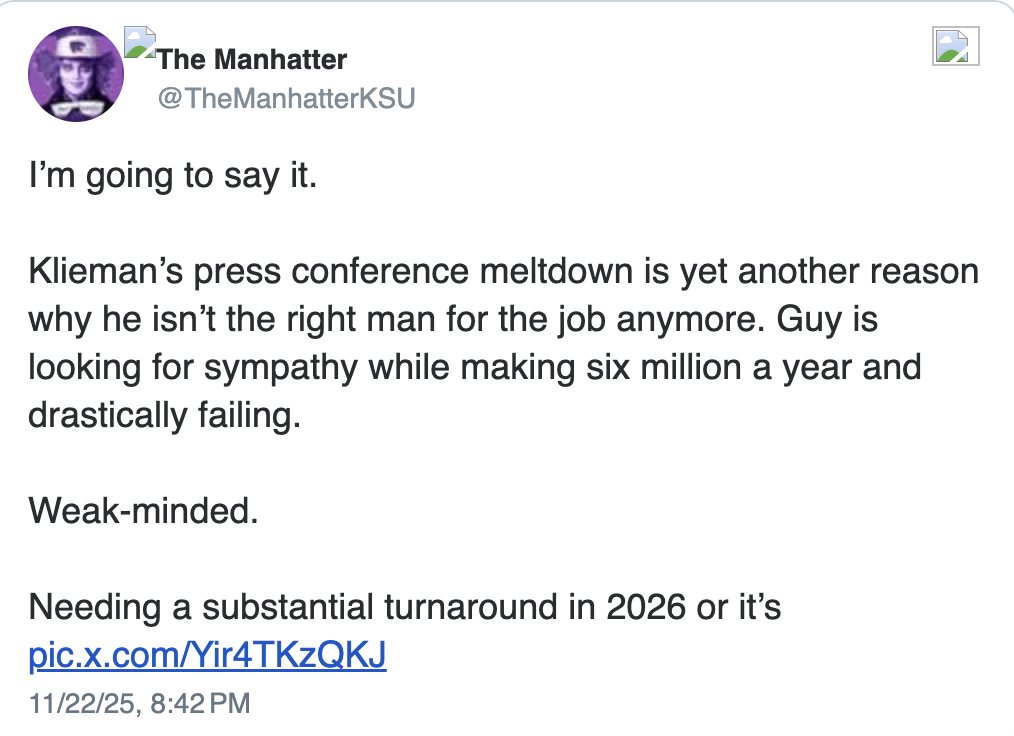
This post is exactly why coaching can feel impossible — and why so many coaches end up passing down the same emotional pain we get hit with from the outside world.
Kansas State’s Chris Klieman tears up after a 51–47 roller coaster of a game — momentum swings, big plays, heavy pressure, questionable calls, the whole thing — and somehow the reaction from fans is… “weak-minded.” As if money makes a person immune to emotional overload. As if a man’s only acceptable response to heartbreak is stoicism.
This is socialization in real time. The world literally telling a man: don’t feel, don’t express, don’t show anything real unless it’s victory.
And here’s the connection that matters for coaches: when we’re trained to numb ourselves, we end up training our players to numb themselves too.
Which is why moments like this are perfect teaching clips. Because in our program — from head coach to manager, starter to scout — we feel all the feels. We don’t shame it. We don’t hide it. We make space for fluency, growth, and connection, scoreboard be damned.
That’s the work. That’s the antidote to this nonsense.
COACH PROMPTS
When’s the last time you modeled emotional honesty for your players — not just emotional control?
What expectations have you internalized from fans, boosters, or culture that end up hurting your team?
How would your program shift if players saw vulnerability as competence, not weakness?
PLAYER PROMPTS
Who taught you that feeling something after a loss makes you soft — and were they right?
How do emotions actually show up in your game: do you bottle them, or use them?
How would your team change if everyone felt safe being real after big moments?
Toughness Isn’t a Cotton Sweatshirt
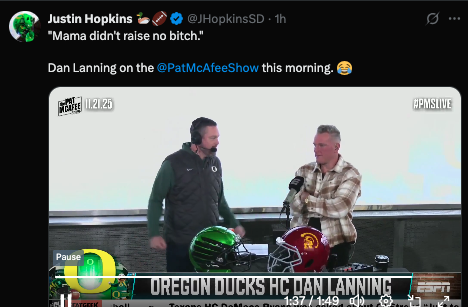
I watched this clip today because I’m a big Ducks fan — excited for the USC matchup and genuinely impressed with a lot of what Dan Lanning has built. And I get the bit: the host doing a Lou Holtz impression, Coach Lanning playing along, everyone keeping it light.
But when we see performative manboxing, we have to call it out — even when the stakes are low.
Coach Lanning froze his ass off in the rain at Iowa a few weeks ago, and somehow that moment has now become a rallying cry for the “toughness = suffer loudly” crowd. The narrative became: Look how wet he got. That’s leadership. That’s why they won.
Except… Oregon’s players — the ones who actually blocked, tackled, caught passes, and competed in a downpour — wore Nike’s best rain-proof gear, rotated coats between drives, and stayed functional. That doesn’t make them soft. That makes them prepared.
An umbrella doesn’t make you weak. Not enjoying being drenched doesn’t make you less of a man. And being miserable on purpose doesn’t make you a better coach.
This clip is another low-hanging example of the Man Box selling the same tired message: real men suffer, real men reject comfort, real men tough it out because their mama “didn’t raise…” — you know the rest.
Coach Lanning and his staff did a great job with the football in that win. Being soaked had nothing to do with it. We’d all be better off if we stopped confusing avoidable discomfort with real toughness, and stopped pretending theatrics equal leadership.
COACH PROMPTS
Where in your program are you modeling “toughness” in ways that don’t actually help your players?
Do you ever reward suffering more than preparation — and what message does that send?
If your definition of leadership requires performative pain, who’s being left behind?
PLAYER PROMPTS
What’s the difference between real toughness and just trying to look tough?
Have you ever pushed through something just to match an image — not because it made you better?
Which teammates earn your respect through consistency, not theatrics?
Have You Outgrown Fun As A Coach?

I watched the Joe Mazzulla clip above yesterday and had to shake my head. It’s gone viral because it’s coach-bait: a big-time coach, NBA pedigree, championship résumé, saying something that looks great on a poster. But sit with it longer than a scroll — especially considering the question came from a kid — and it gets murky fast.
What is he actually saying?
That fun doesn’t exist in the adult world? That’s a recipe for mental health problems.
That sports aren’t supposed to be fun? That’s burnout waiting around the corner
Or — maybe — he meant something more nuanced about players using “I’m not having fun” as an escape hatch when the work gets hard. I could see that interpretation… but notice how much heavy lifting I had to do to get him there. Coaches forget this way too easily: we didn’t fall in love with our sport because it was serious. We fell in love because it made us smile. Because it gave us joy. Mazzulla gets paid to turn that joy into wins for a billion-dollar franchise, but the essence hasn’t changed.
It’s still a game.
And if the adults in the room can’t talk about fun without flinching, our players won’t stand a chance of keeping theirs.
COACH PROMPTS
When did you start acting like “fun” was something players earn instead of something that fuels their effort?
How often does your language treat joy like a distraction instead of a competitive advantage?
What would your practice look like if you built it the way you loved the game at 12 years old?
PLAYER PROMPTS
When’s the last time you let yourself actually enjoy the sport you’re grinding for?
What’s the difference between “this isn’t fun because it’s hard” and “this isn’t fun because it’s unhealthy”?
Who on your team brings joy to the gym — and are you one of those people?
If You Can Script “Down 3”… You Can Script This

I saw a post today about coaches using playing-card “special situations” to prep for late-game chaos. I used to do the same thing — random cards, random scenarios, one pulled each week. Great coaching. It proves what we already know: guys need reps in hard stuff if we expect them to succeed when hard stuff hits.
But here’s the miss: We’ll script “down 3, five seconds left,” but we won’t script the situations that actually put our players’ lives, futures, and relationships at risk.
What about:
“Your group chat is blowing up after a big Friday night and you know the plans could go sideways.”
“You are sitting in the car after a date and you know what your boys will say if you don’t ‘make a move’.”
“Your best friend is a ghost for a month on text, on video games and rarely at school…and you know something at home isn’t right.”
These are special situations too. Higher stakes. Zero do-overs.
The question isn’t whether we know how to teach situations — we clearly do. The question is why we won’t bring that same intentionality to the ones that matter most.
If we can carve out five minutes for a baseline inbound, we can carve out five minutes for the moments that could cost them far more than a possession.
COACH PROMPTS
What “off-court special situations” do your guys already face every week — and when’s the last time you walked them through one?
Where in your practice plan can you consistently carve out five minutes for life-prep?
What’s one scenario you could script this week that speaks directly to your team’s reality?
PLAYER PROMPTS
Which off-court moments feel hardest to navigate — and why?
When have you wished you had a “replay” or a second chance in real life? What would you do differently now?
Who on your team could you talk to when things start to get sideways?
What Are Your Guys Really Laughing At?

In every team I’ve coached — and in the teams I grew up in — laughter was the soundtrack. We treated it like a sign of connection, chemistry, even culture. But I’ve been realizing something uncomfortable: not all laughter builds a team… and a lot of it breaks boys down in ways we never see. Last week I wrote about the ways humor becomes both the shield boys hide behind and the sword they swing at each other — and why coaches can’t afford to ignore it anymore.
If you work with young men, this is one you’ll want to read.
COACH PROMPTS
Where in your program does humor go unchecked — and what’s the real message players are learning from that silence?
When’s the last time you interrupted a laugh that didn’t sit right? What stopped you the last time you didn’t?
If your players were asked what kinds of jokes a teammate can “get away with,” what would their honest answer be — and what does that tell you?
PLAYER PROMPTS
Think about the last time everyone laughed in the locker room. Was the joke about something true — or something someone was trying to hide?
Whose feelings are easiest to ignore when the laughter starts? Why is that?
What’s one joke you laughed at this week that you wouldn’t want someone using on you?
When the Odds Always Win: A Lesson for Teams
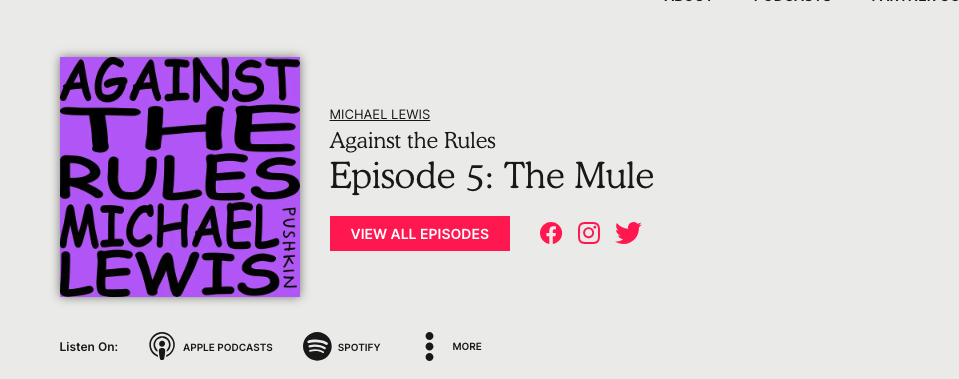
I picked this topic today — and am pushing out this Against the Rules episode by Michael Lewis (Episode 5: “The Mule”) — because the conversation around sports gambling has exploded lately. Between the NBA and MLB betting scandals and how often I hear “my parlay” in team conversations, it feels unavoidable.
I’ve had to stop more than one locker room conversation with:
“Guys, we can’t be throwing our money away like this.”
“Are you even old enough for that?”
Usually I get, “My dad/grandpa/uncle does it for me, Coach.”
So instead of just lecturing with “don’t do it,” I shared this podcast episode with our entire team — and even one of our staff members who loves to bet on games. Lewis lays out how the system actually works: even if you’re good at it, companies like FanDuel, DraftKings, and MGM Bet will throttle your account the minute you start winning too much. You literally can’t win big.
The game is rigged. Not emotionally, not morally — mathematically.
And that’s the point I want our players (and honestly, us adults) to understand. Saying “don’t gamble” without explaining why doesn’t land. But understanding that the system is designed for you to lose? That’s a real conversation worth having before or after practice — when “I hit the over” inevitably comes up.
Coach Prompts
Have you ever discussed gambling as a system designed against players rather than a moral issue?
What parallels exist between gambling odds and the illusion of control athletes crave in competition?
How might explaining why a system preys on people help your players make stronger choices in other parts of life?
Player Prompts
Why do you think gambling ads always show people winning?
What’s the difference between confidence and control — and which one does betting really offer?
If you knew the game was fixed against you, would you still play?
Showing Up Isn’t Extra Credit

I came across this video of a young person lighting up when they spotted their dad in the crowd at a school event — it’s an awesome, heart-melting moment. You can literally see the joy burst across their face in real time.
But it also got me thinking about something deeper. The caption says, “Shoutout to the dads who show up.” And while I get the sentiment, it immediately brought to mind Chris Rock’s line: “You don’t get a cookie for doing shit you’re supposed to do.”
Because honestly…aren’t we supposed to show up? Isn’t that parenting 101?
Now, full transparency — I’ve absolutely caught myself feeling proud, even self-congratulatory, for showing up at a game, practice, or school pickup. That’s not evil, but it’s revealing. Somewhere along the way, many of us men were conditioned to think being present and emotionally available was extra credit. That’s the Man Box at work.
So no, this video isn’t a call-out — it’s a call-in. It’s a reminder to normalize being awesome at fatherhood. To make showing up the baseline, not the breakthrough.
And the best place to start that work? In your team room. Helping your players — many of whom are watching and learning what “manhood” means — see that being consistent, caring, and present isn’t something to brag about. It’s just what real men do.
Coach Prompts
What do your players see modeled by you about presence and consistency?
Do you ever treat “showing up” as something special instead of standard?
How can your staff normalize presence — not praise it as rare?
Player Prompts
Who are the people who consistently show up for you — and how do you show that back?
How would your teammates describe your reliability off the court or field?
Do you only value people who show up for the big moments, or the daily ones too?
When the Film Session Is About a Friend

This article from ESPN about Mike McDaniel and Dan Quinn deserves to be shared far and wide — not because of a play call, a strategy, or a championship moment, but because it’s a story of coaches doing what we always say we want our players to do: notice, care, and act.
In 2016, Quinn, along with Kyle Shanahan and Raheem Morris, sat McDaniel down and told him he was drinking too much. It wasn’t a “none of my business” moment. It wasn’t brushed off as “he’s just being him.” It was a moment of seeing someone fully — and stepping in with love, honesty, and courage.
We often use this space to hold coaches accountable for failing to model what they teach. But this one is different. This story is a reminder of what we’re capable of at our best.
These were friends and colleagues who noticed need, joined together, and took action.
They didn’t wait for a crisis. They didn’t protect comfort. They prioritized care.
That’s the work. That’s TeamsOfMen.
This is proof that our ability to notice doesn’t have to stop at 3rd-down technique or end-of-game execution. It can reach into the personal lives of the people we lead and work alongside.
Because the sport itself is neutral. The people are what make it matter.
And moments like this show that our real wins don’t happen under the lights — they happen in private rooms, when we have the courage to tell someone we love that we see them struggling.
Coach Prompts
When’s the last time you noticed a colleague, player, or staff member struggling — and actually said something?
What’s stopping you from turning “noticing” into action in your program?
How can your staff normalize checking on each other beyond performance?
Player Prompts
Who’s someone on your team that might need you to notice them right now?
What’s one way you can show care for a teammate that has nothing to do with basketball?
How would you want someone to approach you if they saw you struggling?
“When ‘Stay Present’ Becomes Emotional Avoidance”

I first pegged this post as a reax piece because anytime I see someone equate emotions with weakness, my TeamsOfMen radar lights up. The caption — “Emotions beat teams more than their opponents do” — immediately triggered that response.
It’s a common refrain in coaching circles, and one that’s drenched in ManBox thinking: the idea that we should train our players to become emotionless machines, perfectly composed and fully detached. But that’s not strength. That’s suppression.
So I clicked the video expecting more of that “stoic equals strong” messaging — and what I found instead surprised me.
There’s nothing in the video about emotions. No actual mention of “emotional control,” no insight into emotional fluency. Just the usual motivational buzzwords:
Be where your feet are. Attack every rep. Win every possession.
And while those might sound good on a T-shirt or locker room wall, I think they also raise an important question:
At what point does “staying present” become just another way of avoiding presence—of never allowing yourself to actually feel?
If we train athletes to constantly “attack the next moment,” when do they get to feel joy? When do they reflect? When do they recover?
“Zero-zero mentality” might win games. But if that same mindset leaks into how they process life, it can lead to numbness, not resilience.
Coaches — let’s teach focus, yes. But let’s also teach humanity.
Being present doesn’t mean shutting off emotion. It means noticing it, naming it, and then choosing your next step with intention.
Coach Prompts
When do you catch yourself using language that sounds like “attack the moment” or “next play”? What tone does it set for your team emotionally?
Does your team know the difference between composure and suppression?
How can you model being emotionally honest without losing competitive edge?
Player Prompts
When’s the last time you celebrated something fully — or admitted you were frustrated — without fear of being judged as “soft”?
How does staying “locked in” help you… and when does it start to hurt you?
What’s one emotion you’ve learned to name this season that used to just show up as anger or silence?
Boundaries Aren’t Soft — They’re Structure.

This post from Jen Fry is something every staff should grapple with before bringing it to their team.
Why? Because I don’t think boundaries get anywhere near the attention they deserve in most programs.
We spend a ton of time building “standards,” defining “expectations,” and deciding consequences for when those aren’t met. But how often do we talk about boundaries—what they mean, where they are, and how to honor them?
For a lot of coaches, the word boundaries instantly triggers thoughts of consent—and that’s where the discomfort shows up. Some avoid it out of fear or lack of knowledge. Others assume it’s “not our lane.”
But boundaries live everywhere in our programs. They show up when:
A player decides how much pain or exhaustion they’re willing to push through.
A coach gives a correction and the tone crosses a personal line.
Teammates interact in the locker room, on the bus, in the weight room.
“Who can say what to me?”
“What kind of physical contact is okay?”
“When does intensity become disrespect?”
These are all boundary questions. If we as a staff aren’t aware of what we’re asking our players to accept, endure, or ignore, we risk crossing a line that damages trust—without even realizing it.
I’m not saying we can’t set high standards. I’m saying we need to define them clearly and make sure they’re not mistaken for ownership of someone else’s limits.
Boundaries don’t weaken a team.
They protect it—from confusion, from conflict, and from harm we didn’t mean to cause.
Coach Prompts
When’s the last time your staff named specific boundaries—between players, between coaches, or between the two?
What behaviors or language do you consider “normal coaching” that might cross a player’s personal boundary?
How can you model holding firm standards without blurring those lines?
Player Prompts
What are examples of boundaries you want respected in your team environment?
How do you respond when a boundary of yours is crossed—by a teammate or coach?
What’s one way you can help others feel safe setting their own boundaries this season?
If It’s Not on the Calendar, It’s Not a Priority

A personal share today: Like many of you, I’m closing in on the start of high school hoops season and deep in prep mode. Between practice, film, weights, scouting, travel, games, and grade checks, there’s no shortage of processes to plan and calendar for the next 4–5 months.
While I love the prep work, it can get overwhelming — the sheer volume of planning can eat up your entire headspace.
One thing I started seven years ago, though, was mapping out my #TeamsOfMen calendar back in August. Back then it was at the college level; now, it’s part of our high school rhythm. I knew that if I waited until the season rush, it would be too easy to push those sessions aside — or drop them altogether. Because when you’re staring down a Wednesday during conference play, and you’re fuming over a blown pick-and-roll coverage, it’s easy to say, “we don’t have 20–30 minutes for character work today.”
So instead, as I sit here in full prep mode, what I claim to value most — building space for young men to grow in their humanity — is already set in stone. It’s on the calendar. The time is protected. The stress about whether it’ll “fit in” is gone.
Coach Prompts
Do I schedule character work with the same discipline I schedule practice?
What parts of my “values” are actually visible in my team calendar?
If I looked at my season plan, could anyone tell what I say I care about most?
Player Prompts
What are the things in your week that you claim to care about but don’t actually make time for?
How could scheduling time for self-reflection or growth make you a better teammate?
When the season gets stressful, what helps you keep your priorities straight?
Man Up or Grow Up? The Fine Line in Coaching Language
I’ve been paying more attention than ever to the Memphis Grizzlies this year, mainly because one of my former players was drafted by them, and I love seeing his name in the box score.
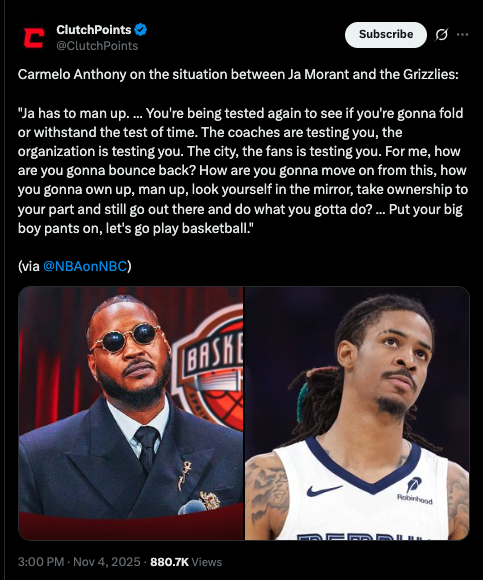
But when you study the Grizzlies, it’s clear the entire franchise orbits around Ja Morant. Recently, the team suspended Morant for one game for conduct detrimental to the team — reportedly stemming from his verbal and physical reaction to in-person criticism from the head coach.
The screengrab above is from Hall of Famer Carmelo Anthony and his attempt at “speaking” to Morant, offering advice on how to move forward. What stands out to me, through a TeamsOfMen lens, isn’t Melo’s intention — which is clearly to help a younger player refocus and grow — but the language he uses to try to get that message across.
“Ja has to man up.”
“Own up, man up.”
“Put your big boy pants on.”
I’ve said those same things before, and I’m sure many of you have too, all with good intentions and a desire to inspire accountability. But right alongside those tired tropes of masculinity are phrases like “testing,” “look yourself in the mirror,” and “take ownership” — all of which we can agree are legitimate life skills.
Words matter. Melo’s message is close to being spot on — it just needs an adjustment in language, a removal of the clichés about “manliness,” to make the transformation complete.
Coach Prompts
How often do I use outdated or gendered phrases when I’m actually trying to teach accountability?
What’s my go-to language for calling players up instead of calling them out?
Could I replace “man up” with something that reflects growth rather than toughness?
Player Prompts
When I hear a coach or peer say “man up,” what do I think it means?
Do I equate accountability with emotionless toughness, or with learning and self-reflection?
How can I “look in the mirror” without letting shame or defensiveness take over?
Coach Cronin’s Confession — and the Lesson for All of Us

Coach Cronin has never been one to hold back. After reading the full transcript of his postgame press conference, I’m glad I didn’t just react to the clip that went viral. Because while the short version screams “angry coach meltdown,” the full context reveals something more layered: a frustrated leader who saw arrogance coming all week, tried to intervene, and still couldn’t stop it.
Originally, I thought this would be a post about practicing what we preach — that if we accuse players of arrogance and a lack of humility, we’d better #MirrorTrain and check our own tone first. But after reading it all, I see a man who already did that. Cronin repeatedly blames himself, admits failure to reach his team, and holds himself accountable in a way few coaches ever do publicly.
That said, there’s still something here worth examining: our emotional pause button.
Because even if everything he said was true — and maybe it was — the question remains: Does saying it publicly help his players grow, or just protect his pride?
I’ve said versions of what he said behind closed doors to my own staff. Most of us have. The difference? There wasn’t a camera there to catch it.
So maybe the takeaway isn’t about whether Cronin was right or wrong, but whether we as coaches can model one more step of emotional fluency — the moment we feel that surge, can we pause, breathe, and decide if our truth serves anyone but ourselves?
Coach Prompts
When’s the last time your frustration was valid but your delivery wasn’t?
What’s your personal “pause button” look like in high-emotion moments?
Would your players say your postgame comments help them or haunt them?
How often do you debrief your own behavior after a loss?
Player Prompts
How do you want your coach to hold you accountable after a bad game?
When you’re frustrated, do you look to vent or to learn?
What’s your version of a “pause button” when your emotions spike?
Do you hear critique differently when it’s public versus private?
The Marginal Returns of More Assistants

In some ways, this post speaks for itself. With the sheer number of coaches making up big-time college hoops staffs these days, much of what they do just isn’t repeatable at the high school level.
But what I want to call attention to is the inefficiency of sheer numbers when all those people are devoted only to scheme and skill work.
My degree’s in Business Economics, and the concept of diminishing marginal returns absolutely applies here. There are only so many sets of eyes you can have on the same film before everyone becomes noise, not signal.
My counter argument isn’t fewer people — it’s new tasks.
When I scroll a program’s staff directory — like Florida’s, where this image came from — I see plenty of titles: assistants, analysts, directors of player development, quality control. But not one says Character Development Coordinator, Mental Health Access Lead, or Emotional Fluency Coach.
You’re telling me that wouldn’t be more conducive to winning than another set of scout notes?
We’ve dramatically overvalued film work and undervalued people work.
Coach Prompts
If you could add one non-tactical role to your staff tomorrow, what would it be?
How much of your staff meeting time is spent on who your players are vs. what they run?
Do your assistants know the emotional temperature of the locker room as well as they know the scouting report?
How would your win total change if your players felt seen as much as they’re analyzed?
Player Prompts
How would you describe the “non-basketball” parts of your program?
Who on your team knows when you’re struggling — and what do they do with that info?
What’s one way your team could get better without touching a basketball?
Would you rather have a coach who knows your stats or your story?
When Caring Sounds Messy, But Still Matters

This post, capturing a desperate plea from a coach to a young man thinking about quitting his program, has my mind (and heart) pulled in a lot of directions.
Most of them are gratitude-based. Like the original poster, I’m thankful for coaches who care enough about their players’ real lives to reach out like this — the emotion and authenticity in his voice are things many of us have probably felt.
Do I wish he hadn’t said, “Be a man,” in the middle of his plea? Sure.
Do I not relate to ending it with, “I’m praying for you over everyone”? No — I get that.
But I don’t think I want to litigate the how here as much as praise the why. A coach using his platform to say, “I love you,” and “I care about what’s in front of you in life,” deserves recognition.
I’d encourage everyone to watch the clip for themselves and sit with the #MirrorTraining it provokes. [https://t.co/uWy7jrI7mT]
Coach Prompts
When’s the last time you told one of your players “I love you” — out loud?
How do you balance accountability and empathy when a player wants to walk away?
Are there moments where your emotion might cloud — or clarify — your message?
What would your staff say is the difference between coaching hard and showing heart?
Player Prompts
What would it mean to you if your coach reached out like this?
Have you ever walked away from something because you didn’t feel understood?
How do you want the adults in your life to respond when you’re struggling?
What kind of “love” from a coach actually helps you grow?
Authenticity Without Reflection Is Just Stagnation

This post from @isaiahfrizzelle stopped my scroll today, and I think not only should you play it for your guys, but you should also use it to reflect on the mechanisms you and your staff have in place for your players when they make poor decisions as human beings.
I’ve often wondered myself: If I’m the “find your authentic self / be your authentic self” guy, what does that mean if my true self causes harm?
That’s where I think we have to base identity in fluidity, not rigidity.
I am someone who is chasing better always. That means allowing myself room to grow, to unlearn, to drop bad habits, and to evolve.
If we want our programs to embrace that same mindset, then we can — and must — hold our guys accountable for their actions without confusing that with rejection. That’s not punishment; that’s coaching for growth.
When you translate this to the court or field, the analogy writes itself: We would never let a player say, “Coach, I can’t learn that new skill — I’ve got to stay being me.” So why would we ever accept that logic in their character?
Grace doesn’t mean enabling. Accountability doesn’t mean condemnation.
Both are essential if we’re truly building men who can live out what they learn with us.
Coach Prompts
When a player makes a mistake, does your first instinct lean toward protection or accountability?
How do you model “chasing better” for your staff and players — not just talking about it?
What mechanisms do you have for helping players reflect after causing harm instead of just serving consequences?
Are you offering grace that leads to growth or grace that allows stagnation?
Player Prompts
When you make a mistake, do you take ownership — or hope it’ll fade away?
What’s one area of your character you’ve outgrown because someone held you accountable?
How do you know when you’re being shown grace… and when you’re being enabled?
If being “yourself” is causing harm, what part of yourself might need unlearning?
Obedience Isn’t Development

I don’t think Coach Winegar is alone in his thinking here. There are a lot of coaches—maybe most—who would see his list and nod along. Whether it’s out of deep respect for the coaches who shaped them, or a sense of duty to uphold “standards,” there’s comfort in repeating what we were taught.
I’ve had a dress code for game days. I’ve had guys tuck in jerseys. My teams track charges.
But here’s where I start to push back: Coach Winegar’s response to Coach McCormick’s question.

He says, “We are teaching more than basketball… our goal is to develop people first, players second.” That sounds great on the surface, and you might assume I’d agree. But here’s the problem—developing people requires talking about life, not just enforcing obedience and calling it “life skills.”
If we say, “we have a responsibility beyond ball,” then we have to live that. Talk about consent. Talk about relationships. Talk about mental health.
I don’t know how to tie a Windsor knot, and I’ve been a coach for 25 years and run my own business just fine. I’ve also let my teams pick their own dress themes—hoodies, throwbacks, whatever—and those teams still found ways to be successful.
We get in trouble as coaches when we start equating wins to rituals that can’t be measured.
There’s no way to prove a tied tie helped you beat your rival—or made your players better people. All it really proves is how comfortable we are reinforcing power instead of reimagining it.
Coach Prompts
When was the last time you questioned a “program standard” you inherited instead of created?
Do your team rules teach life lessons—or just compliance?
What life conversations have you avoided this season under the guise of “we’ll talk about that later”?
Are your standards serving your players—or serving your comfort?
Player Prompts
What’s one team rule that makes sense to you—and one that doesn’t? Why?
Does your coach ever explain why certain traditions exist, or just tell you to follow them?
How do you define respect: obedience or understanding?
If you could set one new “standard” for your team culture, what would it be and why?
Stop Trying to Scream Manhood Into Young Men

I hadn’t heard of @thedearsonpodcast before, but this clip came through my algorithm today, and I’m really thankful it did. Not just for the line in the caption—“You’re too ready to take your son out, but not ready to bring him in”—but also for what he says in the clip itself:
“You can’t bully your son into manhood.”
That’s a powerful reframing for dads… and for coaches. Because we’re often guilty of trying to mandate good behavior or strong character out of the young men we lead, using the very same tools we claim to be fighting against: screaming, intimidation, and public shaming.
With my own oldest son (he’s 18 and at community college now), I wrestle with this all the time—what parts of me do I want him to have and act on, and what parts do I not want him to carry forward?
Our programs work the same way. There are traits we use as competitors that absolutely serve our players once the game starts. But if we’re going to double down on those, we’d better also own the traits that don’t serve them—and make sure they know which ones they should leave behind.
That’s real coaching. That’s real fatherhood.
Coach Prompts
Do you ever use the same tone or tactics with your players that you wouldn’t tolerate them using on others?
Which parts of your own competitive drive serve your athletes—and which parts harm them?
When’s the last time you showed your players strength through calm, not control?
How do you “bring your players in” instead of “taking them out” when they make mistakes?
Player Prompts
How do you respond when someone tries to “toughen you up” through yelling or intimidation?
Who in your life models manhood in a way you actually want to follow?
What’s one “dad move” or “coach move” that you’ve promised yourself you won’t repeat?
What does real strength look like to you—control or compassion?
Warm Feet, Cold Hearts: Coaching and the Manbox

I don’t know the full context of this post. It could be a joke — but if that’s the case, you make that offhand attempt at humor directly to the player, behind closed doors. You don’t post it and then try to hide behind the cliché excuse of “it was just a joke.”
At best, if this was poor humor, this coach needs to evaluate his communication methods and timing. But if it’s what I think it is — another Manbox-bathed critique of “today’s kids” — then it’s exactly why coaches remain the focus of TeamsOfMen.
Because we have mandated platforms with young men every day of a season (and often beyond), what we believe—and how those beliefs shape our words and actions—matters. If, as in this example, a coach believes toughness equals mocking a player for wanting warm feet, he spreads that message both online and in the locker room.
Instead of thinking, “Why don’t we have extra socks or warmers for this exact situation?” he defaults to ridicule. And that ridicule either forces players to stomach the disrespect and keep quiet—or worse, teaches them to pass that same distorted version of manhood down the line.
His feet matter. His comfort matters. His humanity matters.
We have to be better.
Coach Prompts
What kind of toughness are you modeling—resilience or ridicule?
When a player shows vulnerability (physical or emotional), how do you respond in front of others?
Would your players describe your leadership as empowering or performative?
Does your staff have shared language for distinguishing softness from self-care?
Player Prompts
Have you ever stayed quiet while a teammate got mocked—what stopped you from stepping in?
How do you personally define “toughness”?
Can comfort and competitiveness coexist for you?
What would it look like to call out a “joke” that actually hurts someone on your team?
When an NFL QB Cries, Every Coach Should Pay Attention.

While I was watching the lowlights from my Cowboys blowout loss to the Broncos last night, clips from the Jets’ first win of the season came on. Afterwards, I caught QB Justin Fields’ postgame press conference and wanted to share a few of his words here (you can click the screengrab above to watch it yourself, maybe even with your players):
“It’s been a lot for me emotionally, spiritually. When I was on the field, I was damn near about to start crying — not because we won, but because of the goodness of God.
I’m going to get pretty vulnerable right here. This week I found myself in my closet crying on the ground, lying down. Not because of the hardships, not because of the troubles — I felt like I was built to handle that. I was praying over and over… just one win.”
For context: Fields had been benched the week before, the Jets were winless, and owner Woody Johnson had publicly criticized his play, putting much of the team’s failure on his shoulders.
I’m not overly religious, so the God aspect of his quote isn’t my main focus (though maybe it is for you). What I do want to highlight is vulnerability — and not just in words, but in visibility.
Here’s a high-profile male athlete naming the emotional weight he’s been carrying. Admitting he cried. Acknowledging the heaviness of his week.
That’s not weakness — that’s connection.
We talk all the time about “winning the locker room,” “building trust,” or “showing leadership,” but this kind of transparency is the foundation of all three.
It’s rare for male athletes to see this level of honesty modeled publicly, and it’s exactly what our “Vulnerability Is a Connection Point” shirt is about: link.
We all know lessons are easier to upload after wins than losses — but this one feels scoreboard-proof. It’s okay to admit something was hard. It’s okay to share your struggles. It’s okay to be honest about feelings that have felt inescapable.
Bravo, Justin.
Coach Prompts
When’s the last time you modeled vulnerability in front of your team instead of just asking them for it?
What spaces in your program allow players to admit, “This week has been heavy”?
Do you treat emotional honesty like a skill worth coaching — or just hope it shows up on its own?
Player Prompts
What’s something that’s felt heavy lately — and who in your circle actually knows that about you?
When was the last time you let yourself feel something instead of hiding it behind jokes or silence?
Why do you think male athletes so often connect vulnerability to weakness instead of strength?