

What Actually Breaks the Manosphere’s Grip
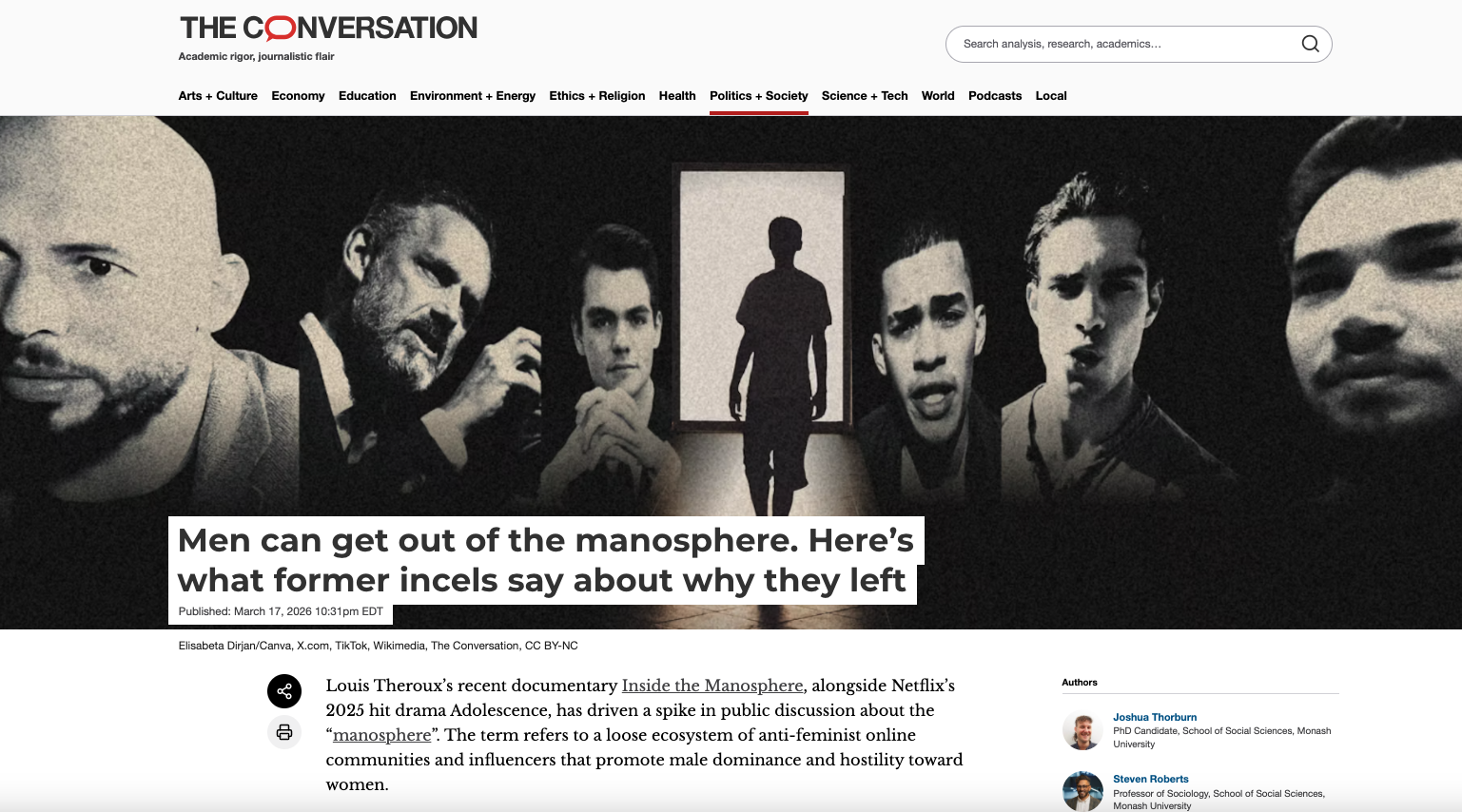
Today’s blog is in response to an article in The Conversation by Joshua Thorburn and Steven Roberts titled “Men can get out of the manosphere. Here’s what former incels say about why they left.”
Full credit for the share goes to a friend of ours, Dennis J. Barbour, Esq. (President and CEO, Partnership for Male Youth; Newsletter Editor).
Why this article for today?
Because it speaks directly to one of the HOPES we have at TeamsOfMen—that if you embrace this work in your coaching, you can help a player ESCAPE the manbox. But it also forces us to sit with two harder questions:
WHY do they get pulled into it in the first place?
And WHAT actually helps them get out?
I won’t lay out the entire article here (we live in an algorithm-dominated world—these authors need their clicks, so go give it to them), but two points hit hard.
First:
“A growing body of evidence suggests many men first encounter these communities during periods of insecurity or loneliness.”
And isn’t that exactly what we claim our SPORT is supposed to combat?
“Join us and you’ll get a family.”
“Play here and you’ll get brothers for life.”
But have we actually vetted our spaces to see if that’s true?
Second:
“Positive interactions with women, supportive friendships, or simply observing that relationships in the real world do not follow the rigid rules promoted online… can begin to undermine the worldview.”
Read that again.
Not lectures. Not punishments. Not one-off talks.
Experiences. Environments. Daily interactions.
If your program creates spaces—team room, bus, bench—where: emotional fluency is practiced, women, minorities, LGBTQ+ individuals are respected and celebrated and connection is real, not performative…it can counter the harmful ideology of the manbox.
That’s not theory. That’s proof.
The question is:
Are you creating that…or leaving space for something else to fill it?
Coach Prompts
Where are my players experiencing real belonging—and where are they not?
What messages about manhood are reinforced daily in my program (intentionally or not)?
Would an outside observer say our environment challenges harmful beliefs… or ignores them?
Player Prompts
When I feel insecure or alone, where do I go for answers?
What do I hear about women, relationships, and being a man from the people around me?
Do the spaces I’m in help me grow… or just help me fit in?
Would Your Players Say This About You?
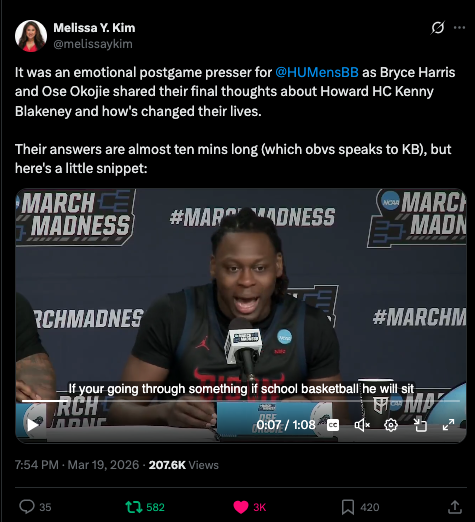
Today’s blog is a POSITIVE REFUELER from TeamsOfMen.
I know I spend a lot of time writing about the ways coaches—and the male athletes they serve—can get trapped in the Manbox and cause harm.
But this…
This is the other side of the work.
The postgame press conference from Howard University men's basketball seniors—speaking at length about the impact their head coach, Kenneth Blakeney, had on their humanity—is refreshing.
It speaks to the WHY behind this work.
It speaks to the delayed scoreboard we tell you about—the one you have to learn to value if you choose this path.
And it speaks to something a lot of us struggle with:
Sometimes getting your “flowers” has nothing to do with the scoreboard.
In this case, Howard had earned a trip to the Big Dance…
And this moment still came AFTER a loss to Michigan Wolverines men's basketball.
That matters.
Because it reframes what “winning” actually looks like.
I encourage you to watch it.
And then ask yourself—honestly:
Would my guys say this about me?
Should they say this about me?
Have I earned this?
And then make moves based on your answers.
Coach Prompts
What do your players value most about your leadership—effort, results, or how you treat them?
If your season ended tomorrow, what would your seniors say about you when you’re not in the room?
Where are you chasing scoreboard wins at the expense of long-term impact?
Player Prompts
What makes a coach someone you respect—not just someone you play for?
How has a coach impacted you beyond basketball?
What would you say about your coach if they weren’t in the room?
Appalling… But Not Surprising

Today’s blog is in response to an exploration of a horrific incident involving a high school boys program in Washington. I won’t rehash the details here—you can find those yourself.
What I will say is this:
It’s appalling… but NOT surprising.
“How can you say that, Kip?”
Because I’ve lived in, studied, and worked to change the reality of how young men—when in groups—police one another into the trappings of the Manbox. I KNOW the extent to which they will go to PROVE THEIR MANHOOD to each other. And in doing that, the things they are willing to DO TO ONE ANOTHER to solidify their status.
This doesn’t start with a moment like the one in the headlines.
It starts with what gets laughed at.
What gets ignored.
What gets excused.
What never gets talked about.
As coaches, we have to intentionally talk, model, and mandate that our spaces can identify the Manbox—and reject what it teaches.
Because if we don’t…
If we don’t level up the words our players use,
If we don’t challenge the lie that “being an alpha” is something to prove,
If we don’t teach them to see the humanity in others—especially those most often targeted in male spaces—
Then we are not neutral. We are allowing something to grow.
“Kip, you’re being dramatic…”
Ask the coaches in that program if they would have said the same thing when their season started. If you’re not sure how your team would respond in a moment like this… that’s the work.
This is the type of work we don’t just talk about—we build plans around—at the 3rd Annual Active Agent Summit.
Your team room can either be a launchpad for growth… or a space where harm goes unchallenged.
Coach Prompts
What gets laughed at in your team space right now?
When was the last time you directly challenged harmful language or behavior—and what happened after?
If something serious happened in your locker room, who would your players go to first?
Player Prompts
What does “proving manhood” look like in your friend group or team?
What’s something you’ve seen or heard that didn’t sit right—but you didn’t speak up about?
Who sets the tone in your locker room—and how do they do it?
How Deep Does the Conditioning Go?
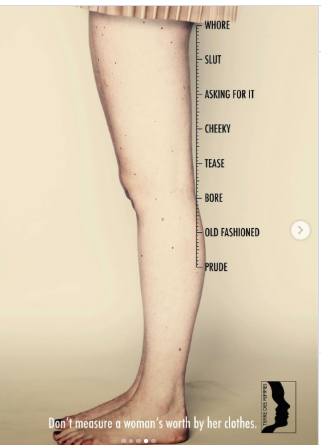
This visual — originally posted by Terre des Femmes in partnership with Miami Ad School — is a powerful tool for gauging just how deeply Manbox conditioning has permeated your team room.
As a coach, you will need to set up anonymity for the individual responses you collect in this session if you want real answers from your guys. A Google Form, Poll Everywhere, or even handwritten responses on equal-sized slips of paper could all work.
There are deeper reflection questions you can ask from this graphic:
What does this visual want you as a man to realize?
What Manbox-inspired ideas is it challenging?
What does it reveal about how women are judged before they even speak?
But I think those questions need to come after a harder one.
Ask them first:
There are 8 “notches” of judgment on this scale. How many of them do you think accurately reflect what a group of male athletes your age would say if they saw that much leg on a girl based on what she wore to school that day?
That’s the question you might be tempted to avoid.
Because if you ask it honestly, you may hear things you do not want to hear.
And not wanting to hear them is exactly why the question matters.
Their responses will reflect not only the work you still have to do — but also what you may have been allowing, intentionally or unintentionally, to grow in your spaces.
That’s the uneasy pain we have to be willing to process as coaches.
Because if we want to combat the symptoms, we have to be willing to face the roots.
Coach Prompts
What question are you most tempted to skip because the answers might indict your culture?
How do you create anonymity without creating distance from accountability?
What might your players’ answers reveal about what has been normalized in your space?
Player Prompts
What assumptions do guys your age make about girls based on clothing?
Why do you think those assumptions feel so normal?
What does this graphic expose about how women are judged?
IS THIS REALITY — OR A STORY YOU’VE BEEN TAUGHT TO BELIEVE?
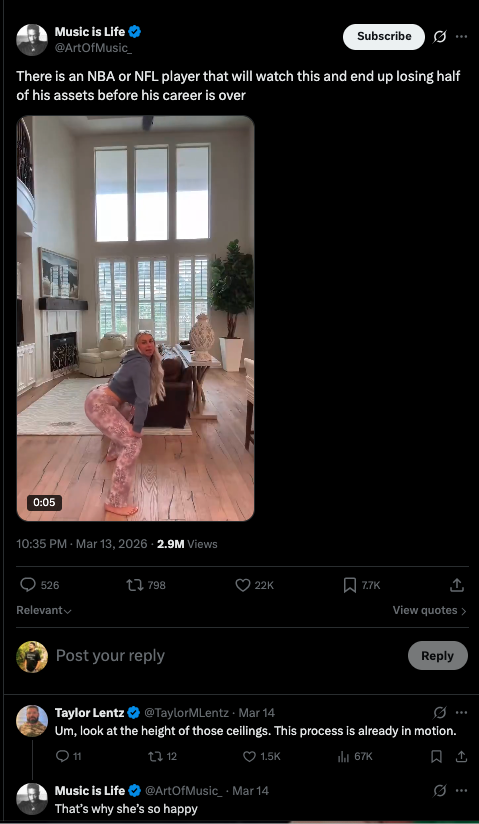
Okay, today’s blog is a nuanced topic and probably requires you, the coach, to either know the maturity level of your group or give a disclaimer that the conversation will include sexual references and innuendo.
The clip above is of an unidentified young woman in a house (we have no idea if it’s hers or not) twerking to the camera for 10 seconds, under a caption claiming that “some NBA or NFL player will lose half his salary to this.”
I purposely included the first two comments because they reveal a type of misogyny and distrust of women that is very prevalent — not just among male athletes, but among the fans of male athletes as well.
The insinuation is clear:
Because she is attractive and can “shake her ass,” she must have already slept her way into that house, funded by some man she manipulated.
That belief system? It’s going to resonate in your team room. Honestly… it’s going to resonate with some of your staff too.
And yes — there are examples of relationships where a woman received significant money after a breakup or divorce with a high-earning athlete. Those examples are easy to find.
But they are not proof that this is the norm. They are not proof that your players should distrust all women. They are not proof that women are taught to deceive and take from men through sex. Those are tropes. And harmful ones.
Women should be allowed to be proud of their bodies.
Just like men are.
Women should be allowed to be sexual beings.
Just like men are.
And both should be held to the standard of a healthy relationship — one built on trust and understanding between the people actually in it.
This is a tough conversation to navigate. Because you are going to get hit with 100 versions of:
“Yeah, but…”
“What about…”
“Isn’t it true that…”
And layered on top of that, our young men have grown up with instant access to sexualized content. So it becomes very easy for them to believe:
“This is the norm.”
“This is what my girlfriend should be doing.”
“This is what I should be chasing.”
I’m not going to pretend that even after 15+ years of doing this work I would execute this conversation perfectly.
That’s not the point. Because this work is rarely black and white. There isn’t always a clean, comfortable line between right and wrong. There is a lot of gray here.
And creating the space for honest dialogue?
That’s just step one.
Coach Prompts
What assumptions did you immediately make watching this clip?
How often do conversations about women default to distrust in your team space?
How do you help players separate examples from norms?
Player Prompts
What did you assume about this woman when you first saw the clip?
Where do those assumptions come from?
Do viral clips show reality, or a version designed to get attention?
If You Won’t Talk About This, Who Will?
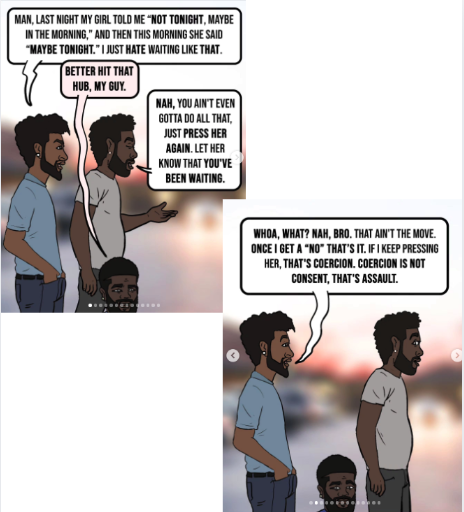
Today’s blog is in reaction to this Instagram post from @real_toons and its framing of long-term relationships and intimacy.
The focus here on COERCION vs CONSENT is so needed for the young men in your program AND for the adult men on your staff as well.
I won’t spoil the whole cartoon, because honestly the post itself is a ready-made slideshow you can swipe, pause, discuss, and swipe again (rinse and repeat) with your program. But in essence it portrays something very real: what happens in committed relationships when one partner is feeling a certain way about sex and the other partner is on the opposite page.
This is going to happen to every single player on your team at some point in life.
Even the suggestions from the friend — including his solution of “just hit the HUB” (a reference to Pornhub) — are rooted in what many of your players would actually hear from a confidant. For a lot of young men, porn is presented as the obvious solution when they’re “horny” or “ready” and their partner isn’t. So the cartoon isn’t unrealistic. If anything, it’s uncomfortably accurate.
Which brings us to the real questions for coaches.
Is the content too real for you?
Is the subject matter off limits in your space?
If YES is the answer to either of those, then we have to ask something uncomfortable:
Can you really claim your program is preparing young men for life?
Do you really have the kind of genuine relationships with your players that we as coaches say we want?
If NO, and you agree these conversations matter, then the next question becomes:
What’s stopping you? Parent concerns. Administrative hesitation.Your own confidence in leading conversations like this. Those barriers are real.
And they are exactly why TeamsOfMen exists.
Let’s talk.
Coach Prompts
Have you ever discussed coercion vs consent with your players?
What messages about sex and relationships do players get from their peers?
Where are young men learning how to handle sexual rejection?
Player Prompts
What is the difference between consent and coercion?
Why do some people keep asking after someone has already said “no”?
Where do guys get their expectations about sex and relationships?
A 15-Year-Old Girl Just Showed You The Opponent’s Playbook
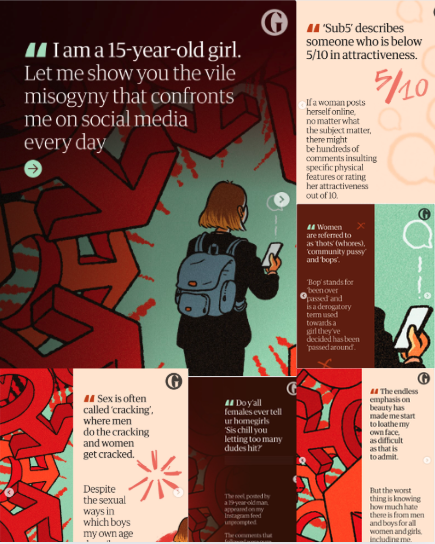
Today’s blog is in response to this series of images from a Guardian Instagram post.
Why should coaches of male athletes care enough to read them AND be moved enough to bring them up in their team spaces?
First, because it gives you an interpretation of the words I KNOW we hear our guys use. They most likely don’t say these things directly to you, but don’t fool yourself — if you walk by your team room and they don’t know you’re there, you will hear one if not more of these.
Second, because it is a direct plea from a young woman who is impacted by the world our players’ words and actions are shaping.
Ignoring this would be like ignoring your opponent leaving their playbook and calls on your bench before the game.
“Here, Coach — you want to know what all our calls and hand signals mean? Oh, and by the way, you can also find in this binder the ways we think we can break down your defense and win the game.”
You would absolutely use that folder of information.
This is a far more important folder.
For a far more important game.
Coach Prompts
What language do you think your players use when coaches aren’t around?
Have you ever created space for girls’ perspectives to enter your team discussions?
If a young woman told your team this directly, how would they respond?
Player Prompts
Have you heard language like this from other guys online or in person?
Why do guys say things around their friends they wouldn’t say in front of women?
What impact do you think these words have on girls your age?
Honesty Isn’t The Same As Humiliation
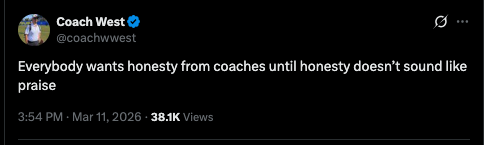
Today’s TeamsOfMen blog is in response to this post.
I’ll be honest — part of me really resonates with it.
And another part of me wants to point to it and say, THIS false binary framing is exactly why coaching is in dire need of reform.
First, where I agree.
There is a real truth here: when you deliver criticism to a player — whether it’s about something they did on the court or something they did away from it — you are putting the harmony of your relationship at risk.
Often times we as coaches are the only adults in a young person’s life who will tell them they are falling short somewhere.
That’s hard.
And it often comes with tension for a while after those hard truths are delivered.
But here’s where I think we as coaches sometimes hide behind this idea.
We lean on the old script of: “I say what I say and if it hurts your feelings, so be it.”
And that’s not coaching honesty. That’s laziness. You can build relationships that can handle calls for growth.
But that requires intentionality.
You can deliver critique without f-bombs. Without personal attacks. Without humiliation.
At the same time, you can also build your players’ resilience so they can hear hard truths without collapsing or shutting down.
Both things can be true. But they require practice. They require reps. They require time.
And maybe that’s the real shift coaching needs to make.
Maybe you don’t need that extra 20 minutes of film today. Maybe you use that time to start building the type of team culture where players understand:
“We love each other enough to tell the truth here.” And because we claim that… we have to practice it.
Coach Prompts
How do you currently deliver hard truths to players?
Do your players trust that criticism is coming from care?
What structures exist in your program to practice receiving feedback?
Player Prompts
What’s the difference between honesty and disrespect?
When someone critiques you, how do you usually react?
What helps you trust that criticism is meant to help you grow?
A Day Devoted To Reimagining Manhood
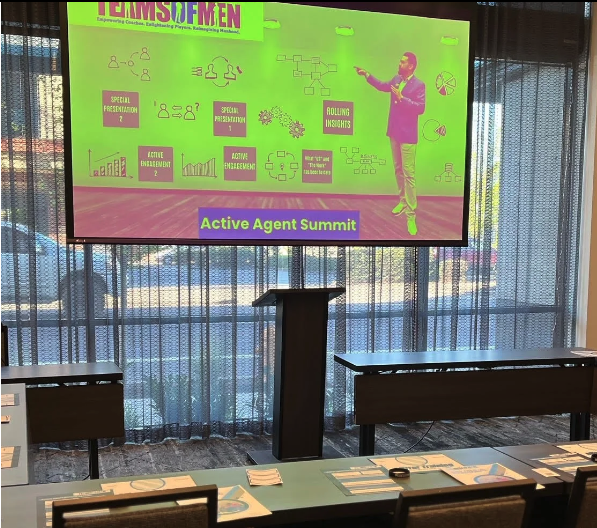
Today’s blog is a plug for our upcoming 3rd Annual TeamsOfMen Active Agent Summit on April 18th here in Salem, Oregon.
https://www.teamsofmenmembership.group/t-shirts-bundles/p/3rdactiveagent
When we execute this event the way it’s meant to be executed, it is NOT a “sit quietly, take notes, and scroll your phone” lecture series.
It’s something very different.
It’s coaches in tears.
It’s coaches sharing the most challenging, the most powerful, and the most effective ways they’ve tried to create space in their programs for young men to grow as human beings.
It’s a room full of people — some veterans of this work, some first-year coaches completely overwhelmed by the concept — spending an entire day sculpting what it actually looks like to devote real calendar time for male athletes to reimagine manhood in the 21st century.
Yes, people stand in front of the room and share ideas.
But that’s only part of it.
You’ll also work with your staff and other coaches on actual plans for your team, your players, and your unique environment.
Yes, there’s food. Yes, there’s a coach social afterward. But what this Summit has that your average clinic doesn’t have is time and space to figure out what YOU want to do with YOUR guys.
Not someday. Not after the season. Right there in the room.
The goal is simple: You leave with a plan. Not inspiration. A plan.
Coach Prompts
When do your players actually have time scheduled to talk about life?
What intentional space exists in your program for young men to grow as humans?
What conversations are you avoiding because you don’t have a structure for them?
Where Coaches Export Their Stress
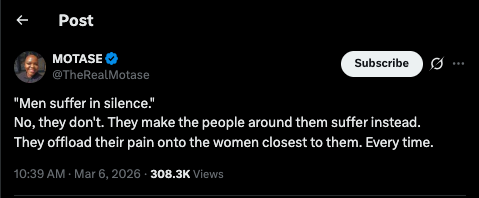
Today’s blog is a reaction to this post, which I find ideal for the work we do with TeamsOfMen.
Why? Because of how often we as coaches tell our players to “leave your shit at the door” before practice. “Focus. Lock in. Don’t bring the day’s distractions into the gym.”
And yet, if we’re honest, we as coaches are often just as ill-equipped — and sometimes completely unable — to unload the stress we carry from the rest of our lives.
When that happens, it shows up.
It leaks out. It bleeds all over our players and our staff during practice. They witness it. They absorb it.
And they are expected to simply deal with it.
Meanwhile, the modeling they’re receiving is emotional dysregulation: pressure builds, emotions get stuffed down, and eventually they explode onto whoever happens to be closest.
Then those same players go out into their own lives and repeat the pattern.
And very often, as the post suggests, the people who receive that overflow are the women closest to them — the partners, sisters, friends, and family members they claim to love.
There is only so much “grit your teeth” and “stuff it down” a person can do before it bursts out of their soul in words or actions that harm others.
The answer isn’t pretending we don’t feel stress.
The answer is learning how to process it.
As coaches, that means seeking out pathways and tools that allow us to regulate our emotions instead of exporting them onto the people around us.
And when we do that work ourselves, we leave breadcrumbs.
Breadcrumbs our players can follow. Because they’re already watching how we handle our lives. The question is whether we’re showing them suppression…or growth.
Coach Prompts
What stress are you carrying into your practices without realizing it?
Do your players see you regulate emotions — or explode them?
What tools do you personally use to process stress before it spills into your team environment?
Player Prompts
What does it look like when someone brings their stress into the room?
How do you usually deal with anger or frustration?
Have you ever taken your bad day out on someone else?
Beyond the Good Guy Narrative
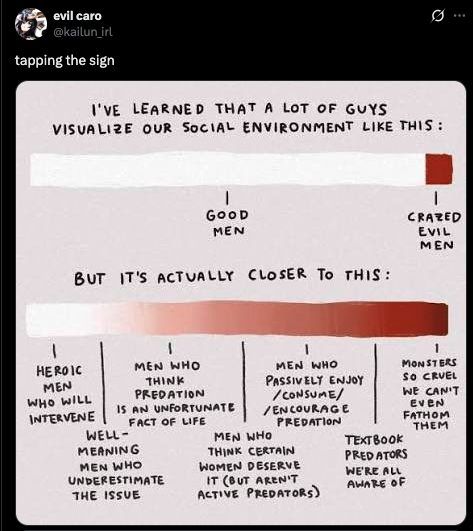
Today’s blog is less a declaration about this graphic and more a suggestion list of ways you could grapple with it in your team room.
Because I know exactly what 15-year-old me, 20-year-old me, and even 30-year-old me would have thought when looking at the ratio the graphic suggests.
I would have leaned HEAVILY toward the first version.
The clean, simple binary: good men vs evil men.
Most of us want to believe the world is that simple.
But over a decade into this journey of reimagining manhood and escaping the Manbox through the work of TeamsOfMen, I now feel the power of the lower chart much more strongly.
The nuance. The uncomfortable middle ground. The idea that harm is often sustained not just by “monsters,” but by people who minimize it, excuse it, or passively allow it.
So here’s the exercise.
Start with your staff.
Ask them: What would your ratio actually be?
What percentage of men fall into each category?
Where would the debate start?
Where would the tension show up?
Then ask the same question of your players.
What percentages would they assign?
Would they even feel equipped to break the scale into multiple categories?
Or are they still operating inside the false binary most of us were raised with — the Hollywood paradigm of heroes vs villains?
Because if that’s the framework, then most young men will automatically place themselves in the “good guy” category and stop examining their role.
A simple entry point might look like this (Start with something familiar:
Write on the board:
Good Player vs Bad Player
Then ask them to break that apart. What other descriptions exist between those two extremes?Selfish teammate. Lazy defender. Great scorer but poor communicator. Leader in practice but disappears in games.
Let them build the middle.
Then introduce the graphic. And repeat the exercise. Because escaping the Manbox requires more than just condemning “bad men.” It requires understanding the full spectrum of behaviors that allow harm to continue.
Coach Prompts
How do you currently talk about harm among men — as a binary or a spectrum?
Where do most men instinctively place themselves on this chart?
What behaviors fall into the “passive encouragement” category in sports culture?
Player Prompts
Why do most people believe the world is just “good guys vs bad guys”?
Where do people fall when they stay silent about harmful behavior?
Can someone see themselves as a good person while still contributing to harm?
The Headlines Start Somewhere
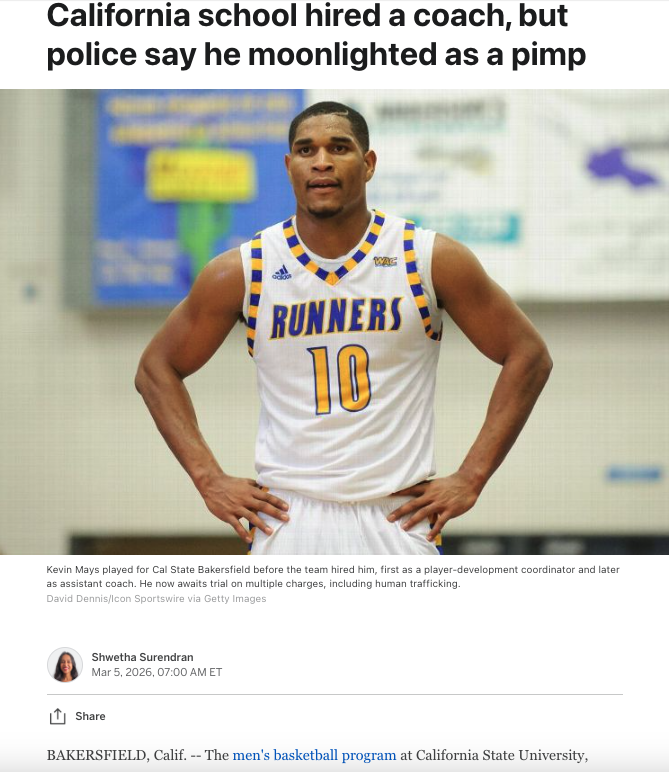
Today’s blog is less a deep dive into this scandal — revealed by ESPN about the men’s basketball program at Cal State Bakersfield and an assistant coach allegedly trafficking women while working for the program — and more a plea to coaches who may still look at TeamsOfMen work with a side eye.
You know the line.
“Kip, this stuff you talk about… it’s not in our school, our university, our team room. We’ve got good guys.”
Yes.
You probably do have good guys.
And yet…
The belief systems that lead men to make horrible choices that harm others are still bubbling around your spaces.
Hopefully your young men — and your staff — have not acted on those outdated scripts the Manbox presents as “rules” of masculinity. But the scripts themselves are everywhere. They are cultural. They are persistent. And they are constantly being reinforced.
That’s why TeamsOfMen conversations exist.
Not because we assume the worst about the men in our rooms — but because we understand the forces that are shaping them.
By creating space for these conversations, you’re not accusing your players of future harm. You’re giving them tools to challenge ideas before those ideas turn into actions.
Because once the headline exists, the learning window has already closed.
The goal is to redirect our guys before the story becomes about our program.
The truth is the Manbox has tried to wire all of us to these ideas.
All of us.
Which means all of us — coaches included — have unlearning and critical thinking to do.
Coach Prompts
When you say “we’ve got good guys,” what exactly do you mean?
What conversations are happening in your program about power, sex, and respect?
Are you addressing harmful scripts — or assuming your players are immune to them?
Player Prompts
Where do men learn ideas about sex, power, and status?
What messages do athletes receive about women and success?
What responsibility do men have to challenge harmful behavior among other men?
Character Isn’t Measured In 40 Times
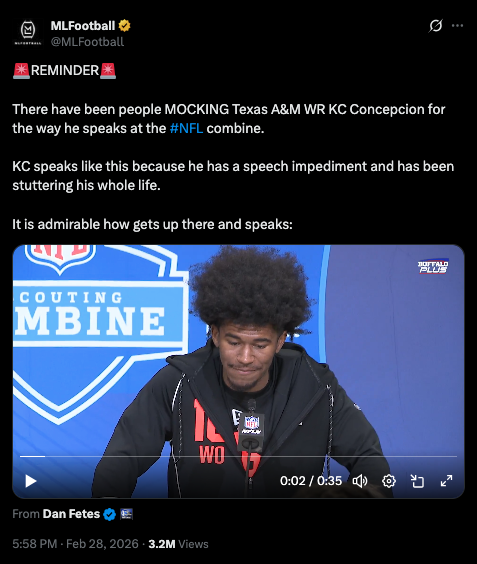
Today’s blog is about this post regarding Texas A&M WR KC Concepcion.
I’m fully aware that the mocking of him could be somewhat of a strawman — meaning the actual number of people cruel enough to post something heartless might be small, and my algorithm could simply be feeding me outrage bait.
But I’m writing about it anyway.
Because this one is personal.
I spent much of my formative years battling my own stutter. I had a regular speech therapist in elementary school. I was terrified of public speaking well into my twenties because there were certain sounds I literally could not get out of my mouth. Even today — 25+ years into coaching, educating, and speaking for a living — I still have moments where a word simply won’t leave without a fight.
So yes, I empathize with KC. And yes, I’m grateful to see the volume of people defending him.
But here’s why this matters for TeamsOfMen.
Cruelty vs. compassion is a choice.
And that choice will stare our players down individually — but even more powerfully when they’re sitting shoulder to shoulder in a team room.
Someone in a large group of young men WILL make fun of KC. Or of another kid who stutters. Or of someone who walks differently. Or reads slowly. Or struggles to get words out.
It will happen.
And in that moment, the group will have three options:
Co-sign it with laughter.
Encourage it with awkward silence.
Interrupt it in front of everyone.
That moment is a far greater test of character than finishing a conditioning test ever will be.
So I’ll ask you:
What steps are you taking — especially compared to the hours you spend designing workouts and practice plans — to prepare your guys to live up to their best selves in THAT moment?
Because we plan every rep in the weight room.
But do we plan for the rep when someone is being mocked for something they can’t control?
COACH PROMPTS
What happens in our locker room when someone imitates a stutter?
Do our leaders know how to interrupt mockery in real time?
Do we rehearse responses to disrespect the same way we rehearse press break?
If a player on our team had a speech impediment, would he feel safe in our room?
PLAYER PROMPTS
If someone in this room made fun of KC’s stutter, what would you do?
Is laughing the same as agreeing?
What’s harder — finishing a conditioning test or stopping your friend mid-joke?
What Happens When It’s One Of Us?
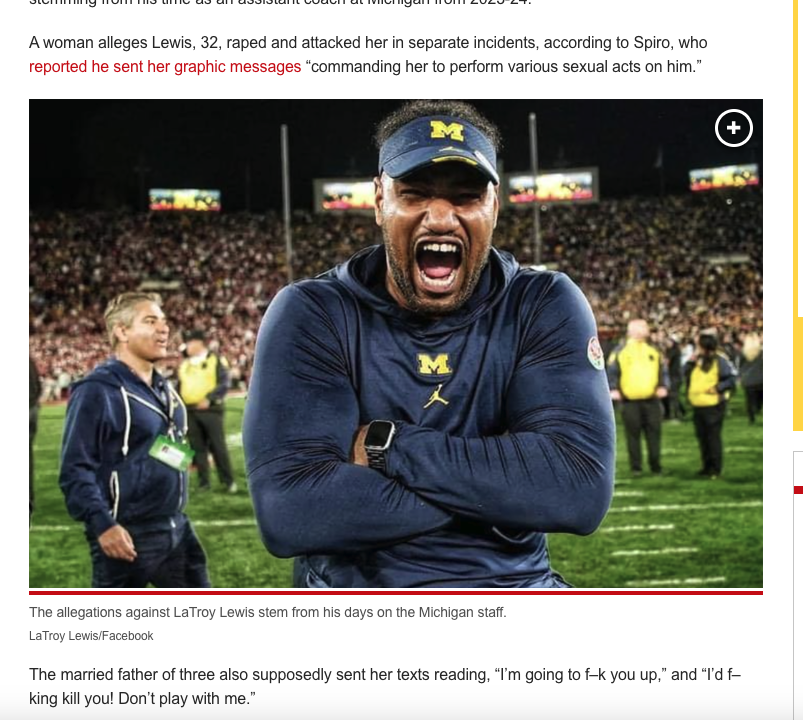
TeamsOfMen was birthed from my personal realization that sexual assault, harassment, and violence against women by men was something I COULD combat in my team room.
I COULD educate young men not just about consent and healthy relationship skills, but about the scripts the Manbox was asking them to perform — and how those scripts are part and parcel to the acts of harm men commit.
This latest sexual assault allegation (and yes, we must use that word legally — alleged — while also acknowledging that false allegations statistically account for a very small percentage of cases) against former University of Michigan and current Atlanta Falcons coach LaTroy Lewis is another validation of WHY this work is needed.
But it’s also something else. It’s a reminder that coaches of male athletes are not just facilitators of the work.
WE are the work.
We love the clichés about building character and pushing young men to be their best selves. But what about us? What about the adults in the meeting room? Are we living the principles we print on shirts and hang on banners — or are those just performances?

Look at the second image above — Lewis’ attorney stating:
“Allegations of sexual misconduct are not proof of sexual misconduct.”
That statement is legally correct. But it is also not proof of a lie.
How would your staff respond to that line?
What would happen inside your program IF — not hypothetically, but realistically — a player or staff member were accused of something this serious? What process would activate? Or would you default to damage control, loyalty reflexes, and defensiveness?
The Falcons, like so many franchises and universities before them, released statements about conducting a “thorough vetting” and promising an “investigation.”
Let’s be honest.
Do we really believe there’s an army of neutral, independent professionals digging into every hire? Or is it more likely a handful of phone calls to familiar networks and comfortable references?
This isn’t about presuming guilt. It’s about auditing preparedness. It’s about asking whether our programs are structurally aligned with the values we claim to hold. Because when allegations surface, that is not the moment to invent your ethics.
That is the moment your existing ethics are exposed.
COACH PROMPTS
What would our program actually do if a staff member were accused tomorrow?
Do we have a process — or just loyalty?
Are we prepared to protect victims with the same energy we protect reputations?
PLAYER PROMPTS
If someone on this team were accused of something serious, what should happen?
What’s the difference between “supporting your teammate” and ignoring harm?
Do you believe false allegations are common? Why?
If This Claim Makes You Angry, Ask Why
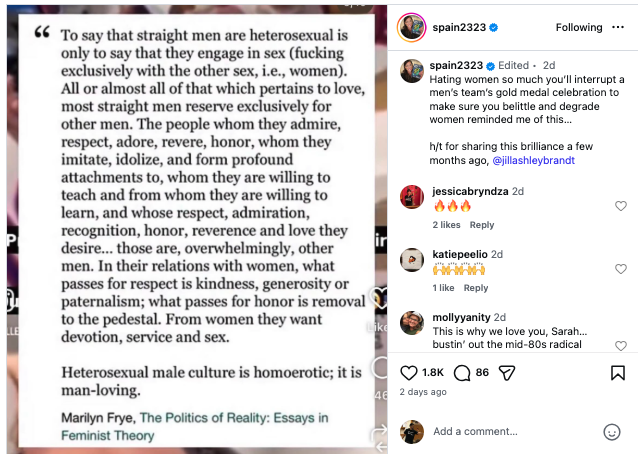
Today’s blog is a reaction to reading a quote from Marilyn Frye (shared recently by award-winning journalist Sara Spain).
Let’s be honest: in 2026 it is highly unlikely your players — or you — are going to sit down and read that entire passage. You should. But you probably won’t. So here’s the distilled conversation starter:
Which gender do supposedly heterosexual men reserve their actual LOVE for?
Because Frye’s argument is that it’s other men. Now ask that question in a team room. And then sit back.
Watch.
Listen.
Observe.
You’ll likely see panic. You’ll likely feel anger. You’ll likely hear immediate defensiveness.
Why?
One, because the manbox has trained them that any association with “love for men” automatically equals “gay” — and that being perceived as gay is a threat.
Two, because expressing love for men is framed as weakness. Emotional exposure inside male circles is status suicide.
Three — and this is the part that hits hardest — because there is truth embedded in the claim.
Who do most straight men admire?
Whose approval do they chase?
Whose respect do they crave?
Whose admiration, honor, and validation do they obsess over?
Overwhelmingly, other men.
From women, many men seek affection, sex, devotion, service, and affirmation. From men, they seek status. That’s harsh.
Good.
Because harsh invites examination. If you feel the temperature rise reading that, that’s the work. The point isn’t to shame heterosexual men. The point is to ask:
What does your love look like?
Who do you emotionally invest in?
Who do you allow yourself to admire out loud?
Who do you allow yourself to care about without caveat?
If Frye’s framing feels wrong, then prove it wrong.
Move differently. Speak differently. Love differently. Because if the only safe version of love for men is competition, hierarchy, or silent loyalty — then the manbox is still running the room.
Coach Prompts
How comfortable are you expressing admiration for another man without couching it in humor?
Where do you see status-seeking overriding intimacy in your team culture?
What conversations have you created around male friendship and emotional expression?
Player Prompts
Who do you admire most — and why?
When was the last time you told another guy you respected or loved him?
Why does saying “I love you, bro” sometimes feel risky?
The Language We Normalize Is the Behavior We Create
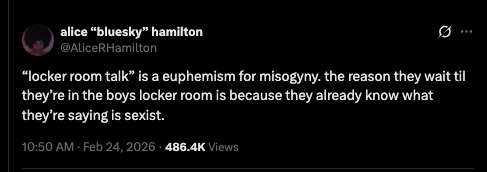
This post relates directly to the ongoing controversy surrounding the aftermath of the USA Men’s Hockey Team winning gold — a few days after the women’s team did the same — and the now-viral celebration phone call with President Trump. During that exchange, the women’s team was disparaged, and members of the men’s team were seen laughing along.
You can probably guess where we at TeamsOfMen land on that moment.
But our reaction — and the algorithmic echo chamber we all live in — is less important than what you and your team room do with it.
Because the real entry point here isn’t politics. It’s language. Specifically: the excuse of “locker room talk.” We have all heard it. Some of us have used it.
“Well, that’s just locker room talk.”
“It’s just boys being boys.”
“It’s not that serious.”
But here’s the uncomfortable truth: “locker room talk” has often functioned as a euphemism. A shield. A way to normalize misogyny, dehumanization, and entitlement in spaces we claim are protected. And the phrase “what’s said in here stays in here” doesn’t actually protect our players. It protects harmful behavior.
It allows young men to rehearse language that desensitizes them to the humanity of others. And language always precedes action. What we normalize verbally becomes easier to enact behaviorally.
We cannot let the manbox normalize the idea that accountability stops at the locker room door.
If something is wrong outside the locker room, it’s wrong inside it too.
This moment — and the viral post calling “locker room talk” what it really is — gives us an opportunity to ask ourselves:
Where have we excused language because it felt culturally acceptable?
Where have we allowed harm to be disguised as humor?
Where have we confused bonding with belittling?
If we’re serious about building men of character, then the locker room cannot be a sanctuary for misogyny.
It has to be a laboratory for respect.
Coach Prompts
Have you ever dismissed something as “locker room talk” instead of addressing it?
What language is normalized in your program that wouldn’t be acceptable in front of parents or administrators?
What does “what’s said in here stays in here” actually protect?
Player Prompts
Why do people say certain things only in the locker room?
Have you ever laughed at something you wouldn’t say publicly?
What’s the difference between joking and disrespect?
Costume vs. Character
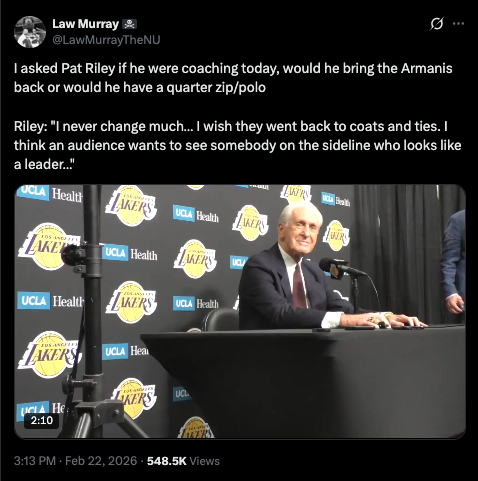
Today’s blog is in response to a recent Q&A with legendary NBA coach (and Heat GM) Pat Riley, where he was asked whether, if coaching today, he would bring the Armani suits back to the sideline or opt for the now common quarter-zip/polo look.
Full disclosure: I grew up on Pat Riley and the Showtime Lakers. They were one of my first FAVORITE teams. I respect a lot of what Riley has always been known for — grit, resilience, discipline, and a no-nonsense approach to accountability on the court.
I also understand the context here.
He was answering this question in advance of a ceremony where the Lakers are honoring him with a statue — literally sculpted in his famous suit. Of course he’s going to lean into that identity.
But his line about audiences wanting to “see somebody on the sideline who looks like a leader” is a great TeamsOfMen self-reflection moment for coaches today.
Because that statement is bathed in old scripts.
It assumes leadership is something you look like first, and something you are second. And there’s also an unrecognized privilege baked into that framing.
Pat Riley’s Armani suits were iconic — and expensive. But let’s be real: all suits are expensive. Leadership cannot be dependent upon your salary. If the visual marker of authority requires access to wealth, then we are defining leadership in a way that excludes a lot of people from the jump.
I don’t think my players suddenly pay more attention to me the one time a year I wear a suit on the sideline. And I don’t think it ever made sense for us as coaches to sweat through a hot gym or arena for two hours just to perform a version of authority. In 2026, we have plenty of options that are comfortable, professional, and representative of our team and school.
Think about it.
A suit screams “me.”
Sideline gear in your school colors — with your mascot, your logo, your identity — screams “us.”
There’s nothing wrong with loving a great suit. I do. But there is a manbox layer to assuming the suit gives you power. Authority that relies on costume is fragile. Leadership that relies on character isn’t.
Coach Prompts
What signals of “authority” do you rely on that aren’t actually tied to your behavior?
Do your players respect your wardrobe — or your consistency?
Where might image be masking insecurity in leadership?
How do you define leadership in your program: visually, verbally, or behaviorally?
Player Prompts
What makes someone look like a leader to you?
Has someone ever looked the part but failed to lead well?
What behaviors earn your respect more than appearance?
If leadership isn’t about clothes, what is it about?
What A.J. Brown Just Said Out Loud
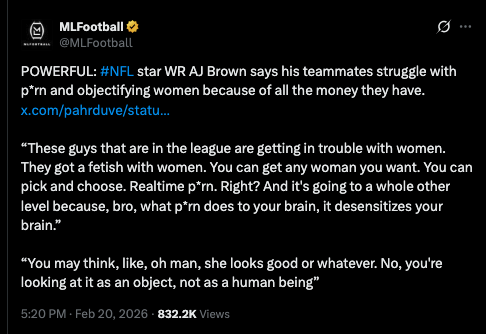
Today’s blog is inspired by a recent interview with Eagles WR A.J. Brown, where he openly discussed his belief that many athletes — especially those with money and fame — are addicted to pornography. He argues that when that addiction mixes with status and access, it fuels objectification of women and unhealthy intimate relationships.
This is the type of honesty we at TeamsOfMen wish more famous athletes would model.
Brown is pulling back the curtain on two overlapping manbox scripts:
If I score and succeed in my sport, that automatically earns me access to women’s bodies.
Pornography is normal, harmless, and just “what guys do.”
Your players — if they’re being honest — will admit (or at least privately recognize) that they’ve been trained to equate athletic success with sexual conquest. It’s embedded in locker room jokes. In music. In highlight culture. In group chats. In the silent metrics young men keep in their own heads.
Success = more attention.
More attention = more sex.
More sex = more status.
That equation gets internalized early.
Brown also names something we rarely discuss openly: porn. Not as a punchline. Not as a moral panic. But as a neurological and relational issue.
If what he’s saying is even partially true, then we can’t ignore it.
Our guys are watching it.
Our staff is watching it.
We are probably watching it.
And pretending this conversation doesn’t belong in the “life skills” category is negligence. Porn trains the brain to disconnect arousal from relationship. It trains repetition without intimacy. It trains consumption without consequence. And when that gets layered on top of fame, money, and access — the objectification can accelerate.
This is not about shame. This is about awareness.
If you are serious about building emotionally fluent, respectful young men, you cannot skip the topic of pornography. It is one of the largest unspoken influences shaping their expectations about sex, women, and relationships.
There are resources available. Organizations like Fight the New Drug provide research-based education on how pornography affects the brain and relationships. Whether you agree with every angle or not, it gives you starting points — language, science, conversation scripts — to engage your team and your own family.
We don’t get to claim we’re developing men while ignoring one of the most powerful shaping forces in their lives.
Brown did his part by naming it.
The question is whether we will.
Coach Prompts
Where are your players learning their expectations about sex and relationships?
Have you created any structured space to discuss pornography and its impact?
Do your players see women as partners… or rewards?
Player Prompts
Where did you first learn what sex and relationships were supposed to look like?
Do you think pornography shapes expectations about women? How?
What would it look like to define success differently?
Interrupting Violence Without Becoming It
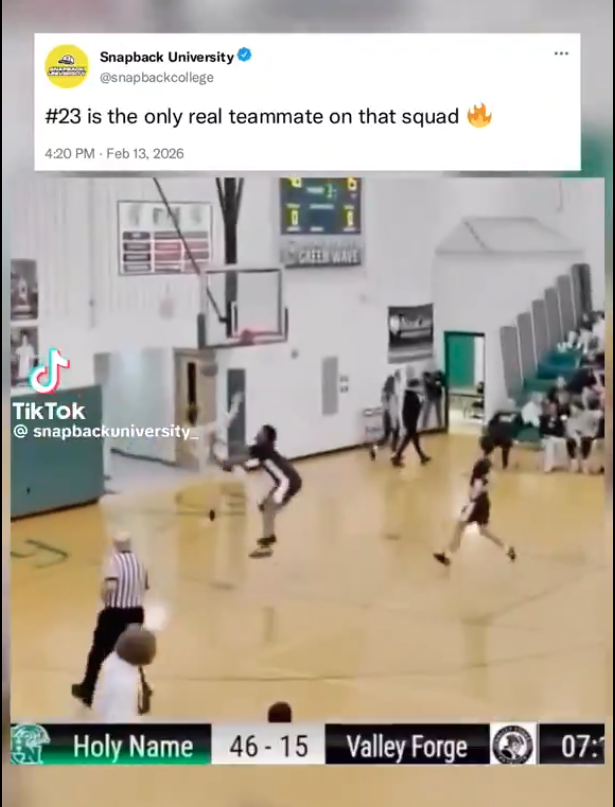
Today’s blog is in response to this boys HS basketball game that ended in a melee after a player brutally fouled an opponent on a fastbreak — and that player’s teammate came sprinting from the other end of the court and shoved the fouler to the ground himself.
The caption on the screen grab gives coaches an immediate entry point into discussion with their guys:
“The only real teammate.”
“Now THAT’S a teammate.”
These are the taglines being used to describe the retaliatory shove. And that’s where this becomes less about that game — and more about ours. Because this is a reflection moment for us as coaches.
What in our program would PREVENT the first ridiculous foul from happening in the first place?
What in our program would regulate the response from others IF our player was the one hammered like that?
SHOULD we even be regulating that response? Or do we quietly cosign it because of how hard the foul was? What have we explicitly talked about with our staff and players regarding leaving the bench, running onto the court, or inserting themselves physically into out-of-control situations?
All of these are worth discussion. And I’ll be honest — I struggle with the answers too.
Because that foul is BULLS***.
And there is a very real part of me that would want my guys standing up for their teammate. But could we rep that response to be verbal instead of physical — so they protect their teammate without triggering the automatic double-penalty and escalation? Could we train interruption without escalation?
I don’t know.
And that uncertainty is exactly why it deserves space in the team room.
Because maybe this isn’t even a “manhood” test.
Maybe this is something more universal.
A HUMAN test of loyalty.
A HUMAN test of protection.
A HUMAN test of emotional regulation inside loyalty.
Which is exactly why we can’t leave it unexamined.
Player Prompts
When you saw the shove, did you see loyalty… or loss of control? Why?
How can you protect a teammate without hurting your team?
What does a teammate owe another teammate in moments of injustice?
What response would make you trust a teammate most: retaliation, or restraint?
Protecting Your Space Means Confronting Your Circle
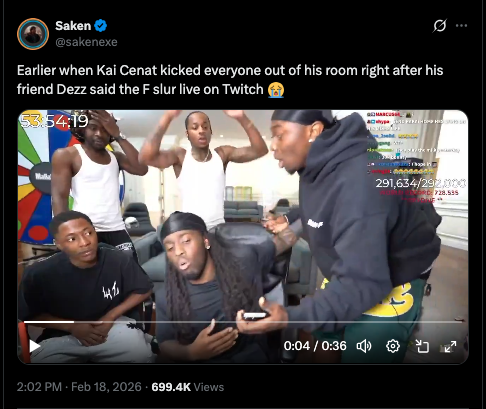
Today’s blog is in response to something we rarely see in real time: an interruption.
Famous streamer Kai Cenat was live with a group of friends when one of them casually dropped a homophobic slur into the room. No hesitation. No “let it slide.” No awkward laugh to smooth it over.
Kai immediately told everyone to get out. Cleared the room. Ended the moment. In his frustration, he also said something that stuck with me:
“Ni***s don’t have no self-awareness.”
(NOTE: There’s a double edge to this. In interrupting the homophobic slur, Kai used the most sinister slur of all time — but with the soft “a” ending that has created controversy in the Black community (and world at large), as many folks believe that version of the word is a familial, reclaimed version taken back from racists, and therefore acceptable in certain contexts.
That in and of itself is a whole other CONVERSATION we as coaches need to be prepared to navigate — especially those of us that aren’t Black — because our players are already navigating it, with or without us.)
Now, in 2026, we should question the authenticity of everything we see on social media. Performance and accountability sometimes wear the same costume. But for the sake of this space, I’m assigning credibility to what we witnessed—because the action itself is the lesson.
He interrupted nonsense language in real time. He protected his space. He enforced a boundary.
And here’s where this matters for us as coaches: your players are in rooms like this every single day. Locker rooms. Group chats. Parties. Team buses. Weight rooms. Spaces where language like this gets normalized through silence.
Not agreement—silence.
Because interruption is uncomfortable. Because interruption risks status. Because interruption risks belonging.
So show them this clip. Ask them plainly:
Would you have done the same thing?
Would you be willing to risk awkwardness, tension, or even friendships to enforce the standards you claim to believe in?
Because protecting your space isn’t just about who you let in.
It’s about what you allow to exist inside it.
And for everyone saying, “Kai only did this to protect his brand”—good. That’s still accountability. That’s still a line being drawn. It may be a low bar. But it’s a bar. Our world is filled with far too many examples of people who won’t audit their space for any reason at all.
Interrupting nonsense—especially when it comes from your own circle—is one of the clearest indicators of growth.
Seeing it is step one.
Interrupting it is evolution.
Coach Prompts
What language gets normalized in your program because no one interrupts it?
How do your players see you handle harmful language—in real time?
Where have you stayed silent because interruption felt uncomfortable?
Player Prompts
Would you interrupt a friend who said something harmful—or stay quiet?
What makes interrupting harder: fear of losing status, friendship, or comfort?
What kind of space do you want to be known for protecting?