

The Day I Fired “The Sniper”
Last week I joined the Hoop Heads Podcast for a conversation about TeamsOfMen, coaching, and the ways our team rooms shape young men far beyond wins and losses.
One of the stories we discussed was incredibly small.
Or at least I thought it was.
Then I realized it wasn't.
Years ago, every time a player tripped over his own feet in practice, I'd yell, "SNIPER!" Everybody laughed. Including me. It was one of those throwaway coaching moments that felt harmless, normal, and honestly pretty funny.
Then one day I caught myself.
Why was violence-infused language so normal that I didn't even hear it anymore?
We weren't talking about actual violence, and we certainly weren't promoting it. But we were swimming in language that treated violence as the default reference point for humor, competition, and everyday interaction. It showed up in phrases, jokes, drills, and coaching shorthand that had become so common we rarely stopped to examine them.
So we made a small change.
Now when a player trips, we yell, "TIMBER!"
The laugh is still there. The joke is still there. The teaching moment is still there. The only thing that changed was the message underneath it.
The point isn't that yelling "sniper" is some catastrophic coaching failure. The point is that language teaches, whether we intend it to or not. Every phrase we normalize carries a lesson. Every repeated expression helps shape how our athletes think about themselves, their teammates, and the world around them.
If language teaches, then every coach has to ask a simple question:
Coach Prompts
What phrase do you use regularly that you've never really examined?
What language has become so normal in sports that you barely hear it anymore?
If your athletes repeated your most common phrases, what would they learn from them?
Player Prompts
What words or phrases get repeated most often on your team?
Which ones build people up?
Which ones might be worth rethinking?
What Women See That Men Don’t
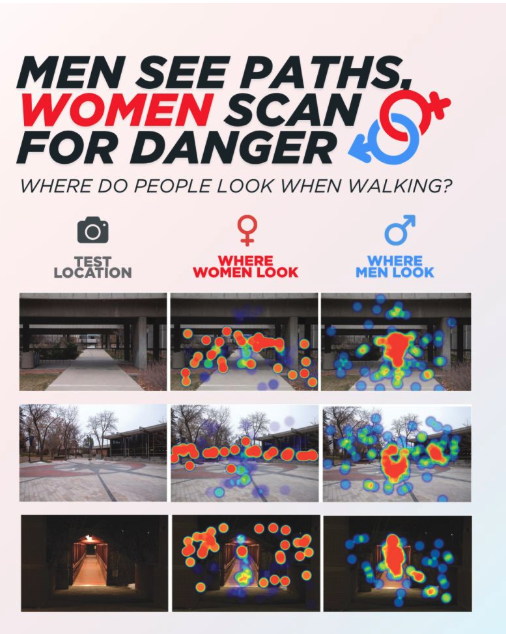
What you’re looking at in the title image here is a study tracking where men and women’s eyes and gaze tended to go while walking through outdoor city environments. Dark red spots represent heavier concentrations of visual attention while blue spots represent less focus. As you can see, the way the two groups move through these spaces is drastically different.
In short, men generally look straight ahead, focused on destination and movement, almost as if the path itself is assumed to be safe. Meanwhile, women scan. They look around, paying particular attention to areas with low light, limited visibility, or difficult escape routes. That’s not coincidental. It’s a reflection of something many women instinctively know from lived experience: the possibility of danger changes how they move through the world.
The study’s conclusion is difficult to ignore: gendered violence shapes how women experience cities, influencing the way they navigate even routine moments like walking to a car, crossing a campus, or heading home at night.
So how is this applicable to your team of male athletes?
First, we talk in almost every sport about the need for clear, accurate, and timely vision. We can’t make decisions on a pass, shot, read, or pitch if our eyes aren’t clear. I think that idea extends well beyond sport. Seeing where you want to go, who you want to become, and how you want to move through life becomes harder when fear, distraction, or self-protection constantly takes up bandwidth.
Second — and this is the harder conversation — women are often scanning these spaces because of MEN.
And before the defensiveness rises up with “I would never” or “not all men,” I’d simply offer this: until women no longer feel the need to move through the world this way, then all men still have work to do.
What are we doing in our spaces to make sure our boys are not becoming part of the problem?
What kind of inner healing, emotional fluency, and accountability are we modeling ourselves so we are less likely to lash out, control, intimidate, or cause harm?
And where, specifically, can we point in our lives that would allow some of these mental hot spots of danger in a woman’s mind to slowly dissipate? Because if the women in our lives are navigating the world with one eye on safety, that should matter deeply to the men we claim we are trying to develop.
Coach Prompts
What conversations are coaches avoiding about the ways women experience public spaces differently?
How do we teach boys accountability without immediately triggering defensiveness?
What behaviors in sports spaces unintentionally reinforce entitlement, intimidation, or control?
Player Prompts
Why do you think women often experience public spaces differently than men?
What role do boys and men have in helping people feel safer?
What would it look like to be the kind of man who lowers fear instead of increasing it?
When Harm Enters The Headlines
I really don’t think continuing to write some version of “Why is this in a blog for coaches today?” is necessarily a strong literary device. But until I find another way to invite coaches into conversations I’ve long believed should be obvious for our profession — and yet somehow remain stuck on the periphery — I suppose I’ll keep asking variations of the question.
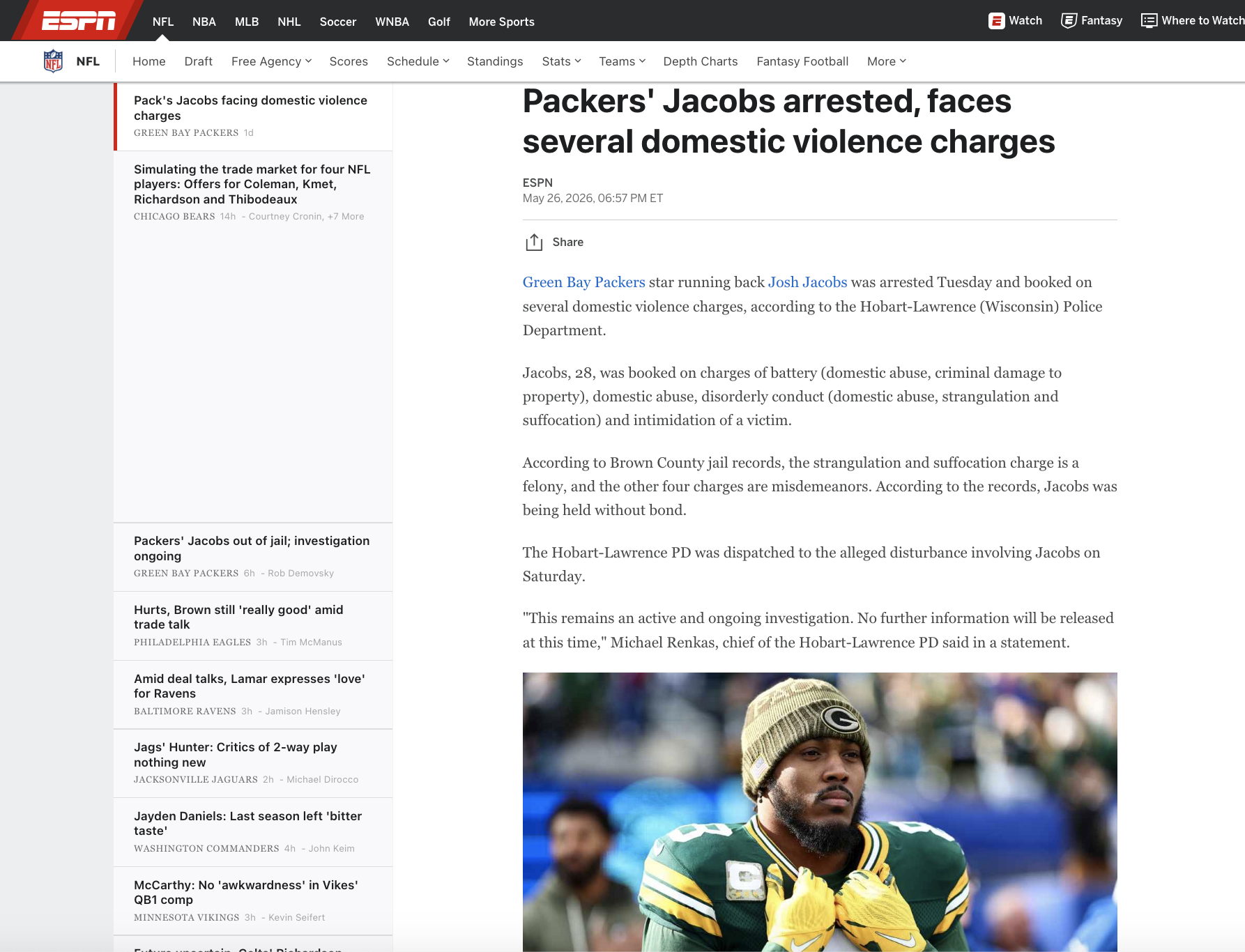
Green Bay Packers RB Josh Jacobs was arrested yesterday and is facing serious domestic violence-related charges, including strangulation and suffocation, tied to what authorities describe as an alleged disturbance involving a partner. The case is ongoing, and Jacobs has denied the allegations through counsel.
And I want to put this, AGAIN, in our space because the script surrounding prominent male athletes in moments like this feels painfully familiar.
Player is accused of violence. Media reports the charges. Team withholds commentary until “the legal process plays out.” And because of that vacuum, so much of the airtime immediately shifts toward defending his character, discussing his value to the team, offering up the usual “everyone deserves a second chance” line, or asking the inevitable question: “When will he be able to play again?”
Meanwhile, the person allegedly harmed starts disappearing from the story. Conversations about the broader patterns of behavior that often precede these moments go dark. And then, if actual consequences emerge for the athlete, we collectively act shocked that accountability showed up at all (and God forbid his team not have him for an OTA practice this week).
It’s DARVO. It’s JADE. And it’s rinse repeat.
I will do a full Tom Cruise-on-Oprah’s-couch celebration the first time one of these incidents is met by a panel of violence prevention experts, healthy relationship educators, or even ONE AMERICAN MALE COACH willing to say:
“We need to take a look in our team room and figure out why we are always apologizing for our lack of emotional fluency and the fallout harm that comes from those crash outs.”
It probably won’t happen on ESPN.
So here’s to hoping you have the willingness and bandwidth to do it in your team room today.
Because if you are the “leader of men” and “shaper of culture” your bio claims, then it should absolutely fall inside your wheelhouse to talk with the men in your room about how to handle themselves around partners, around children, and around people with less power — figuratively and literally — than them.
Otherwise, adjust your bio.
The White Lies Night Problem
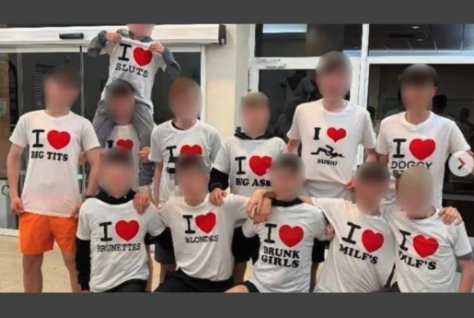
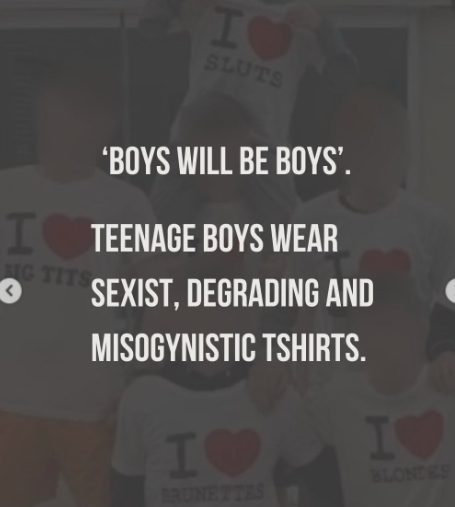
Today’s blog is a co-sign and framing of a post on Instagram by @responsive_parenting concerning shirts teenage boys wore to a school function. I picked this one today because it struck a nerve about something I’ve seen far too often since entering the high school coaching space almost three years ago: “White Lies” themed T-shirt nights at sporting events.
If you haven’t experienced one of these before, in essence it encourages anyone attending a specific team’s game (including players themselves warming up on the court of play) to wear a plain white T-shirt with Sharpie-written “lies” about themselves. Why is this an issue? Because more often than not, teenagers decide the messaging on their shirts should move past a lighthearted fib like “I love homework” and all the way into manosphere-laced misogyny, sexual objectification, and degrading humor (see the shirts in the screenshots above).
These terrible shirts are paraded around a gym as funny, when really they become excuses to do exactly what the original post is calling out.
Why does this matter for TeamsOfMen and for coaches of male athletes?
Because moments like this are opportunities to interrupt nonsense, model what you allow in your spaces, and evaluate just how deeply the manosphere, pornography, and misogynistic humor have already rooted themselves in the minds of young men.
To begin with, you as the coach absolutely have the right to say, “No, we’re not doing a White Lies night at our game.” Like, it really can be that simple. “No. We don’t want it.” And if your players push back with, “Well, no one will come then,” you can either double down with, “Then we better do a better job of playing a style that attracts people without the bullshit,” or pivot toward, “Then let’s make a free team shirt the giveaway instead.” Either one works because both shift the emphasis back where it belongs: on your players earning an audience rather than becoming the side attraction to a harmful T-shirt runway show.
Now, if you’re at an event like this that you can’t control, then you and your staff need to start paying attention. Write down what you see on the shirts. Then sit together afterward and ask yourselves: “How would he gain access to this language?” “Why do they think that’s funny instead of insulting?” and “Why does hiding behind ‘it’s just a joke’ suddenly make harmful messaging feel acceptable in public?”
Once you have your list and have done a real debrief as a staff, go to administration and say, “Look at what the environment the other night was infused with. We need to address this.”
And then see what happens.
(Oh, and if you’re really interested in changing the vibe… CALL US.)
Coach Prompts
What school traditions are quietly normalizing misogyny or harmful humor without adults challenging it?
If your players wore their online influences on a shirt, what would you learn?
What message does silence from adults send in moments like this?
Player Prompts
Why do people sometimes laugh at things they would never say seriously out loud?
When does “just joking” stop being harmless?
What kind of environment do you actually want your games and school events to feel like?
When Life Bursts Into The Locker Room
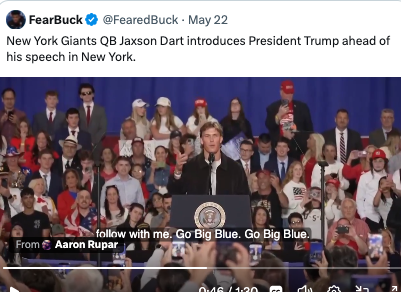
Over the weekend, NY Giants QB Jaxon Dart garnered national attention for his introduction of President Trump. That act alone was making the rounds on social platforms, but went truly viral when teammate Abdul Carter responded in disbelief and shock to Dart’s actions with his own post below
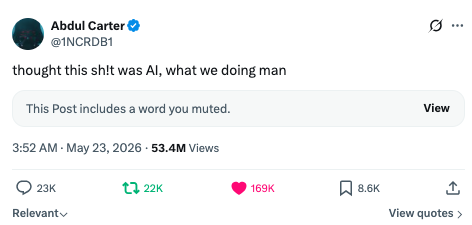
Why is this in a blog for coaches trying to help male athletes toward a better, healthier masculinity?
Because so many of the comments following this exchange rushed to “protect” our team rooms from “politics.” Some even went so far as to argue that the only way to operate a sports program is through locker room “neutrality.”
I’m here to challenge that stance.
I’m here to lament the fact that in the year of our existence, 2026, we still have people pretending “politics” doesn’t touch every aspect of a coach’s or player’s life.
From the quality of the water your athletes hydrate with, to the funding available for your program, to the laws governing every state you travel to for competition, politics has already shaped those realities whether we acknowledge it or not.
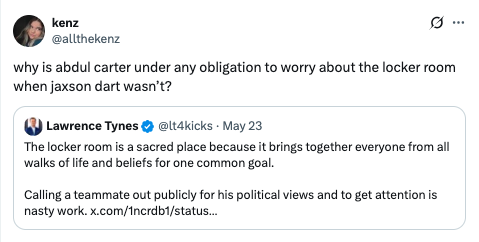
Pretending this incident — where a white quarterback who has, at best, leaned heavily into Black culture (and at worst appropriated parts of it as a persona) introduced a convicted felon found liable for sexual abuse and widely criticized for racist rhetoric — would NOT stir something up for Black and brown players in your team room feels like willful ignorance.
Brushing it aside feels like full ostrich mode as a coach.
Head in the sand.
“Please guys, don’t make coaching harder than it needs to be.”
But it is hard.
Because your players are human beings experiencing the world exactly as it is, not as we wish it to be. And the world they experience follows them into the locker room.
Sure, you don’t hand out playing time based on voting choices.
But coaches have to be willing to create space for players from different backgrounds — race, religion, socioeconomic status, lived experience — to express what they see as non-negotiables in their relationships with teammates and coaches. If I’m in a Black or brown body and someone publicly aligns themselves with rhetoric or people I experience as hostile to my humanity, I’m probably going to feel a certain way about it.
Ignoring that feeling doesn’t make it disappear.
Coaches can’t claim “sports teaches life” and then, the moment life delivers discomfort into sports, suddenly pretend the two aren’t tied together.
Life is messy.
Life is disagreement.
Life is struggle.
And sports only become a meaningful mirror if we are willing to let them reflect the hard things too. If players emerge from difficult conversations still able to compete together, trust each other, and move forward, great. But it can’t be because we demanded everyone pretend they don’t believe what they believe.
Coach Prompts
What topics get labeled “too political” in your team space and who benefits from avoiding them?
What does healthy disagreement look like in a locker room full of different lived experiences?
Are you creating real space for players to process difficult moments or simply asking them to move on?
Player Prompts
Have you ever felt like something happening in the world followed you into sports?
What makes it hard for people with different beliefs to actually talk to one another?
Can teammates disagree deeply and still trust one another? What would that take?
Your Guys Are Really Close…But Are They Brave?
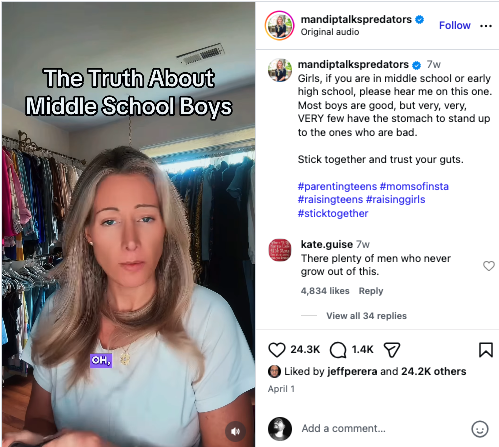
A couple things really struck me from this clip from @mandiptalkspredators on Instagram.
“Girls, if you’re in middle school or just starting out in high school…” is her opening warning to the audience, and it should immediately matter to those of us in coaching who WORK with that same age group of BOYS. So yes, coach, she is warning young women about the current lack of courage and bravery many boys have when it comes to standing up to one another.
Her statement that “boys are more insecure and hyper focused on maintaining their friend group and maintaining their cool in their friend group” is exactly the worry we have here at TeamsOfMen when coaches proudly tell us, “Our guys are really close. Our culture runs deep.”
Because, far too often, what sits underneath that closeness is a culture of silence and complicity around harmful language, laughing at someone else’s harm, or ignoring what teammates are doing right in front of one another.
Then she lands on this:
“They might not participate, but the best you can expect is that they will be quiet or leave [when harm is happening to you].”
That right there is the specific courage ask we constantly make of young men in TeamsOfMen sessions. Nine out of ten young men will never commit acts of harm toward women. But those same guys too often fail to interrupt the one person in their group who IS creating harm.
That is where courage actually lives.
This clip is a must-watch for coaches and male athletes. You need to grapple with the defensiveness it might bring up in you. You need to wrestle with the uncomfortable reality of WHO IN YOUR GROUP immediately comes to mind as she talks — both the person causing harm and the people standing silently beside it.
Then the conversation has to move toward:
“What CAN I say?”
“How do I STOP my guy?”
Because I genuinely believe there is a desire in many young men to be better. What often gets in the way is not malice. It’s “I don’t know what to do right now.”
Coach Prompts
When coaches say “our culture runs deep,” what behaviors are actually being tolerated underneath the surface?
Are your players being taught how to interrupt harm or simply told to “be good guys”?
What phrases or interventions do your athletes have access to when something feels off?
Player Prompts
Have you ever seen something wrong happening and not known what to say in the moment?
What makes it hard for boys to challenge their own friends?
What would it look like to stop your guy without losing your group?
“He’s Deadly, He’s Kind”
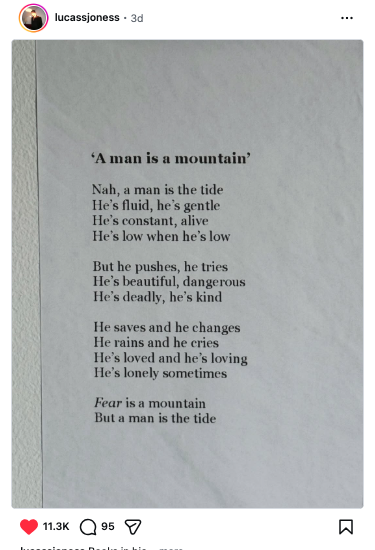
I wouldn’t call myself a “big poetry guy.” I also wouldn’t try and tell coaches of male athletes to try and engage their young men with poetry via the Hollywood trope of “It’s just rap music on paper guys.” But, I do think @lucassjones puts out hard hitting prose that often grapples with the subjects TeamsOfMen wants you to be talking about with your players.
This poem, this time debating whether men are MOUNTAINS or better described as the tide, is one of those I think is instantly usable. Give a group of 3-4 guys one stanza each. Ask them to “put this in terms you think our team can understand” and then turn them loose with it for 4-5 minutes. Ask them to search for words that accurately describe themselves. Words that DON’T fit who they view themselves as. Tell them to compare the idea that “he’s deadly, he’s kind” and how those two things can be true at the same time. Offer up how you view the idea that “he rains and he cries” and what that might actually mean.
Remember, often in this work there is no RIGHT or WRONG answer. There’s only the journey, the discussion and the space to share with one another.
Coach Prompts
How often do players get invited to interpret something instead of simply being told what to think?
What line in the poem would spark the strongest conversation in your team room?
Are there contradictions in masculinity your players need more space to discuss?
Player Prompts
Which line in the poem felt most like you? Which one felt least like you?
Can someone be both strong and soft, dangerous and kind? Why or why not?
If you rewrote one stanza to describe yourself, what would it say?
Don’t Surrender The Feed
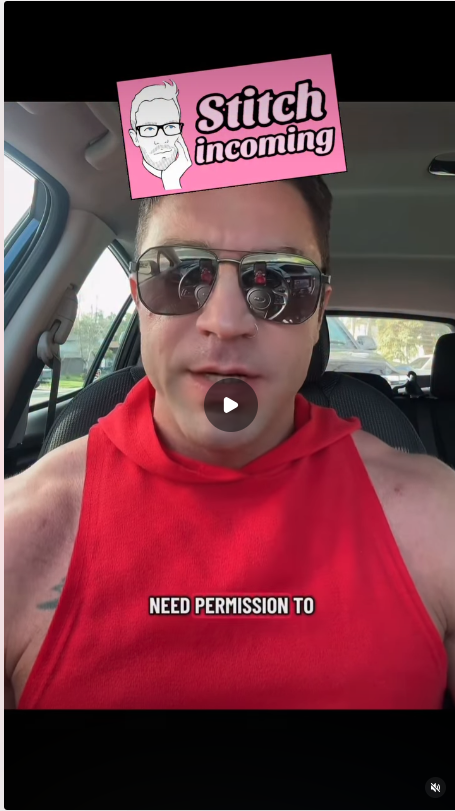
First of all, I refuse to put the Instagram handle of this man here, because his thoughts need ZERO oxygen. He’s seen here in red screaming that “You do not need permission to access your spouse's body. Their body belongs to you. Your body belongs to them. You belong to each other now.”
What I will DO is platform this post because it is from my friend @professor_neil and his MASTERFUL takedown via a thought exercise proposal that you should show your team TODAY.
I’ve long argued that as much as coaches like to lean on the old trope of “social media bad” the reality of the world is our guys are on it constantly. Add in the fact that what they scroll through daily is influenced by the algorithms of whatever platform they are on and you have a recipe for their lives, beliefs, and relationships being directed by those “voices” instead of yours.
That reality is why we intentionally provide access to accounts like Neil’s and we have teams every year FOLLOW and LIKE with no requirement beyond that. Because if you can at least combat the algorithm with healthier content creators, you have a better chance of that coming up the next time your guy goes down a rabbit hole.
I’m not going to spend too much time restating what Neil does with his takedown, as I think the brilliance is there for your guys to engage with as is. But, I will say that his statement of “You strike me as somebody who is probably in possession of a whole lot of homophobia and very fragile, restrictive masculinity” is EXACTLY why you need to be following him and telling your guys to do the same.
Coach Prompts
What voices are shaping your players’ beliefs about women, relationships, and masculinity right now?
Are you intentionally introducing healthier content into your team ecosystem or simply hoping players stumble onto it?
If the algorithm is teaching every day, what are you doing to interrupt it?
Player Prompts
Who online most influences the way boys think about relationships and masculinity?
Have you ever noticed how social media rabbit holes slowly start feeding you the same type of message over and over?
What makes someone worth listening to online?
Character Or Compliance?
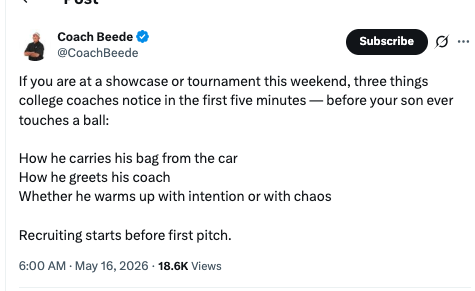
Well, we’re right back here today with another generalization wrapped in cliché.
I do not know @CoachBeede, and I can’t claim to have ever attended a baseball-specific recruiting event. But I did recruit for 20 years in college basketball, and I can guarantee you we were not in parking lots stalking young men as they arrived for games. So why focus on this post, especially in a blog dedicated to framing current events for coaches of male athletes trying to help them break free of the Manbox?
First, because this type of statement is bathed in policing a phony PERFORMANCE of who you are.
Even IF we decided baseball coaches were standing around in the wee hours of the morning, coffee and donuts in hand, watching young men get out of their cars (stalker behavior, by the way), they would only be able to glean meaningful information if the players were unaware of their presence. If the players simply acted the role for the coach’s eyes, it becomes performance, not proof of character or intent.
And that matters because the Manbox is constantly asking boys and men to put up a front, a veneer, a version of themselves designed to pass inspection. Posts like this rarely move beyond surface-level character analysis. Instead, they unintentionally reinforce the idea that being a “good man” is mostly about looking the part while someone is watching.
Second, because we could easily flip this on its head through the Mirror Training lens and ask: what happens if we stop making this player-focused and make it coach-focused instead?
Do parents get to watch you emerge from your hotel room before a long recruiting day and decide what kind of man you are?
Do players get to watch videos evaluating how you treat people who approach you in the stands?
Do high school coaches get to assess the chaos of your notebook, your organization, or your behavior behind closed doors?
Is that all fair game too?
For once, though, the comments didn’t co-sign the silliness. The author is getting rightfully skewered for the take and, surprise surprise, doesn’t appear to be modeling the composure or rigid character standards they claim to value in young men while responding to criticism.
Coach Prompts
How often do we mistake performance for character in the way we evaluate players?
What standards do coaches ask of players that would feel uncomfortable if applied back onto themselves?
Are we teaching boys integrity or simply teaching them how to look disciplined when watched?
Player Prompts
Have you ever felt pressure to “look like” the right kind of athlete or man instead of actually being yourself?
What’s the difference between character and performance?
How would it feel if adults were evaluated by the same standards they use on young people?
Stress Test The Cliché
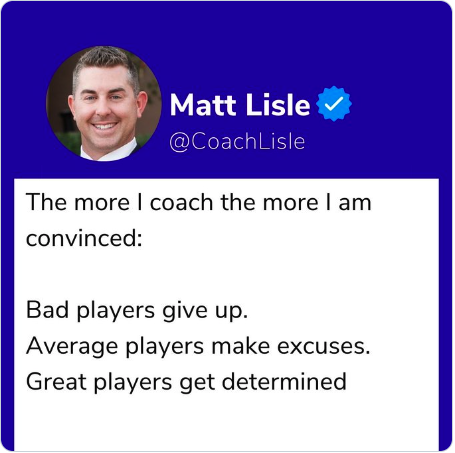
Today’s blog tackles a reframing of this post from @CoachLisle on X this week. Before going too far, I want to be clear: I’m not trying to attack Coach Lisle directly. I think a lot of coaches would (and did) repost this in support of the thought process behind it. And, to be fair, it’s not inherently WRONG. There is truth to the three bullet points. Bad players do give up. Average players do make excuses. Great players do get determined.
My issue with posts like this, always, is less about what they ask of players and more about where they START. They start with the players, not the coach himself.
In fact, before I’d even change “Bad players give up” to “Bad coaches give up,” I’d want us to sit with something even more uncomfortable. What do people feel, think, or believe about the phrase “Bad MEN give up”? Then proceed down the same road with the next two lines. “Average MEN make excuses.” “Great MEN get determined.”
It’s easy, and likely, that you’ve seen some version of this post and applied it to the way you approach coaching a season and a group of players. I think it’s just as likely that many of us HAVE NOT applied these same clichés to our coaching approach or the way we model healthy masculinity while serving as that coach.
That, for me, is really the core issue with these easy generalities. They work well in short bites. They work well as signs in team spaces. They work well as language to challenge players. But too often, they have NOT been stress tested by the coach looking inward first.
And if we’re constantly asking young men to interrogate themselves, push through adversity, and own their growth, then the least we can do is hold the mirror up to ourselves before demanding they stand in front of it.
Coach Prompts
What clichés or motivational sayings do you regularly ask players to live by but rarely interrogate yourself?
If your team applied your standards back onto you, where would you feel challenged?
Are your players seeing accountability modeled or simply demanded?
Player Prompts
What advice do adults give that feels different when they actually live it too?
How would it change your trust in a coach if they admitted where they are still growing?
What’s a phrase adults say all the time that deserves a deeper look?
Who You Say You Are
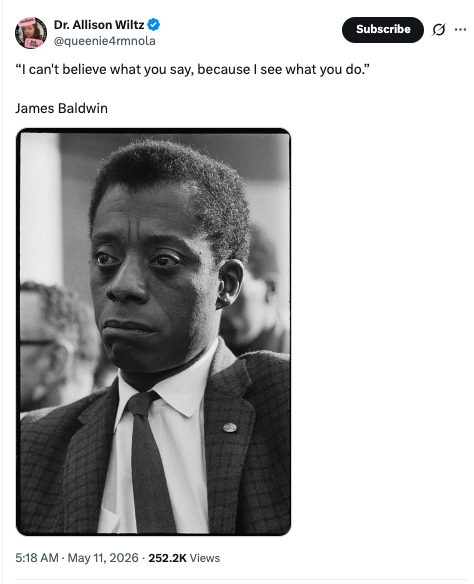
Today’s featured post is simple in its power, both because one of the most prominent voices in activism (James Baldwin) is the source and because it is applicable to literally any aspect of your coaching. I can imagine coaches of male athletes deploying this (or their own versions of it) comfortably when applying it to their players performance on the field or court of competition. I can see them using it when trying to stimulate growth in a player’s academic performance (and the habits they are or are not using in the classroom).
However, my challenge to our industry today is rooted in a change of scenery.
I want you to read this aloud and apply it to what you claim and what you do as a man. Further, as a human being. Are you acting to your claims? Are you behaving in a manner (as a father, a husband, a friend, a brother, a son, etc) that is in alignment with all the cliches you claim to believe and tout to your players?
Of course, I’m not demanding perfection from us. We are human after all. But I am acting for interrogation and analysis of who you are vs who you say you are. We ask this of our players day in and day out. The least we could do is turn the light on ourselves. Better yet, tell them we are doing that, why we are doing that, and admit the times the light showed you something you failed out.
Coach Prompts
Where is there a gap between what you tell players matters and how you actually live?
When was the last time you openly admitted a failure or blind spot to your team?
What would change if coaches treated self-reflection with the same seriousness they expect from athletes?
Player Prompts
Do adults in your life model the things they ask from you?
What does accountability look like when someone older admits they got something wrong?
What values do you say matter most, and how often do your actions match them?
Violence In The Vocabulary
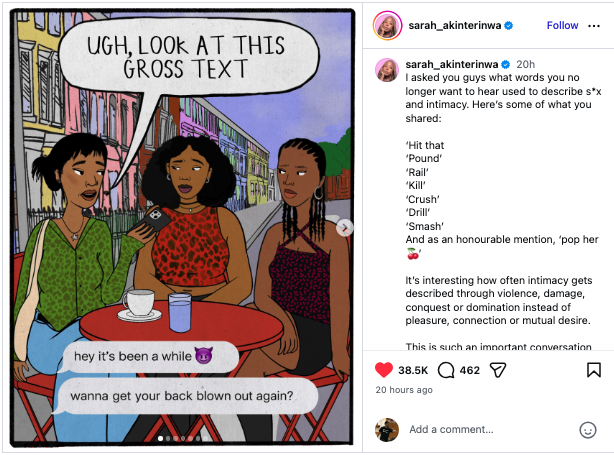
Full disclosure: While this post (from @sarah_atkinterinwa) is probably more readily usable by college coaches of male athletes, it SHOULD be deployed at High School and Middle School as well.
Why do I say that? Because I’ve coached both levels AND, maybe more importantly, because I’ve raised sons (19 and 14 years old) and I know exposure to this belief system regarding sexual performance and intimacy bled into their lives at those earlier ages. The longer the time span between it being imbedded and the moment we try to get them extract and unlearn it, the harder the process becomes.
You hear this language not only in terms of ways to have sex with a woman, but ALSO in how we are going to emerge victorious in a game. Whether it be football, basketball, baseball or soccer, you hear coaches and player alike demand they “dominate,” “destroy,” or “belt to ass” opponents.
Listen, I’m competitive as hell. I want to win games and win games by a lot of points. But, we’ve taken strides in the past two years to change the language we use in our spaces while still maintaining a relentless quest for victory.
We don’t say “sniper” anymore when someone trips over themselves. We say “timber”. We don’t say “Corner Kill” anymore when we want to iso a bad defender off the dribble. We say “Corner Brunson”. I don’t tell my player to “put our foot on their neck.” I say “End the game. Here and now.”
These felt awkard to say at first, and I’ve definitely slipped up and reverted at times. But the fact we told our players the how and why of the change in verbiage meant they went on the unlearning journey with us. That shared journey is another connection point in the program, and we know authentic connection drives change.
Now, whether you can address the language above about sexual intercourse (due to admin, due to parents, due to your own worries about age) is something you will have to gauge yourself. BUT, if nothing else, start with a deep examination of the violence infused language you used to describe your game. In your search for alternatives, your players will see you modeling a shift they can copy.
Coach Prompts
What violence-infused language is normalized in your program without anyone questioning it?
Are there terms in your team space that unintentionally reinforce harmful ideas about dominance, gender, or worth?
If you changed one piece of language tomorrow, what would it be and how would you explain the “why” to players?
Player Prompts
What words or phrases do athletes use so often that nobody even thinks about what they mean anymore?
Have you ever heard language around sports or relationships that felt normal at first but weird once you stopped to think about it?
What’s one phrase you think your team should retire and replace?
Critical Listening Is A Skill
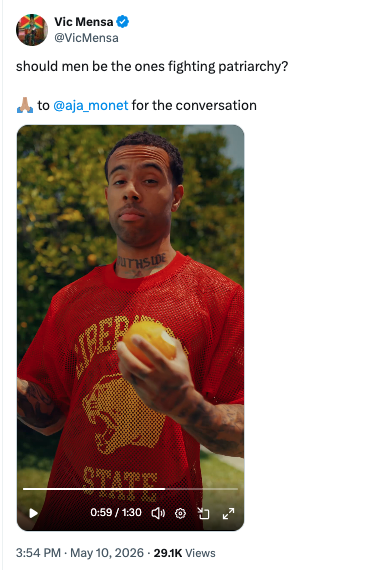
Today’s blog is meant to be a direct rollout with your players. (And if I’m being honest…with you and your coaches first.)
Click on the image above of influencer Vic Mensa’s latest X post and go to the 42-second mark. Hit play. Sit and listen. Then watch it again — this time writing down notes about lines you hear that sound like TeamsOfMen material.
Then watch it one more time (three total now) and write down the lines that sit with YOUR SOUL. Discuss as a staff. When you’re done, rinse and repeat that exact flow with your team.
For me, I honed in on:
“We was all raised in a culture of abuse and misogyny…”
…and…
“Many of us adopted that willingly, wholeheartedly. But we don’t have to be stuck there. We can — we NEED to grow.”
If NOTHING else comes from this, at the very least, you’ve given your players a rep in critical listening and viewing. In 2026, they probably scroll past hundreds of mini speeches like this every week. It’s important we train their ears to identify not only symmetry with what someone is saying, but also places of pushback, tension, and disagreement.
Curiosity is a SUPER POWER after all.
Coach Prompts
What line from the clip sounded most like something your program claims to believe?
Where did you feel tension, disagreement, or discomfort while listening?
Are you intentionally teaching players how to critically engage with content…or just hoping they will?
Player Prompts
What line from the video stuck with you the most and why?
What part of the message did you agree with? What part challenged you?
What messages about men and relationships have you “adopted willingly” without ever really questioning?
The Team Room Test
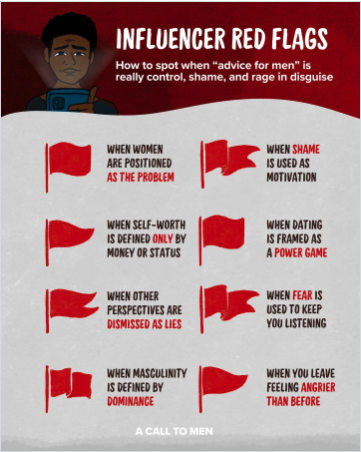
Sometimes the content I share and frame here in the 30 Seconds blog lends itself to a long-form critique. Sometimes the content enrages me. Sometimes it motivates me.
Today’s left me WONDERING.
I wonder what the response percentages would look like in our team rooms if we put this graphic up -alongside a PollEverywhere type anonymous feedback mechanism- and asked “Have you seen these type of accounts in your feed” and “Do you follow accounts like this”.
I wonder what level of shock would hit coaching staff’s around the country when those percentages came back and they recognized just how immersed their guys’ daily scrolls are with this stuff.
I wonder how many coaches can self reflect on their own leadership style with things like “when shame is used as motivation” or “when masculinity is defined by dominance”.
I wonder how many players would connect the dots between experiencing their athletic eco systems and how often they “have their self worth defined only by…status” or “when you leave feeling angrier than before”.
I wonder how many conversations in the locker room of your program have “dating framed as a power game” or “women being positioned as the problem” in your male athletes lives.
And honestly?
What I suspect the answers to these five “wonders” might reveal makes me more resolute than ever in continuing to push for TeamsOfMen in every team room across the country.
Coach Prompts
If players answered anonymously, how much manosphere or rage-based content do you think would show up in your locker room?
Which “red flag” on this graphic is most normalized in sports spaces?
Are there ways your coaching environment unintentionally reinforces shame, dominance, or status-based worth?
Player Prompts
What kind of male influencer content shows up in your feed most often?
How does certain content leave you feeling after consuming it: more connected, more thoughtful…or angrier?
What messages about women, power, and masculinity are young men repeatedly absorbing online?
Untethering Tough Guys
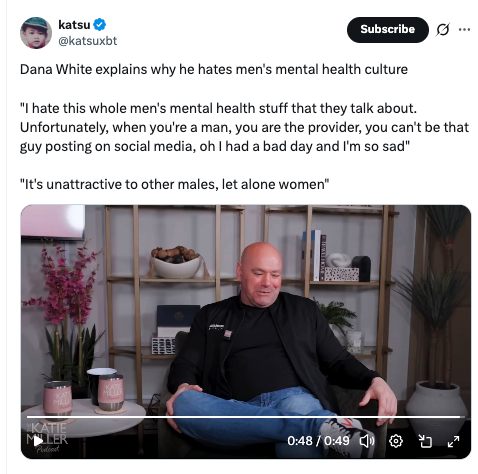
MMA is not my jam. I don’t watch UFC. That being said, Dana White is someone I’m aware of.
But Dana White is not someone I look up to or look forward to hearing from. Add in the context that this conversation took place on Katie Miller’s podcast and I’m honestly surprised I even pressed play on it. (Miller, of course, is the wife of current Trump administration operative Stephen Miller, an overt racist white nationalist.)
This conversation is full of Manbox-infused thinking and you’ll recognize a number of familiar tropes from White’s mini-rant about “men’s mental health culture”:
“I hate this mental health bullshit.”
“You’re the man, the provider, you are the one who takes care of your family.”
“[Soft] is unattractive to other males, let alone women.”
These quotes — complete with Miller snickering in the background — are a testimony to the fight we face untethering “tough guys” from the Manbox.
White, the epitome of “tough” to millions of UFC fans, is parroting the usual rigid beliefs about masculinity while simultaneously appearing completely unaware that he is supporting the idea that men are constantly performing for the approval of OTHER MEN.
That dichotomy is what makes all of this so perilous.
In order to “be a real man,” you have to dance for other “real men,” who are in turn performing for you, all while the stakes keep escalating for what the man-badge-earning deed of the day is. It’s a vicious cycle. And eventually you get someone like White claiming that admitting “today was a bad day” is not only weak, but unattractive.
Huh?
What’s the capper in all this? He says, “You are the example for your kids.”
And he couldn’t be more right about that.
The issue is that what he models — and what so many men believe they should model too — is harmful for both the boys and girls we are raising.
Coach Prompts
How often do boys and men perform toughness primarily to avoid judgment from other men?
What messages about vulnerability are reinforced in your team spaces without anyone explicitly saying them?
When athletes hear “be a man,” what behaviors are actually being rewarded?
Player Prompts
Have you ever felt pressure to act tougher, colder, or less emotional around other boys?
Why do you think vulnerability is often mocked more by men than by women?
What kind of man do you want younger kids watching you become?
“She Not Gonna Let You Hit”
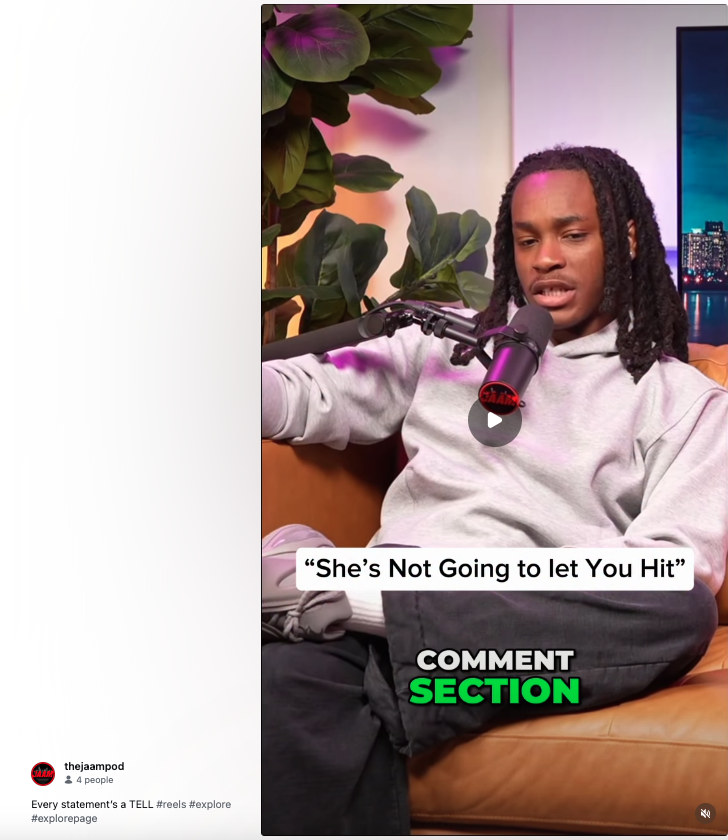
I love JAAM pod. But before you click the clip above, especially if you're an older coach, you need to prep yourself for the language. Lots of soft “a” n-words and f bombs used by the hosts.
But I’m going to be fully transparent: the dipshittery they address sometimes requires real ire and rage.
In this episode, the group is clapping back at the comments their podcast episode defending Megan Thee Stallion garnered after NBA star Klay Thompson cheated on her and ended their relationship. As the hosts share, many men decided the only reason another man would defend a woman is because he wanted to sleep with her. Hence the flood of “she not gonna let you hit” comments in their mentions.
I promise you, your players in your locker room have used that exact phrase or one of the thousand versions of it. And as the hosts so deftly point out, that mindset is rooted in a misogynistic belief that the only reason to be kind to a woman is to find a way into her pants.
“It’s literally coded language…you’re saying there is no legitimate reason for you to be defending this woman right now unless you wanted to have sex with them.”
Then they land on a touchy but painfully accurate point: too many men are “too porned out.”
“…they actually don’t think about things in the logical response, because bro, you don’t go outside. Literally.”
Sit with that for a second.
Many of your young men are being introduced to sex, relationships, women, power, and intimacy primarily through porn on their phones. Not parents. Not coaches. Not healthy conversations. Porn. And the sheer terror that should elicit in all of us is not being talked about enough.
I’ll let you engage with the rest of the clip as is, but honestly, even if you just texted this to your team group chat, there’s tremendous value in presenting a counterbalance to the nonsense takes flooding young men’s feeds every day.
Especially the ones blaming Megan Thee Stallion for Klay Thompson’s inability to stay faithful.
Coach Prompts
What phrases get said in your locker room that are dismissed as “just jokes” but actually reveal deeper beliefs about women?
If porn is the loudest teacher in your players’ lives about sex and relationships, what counterbalance are you intentionally providing?
Are your athletes learning that empathy toward women is human…or transactional?
Player Prompts
Have you ever heard someone get mocked for defending a woman online or in person? Why do you think that happens?
What messages about women and relationships do boys absorb from social media, porn, memes, and group chats?
What would it look like to treat women as people instead of status symbols, punchlines, or access points?
When Empathy Becomes Protection
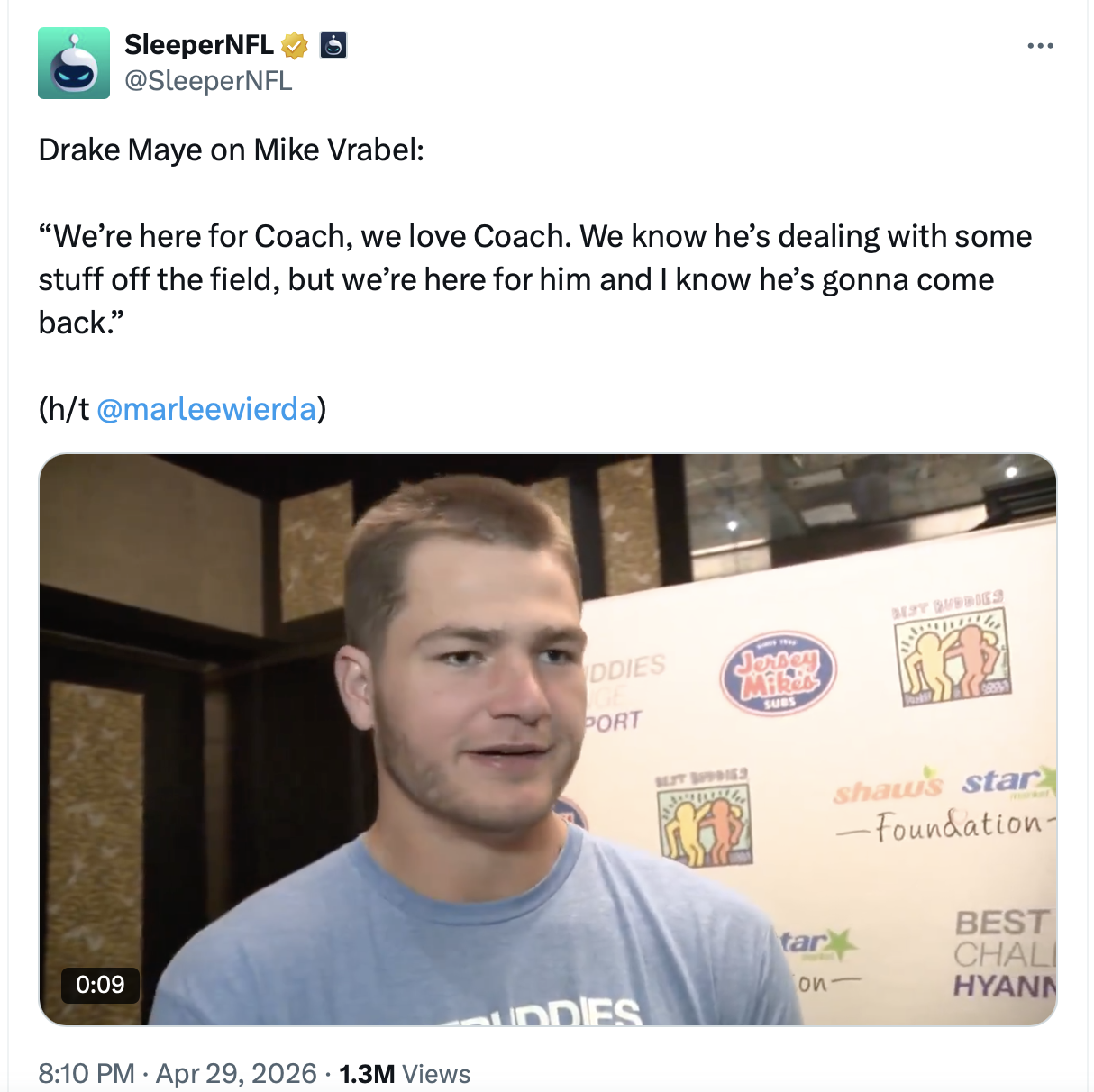
This (from Patriots QB Drake Maye) proves something to me that I think many fundamentally misunderstand about men:
We DO know how to show up for people.
In moments of grief, crisis, heartbreak, or collapse, men are often very aware that community matters. We know how to rally. We know how to read a room. We know when somebody is hurting and needs support around them.
And the fact we DO KNOW makes it even more maddening, more infuriating that Maye (and I’m assuming his teammates because he uses the word “we” here so much) decided to these empathy skills to help their Head Coach Mike Vrabel.
“But Kip, you’re the TeamsOfMen guy. You’re the coach who wants everyone to feel all the feels and embrace compassion..you know, all that soft shit you peddle”.
Yeah, I am. And I’m also the guy versed in the bullshit men like to use. I’m the guy who recognizes when nuance and a little critical thinking is needed alongside emotional fluency to ascertain that my coach being (allegedly) involved in a multi year extramarital affair with an NFL reporter is not a “circle the wagon” moment. We don’t need “all hands on deck” when coach has been cheating on his wife.
Why aren’t they coming together to say “We want coach to do what he’s always preached to us and take care of his family first. However long it takes to get right with his family and the people he hurt most, he needs to do that and I hope he does.”
Why aren’t they making statements like “Well, it serves as a reminder how quickly the best part of your life can be sabotaged by your own selfish, short sighted choices. We’ll learn from him.” A bridge too far apparently. I mean look at this from Patriots season ticket holders:

Is he returning from combat? Did he beat cancer for the third time? No. He got caught cheating on his wife and the mother of his children. And THIS, THIS is where we all want to use our empathy? This, amongst all the ills of the world, the suffering of innocents, this is where the Patriots players and fans plant their flag and say “We got you?”
It’s disgusting. It’s at best misguided, and at worst intentionally rallying around an event you hope to get the same grace for causing yourself in the future. It’s shades of DARVO & JADE wrapped around a veneer of gridiron god worship. Yes, everyone fails at some point in life. Yes, everyone deserves grace going through the process of accountability and restoration. But, the man gave a written for him statement, went to a day’s worth of counseling and now needs to be welcomed back like the messiah?
This should matters to coaches sports. Players are always watching what gets defended, what gets minimized, and what the adults around them rush to protect.
And right now, the message feels pretty clear:
If you win enough games and carry enough status, people will work a hell of a lot harder to restore your comfort than confront your behavior.
Coach Prompts
When does supporting someone cross into protecting them from accountability?
What messages do players receive when adults excuse harmful behavior from powerful men?
How do you respond differently when the person who messed up is someone respected or successful?
What responsibility do coaches have to name harm honestly, even when it involves someone they admire?
Player Prompts
What does it actually mean to “have someone’s back”?
What do athletes learn when famous or powerful people avoid consequences?
How would you want people to respond if your actions hurt others?
Why do you think men sometimes defend each other so quickly in situations like this?
What We Laugh At Matters
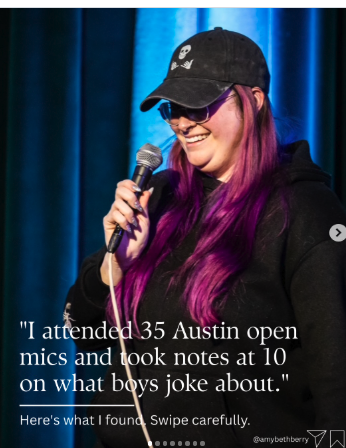
A former assistant coach of mine is now a stand-up comic. He’s hilarious and I scroll his stuff enough, it seems, for the Instagram algorithm to populate my feed with other comics as well. THIS post showed up over the weekend and I had to read the entire scroll and share with you all here. Long story short, the comedian @amybethberry tracked 10 nights of stand up shows in Austin and took notes on joke topics from male comics. Her takeaways are a window into not only what boys/men laugh at, but what we are still (even in the vulnerability laced space that is stand up comedy) scared to stay with emotionally.

Even in a space that markets itself as honest and vulnerable, there’s a pattern. When a joke gets close to something personal—loneliness, relationships, health, anything that requires sitting with discomfort—it often gets abandoned. Something safer takes its place. A gay joke. A racist punchline. Something sexual that pulls the room back to familiar territory.
She calls it a “Vulnerability Vanishing Act.” That phrase stuck with me.
Because I don’t just see comedy clubs when I read that. I see team rooms. I see staff offices. I hear the same words—“dick,” “faggot,” “pussy,” “jerking off”—and I see the same reaction. The room erupts, everyone piles on, and whatever was about to be said gets buried.
I’ve been part of that. I’ve contributed to it. I can land a joke when I want to, and for a long time a lot of those laughs came at the expense of someone else not measuring up to whatever standard of masculinity was floating around in the room. That realization didn’t come quickly, and it wasn’t comfortable when it did.
Humor can be a release. It can bring people together. It can make hard environments feel lighter for a moment. But it also redirects. It can shut something down just as quickly as it opens a room up. That’s the part I keep coming back to. Not whether humor belongs, but what we’re doing with it.
When jokes consistently land on the same targets, it tells you something about the culture. It shows what’s easy, what’s accepted, and what gets avoided. So the question becomes whether that foundation is actually helping us build anything we’re proud of.
I don’t think the answer is to eliminate humor. That’s not realistic, and it probably misses the point.
But I do think it’s fair to look at the patterns.
If certain topics always get laughs, and others consistently disappear, that’s worth noticing. And if we’re serious about changing how young men show up, then we have to be willing to examine what we reward in those moments.
Even if it’s something as small as a joke.
Coach Prompts
What kinds of jokes get the biggest reactions in your team space?
What topics tend to disappear when things start to get real?
How do you respond when humor shifts toward targeting someone?
What does your team’s humor say about what’s accepted?
Player Prompts
What do you and your teammates usually joke about?
Have you noticed certain topics get avoided or shut down?
How do you react when someone becomes the target of a joke?
What kind of environment do you want to be part of?
A Moment Worth Using
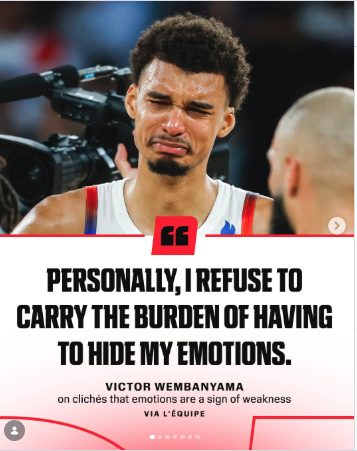
Full disclosure: I, along with my Blazer fanatic sons, was cheering against Victor Wembanyama in the first round of the playoffs.
BUT, this from him yesterday was a breath of fresh air in a sports news and quotes landscape that too often feels like it’s actively working against progress in reimagining manhood. The words he chose stood out right away: burden, hide, fear, social codes. He’s naming something most players feel but rarely say out loud. At the same time, he’s doing it as someone who, physically, stands apart from almost everyone else on the court. That contrast matters. The most imposing presence in the game talking openly about emotion removes a common excuse.
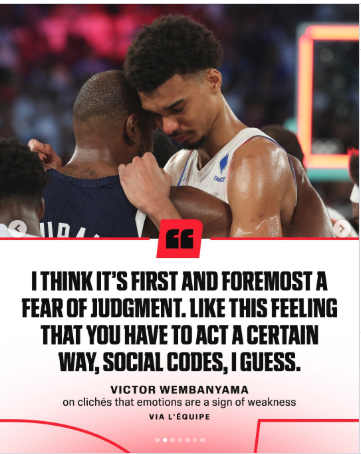
What I appreciate most is the clarity in his stance. He’s not interested in carrying emotions he feels forced to suppress. That applies to how he plays and how he lives. There’s a level of ownership in that choice.
He also points directly at something a lot of us recognize but don’t always address—the way other men shape what feels acceptable. The concern about how you’ll be seen, what will be said, how quickly you might get labeled. That pressure sits underneath a lot of behavior we see in team settings.
When he mentions the feeling that you have to act a certain way, he’s getting close to something we talk about often. There are expectations, sometimes unspoken, that define what a player is supposed to look like and how he’s supposed to respond. Once those expectations take hold, it can be hard to move outside of them.
This is why moments like this matter. They give players a different reference point. Not a speech from a coach, but a current player showing another way to exist in the same space.
As a coach, this is the kind of clip you can bring into your team room without much setup. Most players will know who he is. For basketball teams, it’s an easy entry point. For others, it still lands because the message translates.
There’s value in not letting something like this pass by.
Coach Prompts
How do your players interpret emotional expression from high-level athletes?
What messages about emotions are reinforced in your program, intentionally or not?
Where do you see fear of judgment show up in your team?
How can you use moments like this to open conversation instead of just making a point?
Player Prompts
What emotions feel hardest to show around your teammates?
How much does fear of judgment affect how you act?
What does it mean to handle emotion without hiding it?
Who do you look to as an example for how to respond in tough moments?
Show Them What to Do With It
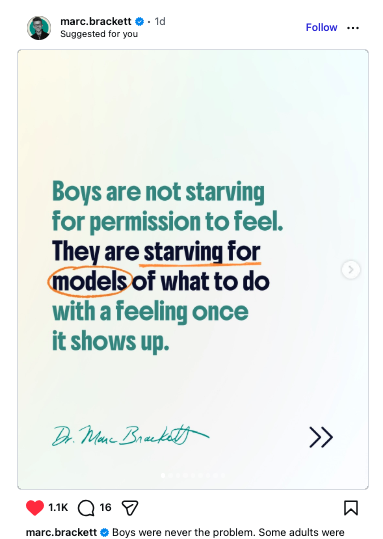
Today’s blog features a tremendous post from @mark.brackett on instagram (see above). This one fits perfectly in this space because after parents and peers, who is better positioned to model for boys what it looks like to move through the world while feeling?
Think about how often young men are on practice fields, in gyms, or in the weight room with a coach present. In those moments, whether it’s intentional or not, something is being shown about how to interact with the world while holding whatever emotion is there.
That’s the part I think gets missed.
TeamsOfMen exists, in part, to open coaches’ eyes to the fact that how they show up each day is not neutral. It’s an input. Over time, those inputs shape how young men carry themselves, how they respond, and how they understand what it means to be a man.
If you take the Mirror Training concept seriously, it doesn’t just change what you say. It starts to affect how you move. There’s a level of consistency that has to come with that. When it’s real, players feel it.
One thing I would add to Brackett’s point is that modeling alone isn’t always enough. We also have to name what’s happening while it’s happening. That can be as simple as saying out loud what you’re carrying and how you’re choosing to handle it.
I’ve tried to lean into that at times:
“Fellas, let me say up front I’m having a rough day. I’m going to do my best to not let that affect how I coach today.”
Or:
“I’m feeling the same stress and worry about what happened as you guys are. I don’t feel like screaming about layups today. How are you feeling?”
It’s not about making the moment bigger than it needs to be. It’s about making the process visible. Because if we don’t show them what to do with a feeling once it shows up, they’re going to find their own way. And we don’t always get to choose where they learn that from.
Coach Prompts
What are your players learning from how you handle your emotions day to day?
Where might your actions be contradicting what you’re asking from your team?
How often do you make your thought process visible in real time?
What would it look like to be more intentional about what you’re modeling?
Player Prompts
What have you learned about handling emotions from the adults around you?
How do you usually respond when something doesn’t go your way?
What does it look like to stay present without ignoring what you’re feeling?
Who in your life shows you how to handle difficult moments well?