
What Is It Like to Be Around You When You're Angry?
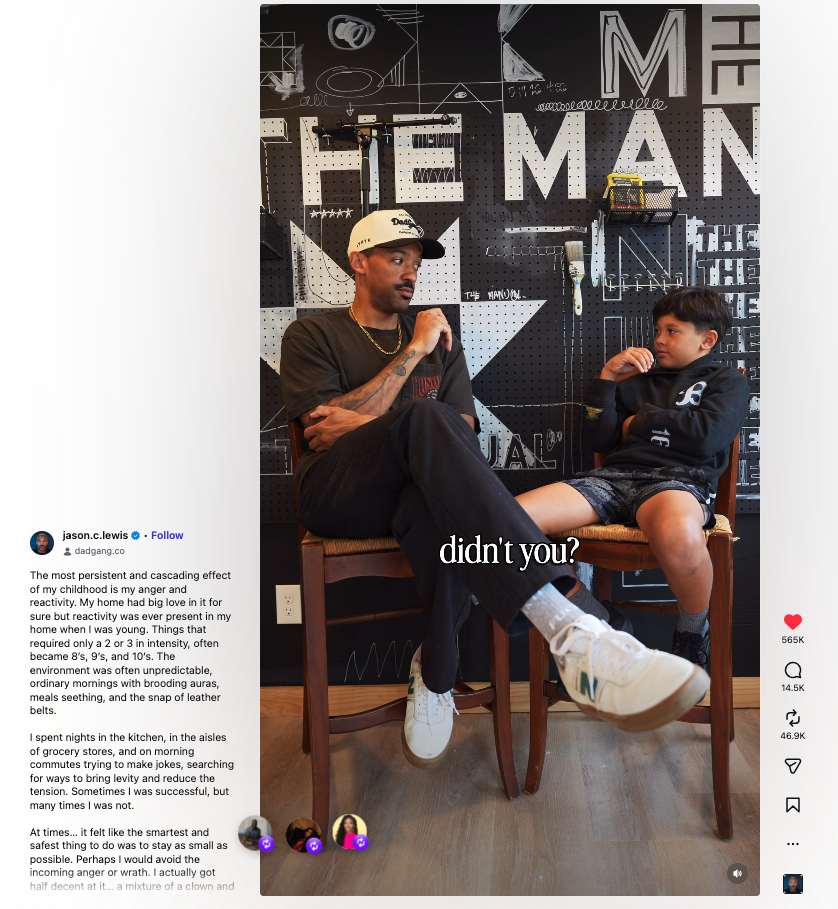
Shout out to TeamsOfMen Inner Circle Coach Joseph Jackson (Milwaukie HS Boys Basketball HC) for sending this my way via IG. Originally posted by @jason.c.lewis the video shows a father debriefing with his son their effort to build a new bed, and features the dad asking his son questions like “how often am I super angry” “what’s it like to talk to me when I’m angry” and the ways that anger showed up when the son was “messing up” in the construction of the bed.
Candidly, this hit me as a SON, as a FATHER and as a COACH.
The line in the caption “The most persistent and cascading effect of my childhood is my anger and reactivity” resonated with me, as much of my upbringing revolved around a fear of setting my father off. Like the author here states, my dad showed my brother and I HUGE expressions of love and was never shy in telling us how much he loved us. He, also, was capable of nuclear explosions that would make grown men quake, much less the boys we were.
As a dad myself, I know I have had reflection moments where I tell my wife, “oh god, that blow up when I was screaming at the kids, that was so [insert my dad’s name]” and the horror that came with remembering the fear I felt in those moments, combined with the knowledge that I could very well have done that to my own kids, was mortifying.
Finally, I know I use my voice selectively nowadays, but in the beginning of my head coaching career (almost 20 years ago now) I know I used it as a weapon often, deploying tirades and volume-intensified rants that I thought were “coaching tough”.
All these reflections and contemplation came from both the emotional video here AND the caption description. Both for me as the current pivot point of many rooms (the angry dad or coach) AND as a former person who “used levity to deflect the rage” or “got as small as possible to avoid it.”
What really sat with me is this:
“When you have the power to move rooms, you can’t assume you are always moving it in a good way. Sometimes, you are TERRIFYING them.”
And that made very uneasy. I don’t want to be that guy.
I believe we must hold our kids and our players and ourselves accountable. I believe we must strive to be better every day. BUT, I know there are so many more tools at your disposal as a father and a coach to make those things a reality.
Anger and volume are not the only solution (and often, part of the problem).
Maybe the rep from this video is as simple (and terrifying) as asking the question this dad was willing to ask his son:
“What is it like to be around me when I’m angry?”
And then shut the hell up and listen to the answer.
Coach Prompts
What is it actually like for your players to be around you when you're angry?
When you raise your voice, are you choosing a teaching tool—or have you lost access to the other tools you have?
Who in your program could tell you honestly that your anger scares the room without worrying about what you'll do with the answer?
Player Prompts
What's the difference between a coach being intense and a coach making players afraid of him?
What happens to your ability to listen and learn when you're worried about someone's reaction?
What does a coach do after losing his temper that helps rebuild trust?
One of the hardest gaps for a coach to see is the distance between what we intend our players to experience and what they actually experience.
“I was holding him accountable.”
“I was creating urgency.”
“They know I love them.”
Maybe.
But what did the room experience?
That gap between intention and experience is exactly the kind of thing DeCA is designed to help coaches examine.
The Camera Doesn't Care About Your Excuse Either
I was ecstatic this summer when our AD informed me that our Hudl InFocus camera had been mounted in our Main Gym. With the click of an app on our phone, I could grab any portion of practice I wanted on film and break it down for use however my staff and I decided. It was a setup I was used to in college and was glad was now, two years in, being the norm at the high school level as well.
More film more film more film am I right?
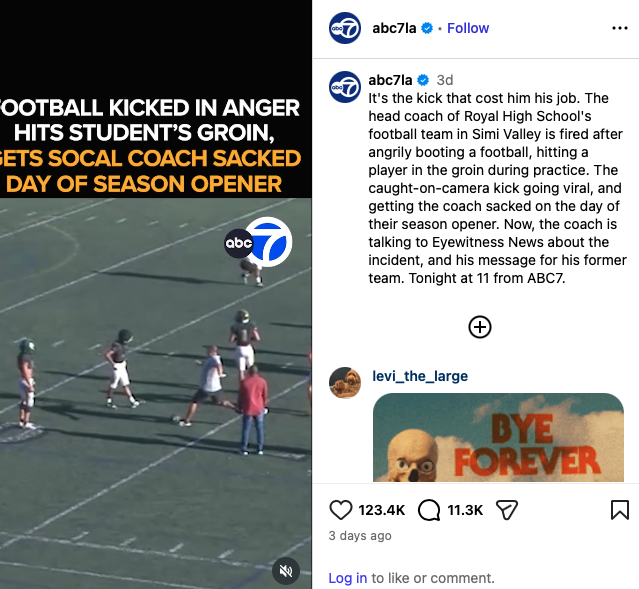
Well, the clip above, originally posted on IG by @abc7la (where a HS football coach is ranting in practice and kicks a ball in anger into a young man’s groin), reminded me of not just the need for emotional fluency in coaching, but also the fact that if we believe “put it all on film” applies to our players (namely, the idea that I can catch them with the eye in the sky slipping and then show them that and expect a new version of them) it also means WE ARE GOING TO BE ON FILM MORE TOO.
Our words, our tactics, OUR RANTS.
Those are going to be captured too.
I lived this in college.
Over a decade into being a Head Coach, I had the Hudl camera running during practice filming a 5 on 5 session. One of our players made a comment to a teammate I didn’t appreciate and I lost it. I screamed eff bombs, etc at him, took him out of the scrimmage and stomped around the floor. Now, I thought it was a warranted rant, as the young man needed to be checked for failing with his words, but I also went too far in the words I CHOSE to correct him with.
And guess what?
That shit was on camera.
And the players all had their own log ins to that days footage.
So that film ended up in front of our AD, because I did a poor job debriefing with the player post practice (because I was still processing rage) and what could have been repaired between the two of us right then and there ended up being a week long issue in our program.
Credit to the young man in the story, as he held grace for me in my own failings to meet the moment and owned his own. We “made up” and had a productive season of him starting. But my point here is both emotional processing AND more “eyes in the sky” means you have to be better at your job.
For years, coaches have loved film because the camera doesn't care about the player's excuse.
“You said you were in help? Let's watch the film.”
“You said you sprinted back? Let's watch the film.”
“You said you didn't say anything? Let's watch the film.”
Well, Coach...the camera doesn't care about your excuse either. We can’t hope for gotcha moments on video that move our guys and then NOT own our own on the same feed.
Coach Prompts
If your players had unrestricted access to film of YOU at practice, what would you be uncomfortable having them watch back?
When was the last time you watched coaching film to evaluate your own behavior instead of your players'?
When you cross a line with a player, how quickly does your system move you toward repair instead of justification?
Player Prompts
What would you notice about your coaches on practice film that they probably aren't watching for?
Does a coach owning a mistake make it harder or easier for you to respect them? Why?
What's the difference between a coach holding you accountable and a coach losing control?
We love building accountability systems for players. Film. Stats. Grades. Standards. Consequences.
Where is the accountability system for the adults?
If your program's decision system only creates feedback loops for athletes, it isn't much of a system.
DeCA examines Coach Readiness too—because the adults designing the environment are making decisions inside it every damn day.
Teach Them to See It
I realize that if you’re a frequent reader of my blog, you have to do a lot of extracting from my writing…meaning I think I put up topics and frames of current events that require you to digest a story you may not have heard of, then decide if the TeamsOfMen frame I apply to it sits well with you…and then ultimately decide if it works for YOUR belief system, YOUR program’s system and WHERE your players are in this particular moment (oh, and don’t forget the little detail of “do I have time and access to them today Kip” to even do this session).
I get it. I’m usually asking for a lot.
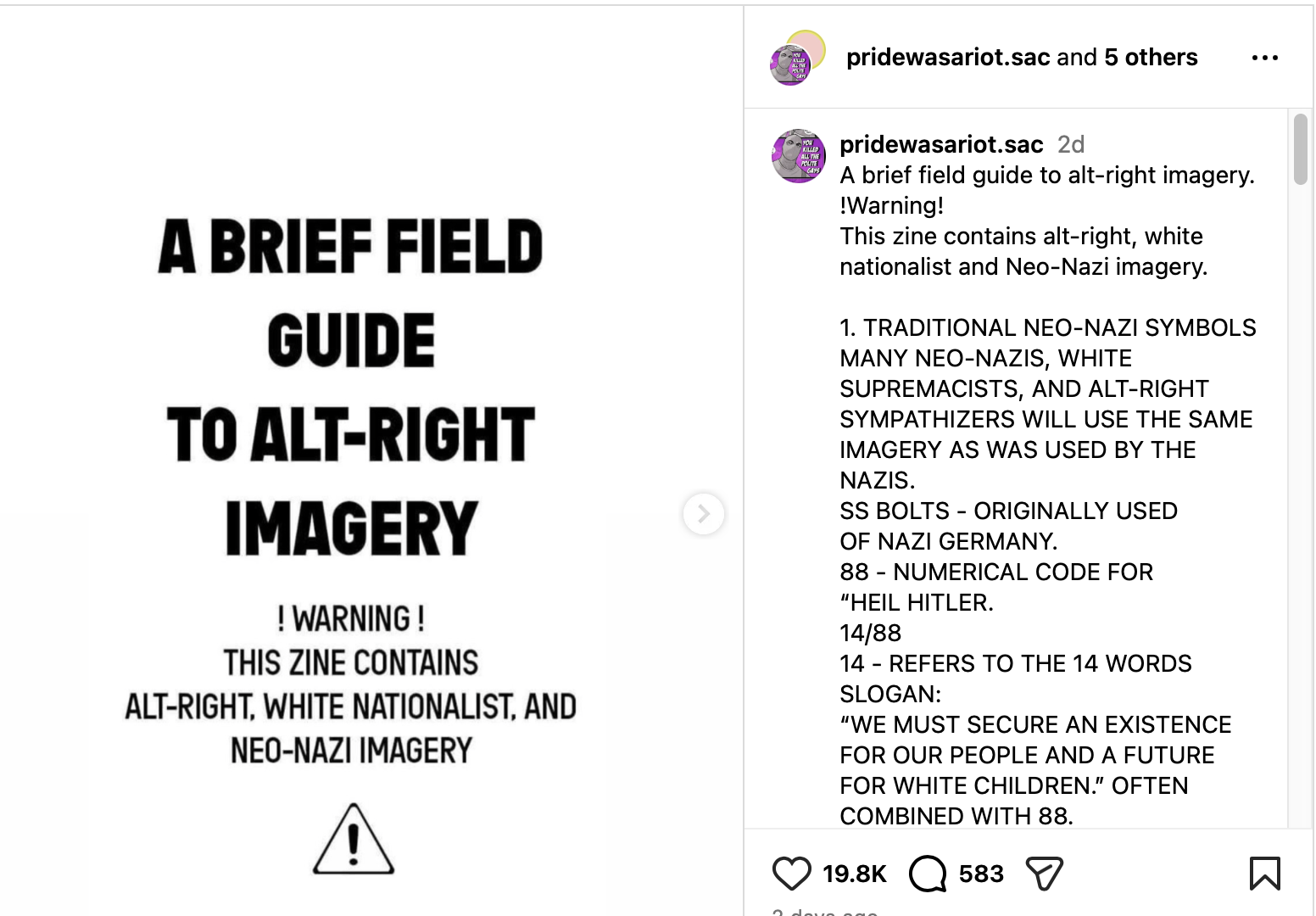
So when I saw the post above (originally on IG from @pridewasariot.sac) I thought to myself “Hey, this should be an easy one. We all hate Nazis.”
Now, if 2026 has taught me anything it’s that that particular sentiment no longer holds 100% certainty, but I do have faith in my readers and fellow coaches. So, I’m not going to waste too much time stating the obvious (our programs need to be free of Nazi’s and racism) BUT as I scrolled the post, I realized I wasn’t able to ID all the images and “code” associated with those things.
For example, I was unaware of:
Othala/Algiz markers
Celtic Cross
Pepe the Frog
Black and Yellow Polos
as dog whistles and sleight-of-hand ways to extremist groups communicate.
Believe me when I say I would imagine the chances you come across this on a player in your team room is small. You vet, you recruit, you parse your space where folks committed to hateful beliefs wouldn’t feel like they belonged there.
BUT, your players go out in the real world. No matter if you’re a college coach or a HS coach, your guys will get time away from your bubble. And what happens then?
No, I’m not claiming they go to Nazi raves…I’m saying they will be in mixed company and it would behoove them to be able to SEE and ID when the people, symbols, jokes, memes and language around them start adding up to something they don't want to be around.
This post today is less about “help your guys unlearn” as much as it is about “PROTECT your guys”.
We talk a lot about equipping young men to recognize unhealthy ideas inside themselves. But we should probably spend some time helping them recognize unhealthy spaces around themselves too.
NOTE: there is an important distinction here: seeing ONE of these things does not automatically mean you found a Nazi. Context matters. A Celtic Cross can just be a Celtic Cross. Pepe can just be Pepe. The point isn't to teach your guys to profile somebody based on a shirt, tattoo or meme. It's to help them recognize when multiple pieces of information start telling them something about the space they're in.
Coach Prompts
Would your players recognize extremist symbols or language if they encountered them outside your program?
Have you taught your athletes the difference between noticing a warning sign and making an assumption about someone?
Do your players know they can leave a party, group chat, gathering or social situation simply because something about it doesn't feel right?
Player Prompts
What would have to happen for you to realize a group or space you're in isn't one you want to be associated with?
If you noticed extremist jokes, symbols or language at a party or gathering, what would make it difficult to leave?
How do you distinguish between one thing you don't understand and a pattern telling you something about the people around you?
Your players don't need another adult telling them Nazis are bad. They need reps recognizing when a situation is becoming something they don't want to be part of—and confidence in what to do next.
That's the difference between believing the right thing and being prepared to make the right decision.
Let the Team Die
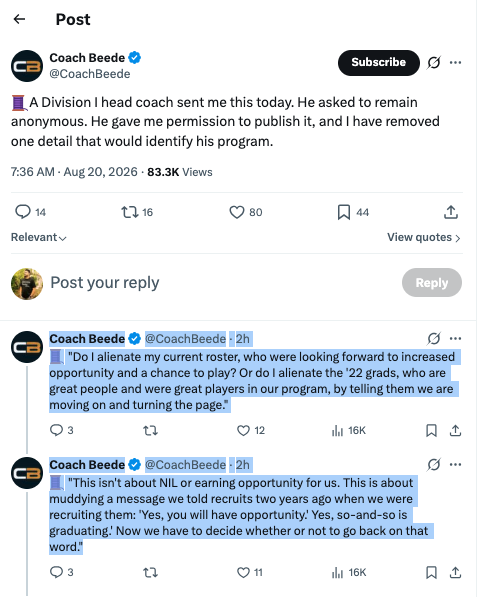
I don’t do “captains” in my HS hoops program. Long story short (and this blog isn’t really about captainship) I used to spend an inordinate amount of time trying to create a “leadership” plan for our captains and then inevitably in season you find yourself lagging on it once the season started.
In addition, to be honest, I believe as the coaching staff it’s your job to lead and too often we scapegoat young people with a “captains” label as a last bastion of desperation when a year isn’t going well (you know you’ve done it, the “well, we need better internal player leadership”).
Anyway, I start there because my commentary on the above post this morning from X stems from something I read during one of those long rabbit hole investigations trying to find captains material.
Namely, something written by Bruce Tuckman called the Stages of Group Development. I will let you deep dive the entire theory, but one of my main takeaways that I’ve held onto since then AND I think applies here to the sheer panic gripping college sports (especially football) after a recent court ruling granted the possibility of eligibility to guys who were already graduated and gone, is that you MUST LET THE LIFE CYCLE OF A TEAM HAPPEN…and that includes LETTING IT DIE (years after his original work, Mary Ann Jensen helped add “Adjourning” to the stages).
Seriously coaches…let them go.
Let’s avoid the banter back and forth about the legality of the ruling, and just address the question here in the screengrab that allegedly comes from a D1 Head Coach. He is asking what to do with the promises made to kids who are “of age” now in the program vs letting back “great guys and great players” and while I understand the stress involved, I think the answer is actually really simple:
Let. Them. Go.
I think the idea of “more time: or “run it back” or “one last ride” is getting overplayed here. These young men, let’s say, were “screwed” out of a year of CFB because of a worldwide pandemic. Sure. Yes. They were. It happened. It was unjust.
But life is full of injustice. Life is full of “dammit, I wish that would have gone better.” Coaches preach that all the time. “Adversity builds character” am I right?
So we can’t pretend these guys didn’t live out a “last year” “last ride” with your program. At the time, everyone believed it was over. He finished and did his senior day spectacle, lived through the senior day emotions, and grieved through the “this was my last time in the uniform” process.
He’s done it. You’ve done it together. That team LIVED its cycle.
It “died” honorably.
It is over.
Let it go.
And in terms of direct TeamsOfMen teaching points? This is for you as a staff. You can’t hold on to something too tight, you can’t prevent TIME from taking its toll. And I’m not convinced we should always want to.
There is something developmentally important about endings.
A senior plays his last game. He takes the uniform off. He cries with his teammates. He walks out of the locker room. Eventually somebody else gets his locker. Somebody else takes his minutes. The team becomes something new without him.
And he has to become something new without the team.
When in your calendar is the natural process of death to mourning to acceptance to rebirth of a new team?
Because learning how to let something you love end—and discovering that you are still somebody after it does—is a life lesson too.
That is a life lesson your team calendar should embrace.
Coach Prompts
Where in your annual calendar do you intentionally acknowledge that one version of your team has ended before beginning to build the next one?
Have you ever tried to hold onto a player, team or season longer than was healthy because YOU weren't ready for it to end?
What are your athletes learning from you about mourning something meaningful, accepting its ending and moving forward?
Player Prompts
What was hardest about the last team, season or role you had to leave behind?
When something important to you ends, what helps you move from wishing you still had it toward accepting what's next?
Who are you when the thing you've spent years identifying yourself by is no longer yours?
We spend enormous energy intentionally bringing teams together.
Tryouts. Retreats. Team dinners. Standards meetings. Leadership exercises. Preseason practices.
How intentionally do you take them apart?
DeCA asks whether development is actually designed into the rhythms and systems of your program rather than left to chance. The ending of a season belongs in that design too.
If your players are supposed to learn how to navigate transition, loss, identity and what's next, where exactly have you built the rep?
Are You Coaching—or Performing Coaching?
I’m a Notre Dame Football fan.
I have loved the Irish since my godfather first introduced them to me during the Tony Rice hey day of Lou Holtz era.
The fight song. Touchdown Jesus. NBC. The alternate green uniforms. I was and am still all in.
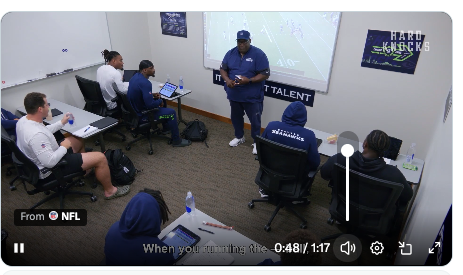
I lead with that because the Seahawks RB coach above, Coach Thomas Hammock, was previously the Head Coach at Northern Illinois and he defeated Notre Dame (in Head Coach Marcus Freeman’s debut) in 2024. So when I saw him on HBO’s Hard Knocks in the clip above it triggered a memory of “Hey I know this guy.”
However, I don’t share it here in our TeamsOfMen blog space to get you to like Notre Dame. I share it because I think this is one of those moments where the term “performative” is appropriate. I know you are probably used to hearing that term in the world of social justice, as it means “actions, allyship, or activism done primarily to increase social capital, protect a reputation, or signal virtue, rather than out of deep devotion to a cause.” But performance happens in coaching too.
I don’t know Coach Hammock so I won’t blanket his career or individual integrity with claim beyond THIS SPEECH he gave his RB room reeked of coaching performance.
Count the bleeped eff bombs. Feel the cringe at the timing and usage of all of them. Look at the players faces as they are delivered. At least from what we can see in this edited clip, NONE of them land, none of them move anyone. If our goal as coaches is to use our platform to teach and inspire change in behavior (both on and off the field), this was a not a tool that delivered.
Hard Knocks is, of course, a hard environment for anyone to coach in. Where are the cameras, when are they rolling, what is the level of clipping and out of context of each scene we see. I get all that.
But, if you’re being honest, you have been in spaces where a coach fell flat like this. Where a coach tried to be someone he isn’t and you know the players FELT IT. Hell, I would argue Coach Hammock would watch this and cringe himself and navigate thoughts of “Who in the hell is that guy up there? That ain’t me.”
Because how many of us have a version of “Coach” that we put on? The voice gets deeper. The profanity increases. The anger gets manufactured. The speech gets louder. We perform toughness because somewhere along the way we learned that this is what leadership in men's sports is supposed to look and sound like.
Maybe that's what happened here. Maybe it isn't. I don't know Coach Hammock well enough to make that claim about him. But I damn sure know I've seen it happen in coaching.
I’ve seen Coach Hammock’s pressers as a college coach (albeit never behind the scenes cutups from any Hard Knocks type production) and he was NOT this guy in those public settings.
It’s worthy of both a reflection and #MirrorTraining by him, but also as an example for you and your own staff to navigate as well. Go find film of yourself coaching this week. Not game film. YOU film. A timeout. A practice huddle. A pregame speech. Something where you're doing the talking. Turn off the sound first and watch your players.
Are they with you?
Then turn the sound back on and listen to yourself.
Is that actually you talking—or are you performing what you think a coach is supposed to sound like?
Coach Prompts
When you turn the sound off on film of yourself coaching, what do your players' faces tell you?
What parts of your coaching personality are authentically yours—and what parts did you inherit because you thought that's what a coach was supposed to look like?
When do you find yourself getting louder, tougher or more profane than you naturally are? What are you trying to accomplish in those moments?
Player Prompts
How can you tell when a coach is genuinely fired up versus trying to manufacture intensity?
What makes something a coach says actually stick with you?
Does yelling or profanity make a coaching message more powerful to you? When does it make you tune out instead?
One of the things DeCA asks us to examine is Coach Readiness. And readiness isn't just knowing what you want your athletes to learn. It's being able to communicate it in a way they can actually receive.
Your athletes can't make decisions aligned with lessons that never got through.
The Decision Confidence Analysis™ gives coaches a way to examine whether the teaching they believe they're doing is actually supported by the systems they've built around their athletes.
What Are the Other 20 Players Doing?
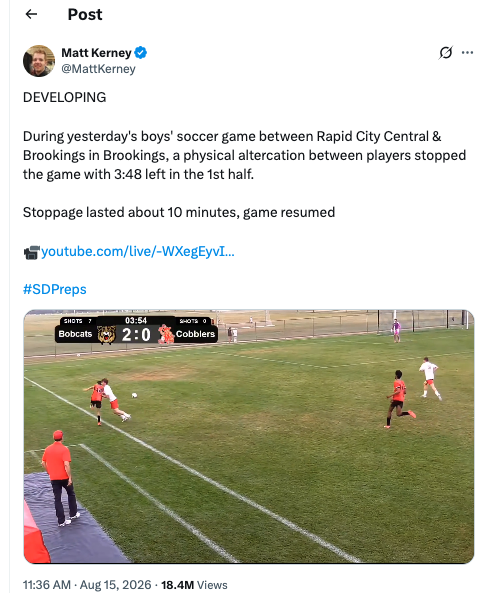
Our blog today is going to be one of those “Where’s Waldo” type film exercises. I say that knowing that I am both DATING the hell out of myself (as Waldo picture books where you had to physically search high and low on a page for Waldo’s red and white hat are a thing of the past) and asking you to deploy a “gotcha” type moment in your film room.
Background first: the screengrab above is allegedly from film from a South Dakota HS soccer game (originally posted here). The first 10-20 seconds are just soccer action but I think that is the hook setting you need for a TeamsOfMen session impact here. As the game plays out you get the moment above where competitive intensity turns into a violent assault by one of the players against an opponent.
Yes, you can (and probably should) stop the film then and there to talk about emotional fluency and processing on the field (note: this film works for any sport, not just soccer). That’s fine, especially for a first year, first month or first exposure ToM program.
But, where the real work can happen is letting it play after that and stopping the film at say the point below.
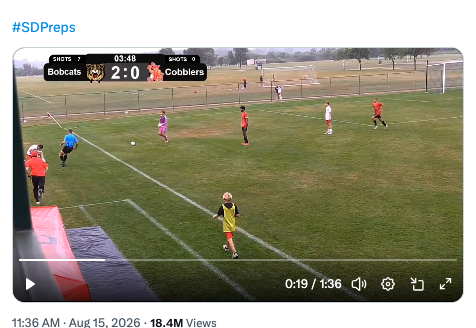
And I say that because the assault is happening. The defender is on top, wailing away with punches at the offensive player.
Now LOOK AROUND.
Ask your players to SCAN the rest of the field. Who is reacting to this? Who is MOVING to this? Who, in the moment, has the courage to go over and STOP THIS? Literally ask them for body counts, for descriptions of age, of team affiliation, etc.
You are going to be able to have a myriad of conversations from this film, including but not limited to:
Look at the teammates FROZEN of the attacker. Why aren’t they rushing to stop him? Is staying out of it necessarily the wrong response?
Look at the teammates of the kid being assaulted. How are they reacting? What would you do?
One teammate eventually comes flying into the situation and reportedly throws punches himself. Is that protecting his teammate—or escalating the violence? Where's the line?
If this was your teammate and he came back to the bench after tackling and punching an opponent, what would you say to him? Why?
Where are both teams' coaches? Did they get there in time in your opinion? What should they do next?
Hell, I’m interested in the comments you could record during playing of the clip from you team. What was the breakdown of laughs, shock and silence? What does that tell you about your program climate and culture?
Email me any and all feedback!
Coach Prompts
When violence suddenly happens, what do your players believe “having your teammate's back” requires them to do?
Have you ever explicitly discussed the difference between protecting a teammate and retaliating for one?
What did your players' first reactions to this video reveal that their polished answers afterward might not?
Player Prompts
Forget the two players on the ground. Who else on the screen made a decision you noticed?
If someone attacks your teammate, what does “having his back” actually require from you?
Where is the line between protecting your teammate and becoming another person who needs to be stopped?
The attacker makes one decision. Everybody else on that screen suddenly has to make one too.
And most of them don't have time for a team meeting, a coach's speech or a reminder of your program values before making it.
That's Decision Confidence.
The TeamsOfMen Decision Confidence Analysis™ (DeCA) asks coaches to examine whether they've intentionally built the systems, conversations and repetitions that prepare athletes for moments exactly like this one—when the coach isn't standing beside them telling them what the right decision is.
When the Laughs Tell You Something
What do your players actually believe counts as rape or sexual assault? This 4½-minute comedy clip could give you a pretty uncomfortable answer—and a hell of a coaching opportunity.
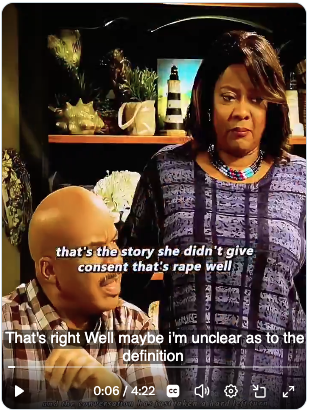
Shout out to long time TeamsOfMen practitioner and Inner Circle member Coach Chris Horton of Warren Wilson College Men’s Basketball for the share of this video (originally posted on X here). The video shows a scene from The Carmichael Show (allegedly Season 3 Episode 1) with a family debating the nature of consent, rape and sexual assault. I have never watched the show, but familiar faces like David Alan Grier, Jerrod Carmichael and Tiffany Haddish interact in the scene and the discussion feels authentic enough that it’s worth a share with your players.
As a coach running this, I would let it play one time through without any comment from you or your staff. Then, at the conclusion (it’s about four and a half minutes long) I would ask the players to physically stand up. Ask them to sit down on the left side if they agree with the argument from the character “Maxine” or sit on the right side if they agree with the argument from the men in the show. Additionally, you can allow players to stay in the middle and call that the “I don’t know yet” space.
Next, I would have them pick one note taker and then as the clip is played again, write down/record which aspects they most identified with. Then, have the note taker and another elected voice from the group stand up and present the WHY behind why they sat down on the side they did.
Now, let’s be real clear here coach: This is not a “both sides are equally right” or a “let’s all kumbaya in the middle of this thing” moment. Rape is (statistically speaking) very unlikely to fit the stereotype of a man in the bushes or a random stranger breaking into your house at night. It is much more likely (statistically) to come from someone known to the victim. In fact, the study linked above found that literally 76% of SA is committed by someone known to the victim. So we’re not going to end this session with your guys who agreed with the old man’s point of view getting a pat on the back and a “hey bro, great convo today” as they leave.
No, you’re going to ask them “where did you learn the ideas or stereotypes that lead you to believe that side of this thing” and “what parts of the manbox are showing up when you lean towards that definition or belief of what rape and SA are” and finally “why was it so hard for you to engage with what the female character was saying”? And then coach, I want you to take specific notes at the answers you get.
They will be a window into the ideas about sex, consent, women and sexual assault that already exist in your team room.
Notice I labeled it an abstract set of ideas and not some targeting of your guys. That is important. Because to engage with them, you will need to separate them from those beliefs. Our hope is they are embracing unlearning and curiosity and vulnerability in your program on a daily basis, so this ask won’t feel foreign. But, in all honesty, you need to be prepared to unearth some things about your guys that don’t sit well. While the clip itself is from a comedy, the topic and the WHEN of the laughs are going to unearth UGLY in your vicinity.
But, that’s the point of TeamsOfMen.
Better to find this now, when they are HS to college aged young people who have lots of time to grow and discard nonsense, than to find out later when they are set in stone and acting towards these ideas. You have the “laboratory” for them in your gym, on your field, in your team room, to run the experiments they need to field test the bullshit.
And hopefully, when the results come back, it hits them in a way that starts the change we want to see.
Coach Prompts
If your players watched this clip today, which arguments do you think would get the most agreement—and why?
Where are your athletes currently learning what counts as consent, rape and sexual assault if you aren't intentionally talking about it with them?
What belief could surface during this conversation that would be difficult for you to hear without immediately judging the player who said it?
Player Prompts
Where did your definition of rape and sexual assault actually come from?
Which argument in this clip felt most believable to you—and what made it feel believable?
Has anything you once believed about consent changed as you've gotten older? What changed it?
And coach, this is prevention infrastructure.
Not waiting until one of your athletes is accused of crossing a sexual boundary and then scrambling to figure out what your guys believe about consent. Creating the space beforehand to surface those beliefs, challenge them, and give your players reps thinking through situations they may actually encounter.
That is exactly the kind of intentional system the TeamsOfMen Decision Confidence Analysis™ (DeCA) is designed to help you examine. If you're curious how much of that prevention infrastructure actually exists in your program right now, start there.
What If He Tells You First?

Full disclosure (without sharing the personal experience of past players and family members) I’ve walked alongside folks experiencing both sides of online sexual exploitation. I been trusted with the agony of the one whose body images are being used to blackmail and I’ve heard the reactions when unsolicited pics are suddenly sent. Both experiences are layered, confusing, emotion laced situations.
I share the above article from Amanda Goharian on LinkedIN because I think coaches-especially coaches of male athletes-need to save it. Not because Amanda wrote it for our industry (it’s actually for mother’s of children) but precisely because when a male athlete is living through this, you could be the very first person they confide in. And in that moment, you want to be able to help.
As we do when prepping for any game on our schedule, we want to have the clearest picture possible of the challenges our opponent presents. An athlete living through online sexual exploitation is obviously far more consequential than any game, but the need to prepare before you're in it still applies.
I want you to read the article entirely, but here’s a couple heavy takeaways to start your “scouting report”:
Reporting the exploitation and supporting the person being exploited are two different jobs.
The first adult response can either reduce or compound the harm.
“Here’s a number—call it” isn't necessarily support.
Whichever one of those makes you feel the most uneasy is where you should begin your prep work and exploration of resources and best practices.
You can also reach out to me privately. I’m more willing to share details of my own experiences one-on-one than I am here on a very public blog. Remember, while we know and embrace the power of story to connect with one another, if it’s not OUR story to tell, a public forum can be a very hurtful place to share someone else’s experience—even when we mean well.
When we sign on to be the coach of male athletes, we have to recognize all that encompasses, especially in the technology-rich environment that is 2026. There are perils and risks associated with simply being 16–22 years old right now that did not exist when we were young coaches, much less when we were players. Our work requires us to stay current with trends in the games we coach AND—as TeamsOfMen will forever champion—stay up to speed with what faces the human beings in our care as well.
Coach Prompts
If an athlete told you today that intimate images were being used to blackmail them, would you know what to do in the first 30 minutes?
Who in your school or athletic department is equipped to help you respond to online sexual exploitation—and do you know how to reach them before you need them?
What topics affecting your athletes are you currently less prepared for than you would accept being for an opponent on your schedule?
Player Prompts
If you or a teammate were being threatened or blackmailed with intimate images, which adults would you trust enough to tell?
What would an adult need to say or do in the first few minutes for you to feel supported rather than judged?
If a teammate came to you with something this serious, would you know how to help them get to a trusted adult without trying to handle it yourself?
Situations like this are exactly why we created the TeamsOfMen Decision Confidence Analysis™ (DeCA). It doesn't test whether you know how to respond to every challenge your athletes might face. It examines something bigger: how much intentional prevention infrastructure actually exists around the young people in your care.
If this article has you wondering what your team, program, or athletic department has intentionally put in place beforesomething happens, take the free DeCA and find out.
What Elite Athletes Can’t Outsource
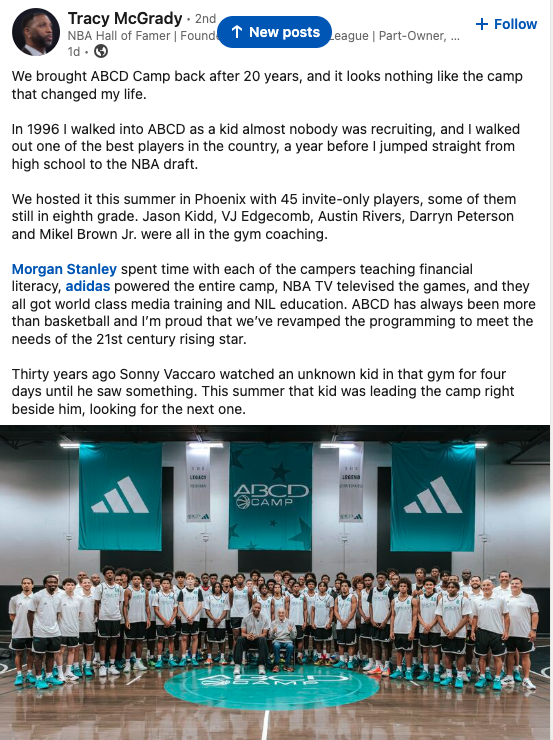
So, yes, I was as surprised as you are to learn Tracy McGrady is on LinkedIn and actually posts.
Not as a judgment of T-Mac, but overall, someone with that level of celebrity rarely shows up on here. (And yes, I know it could literally be a paid employee doing it for him.)
Either way, it was really cool to see the work he has done with the rebranding and rebirth of ABCD Camp. For those unfamiliar, ABCD was a legendary basketball camp that McGrady himself attended in 1996, before eventually jumping from high school straight to the NBA.
Twenty years after the camp disappeared, McGrady brought it back this summer with 45 invite-only players, some as young as eighth grade.
And look at what they've intentionally built around the basketball.
Financial literacy. NIL education. Media training. Access to current and former NBA players. All alongside high-level basketball instruction.
That's awesome.
More importantly, it acknowledges something I wish more athletic spaces would acknowledge: if we're going to put young people into environments that can dramatically change their lives, preparing them athletically isn't enough.
Why, then, did I leave this comment on what was otherwise a post I really liked?
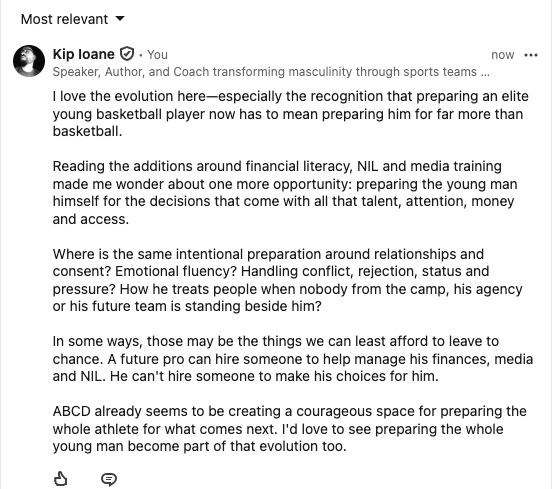
Because I think all too frequently well-intentioned folks creep right up to the starting blocks of what TeamsOfMen believes in, and then—whether from fear, naivety or intentional avoidance—don't go further.
There is absolutely a need for what McGrady and ABCD Camp put these 45 invite-only, high-level, and in some cases likely future professional basketball players through.
My issue is twofold.
First, if some of these young men eventually sign NBA contracts, they're probably going to hire people to help them with many of the things they're currently being taught.
Someone will manage their money. Someone will negotiate their endorsements and NIL opportunities. Someone will help prepare them for media appearances. There will be agents, financial advisors, publicists, team personnel and an entire infrastructure surrounding the professional athlete.
But there's one really important job nobody can be hired to do for them:
Make their choices.
And that's my second issue.
Because some of the most challenging things these young men may eventually navigate won't happen during a television interview or while looking at an investment portfolio.
They'll happen when they're navigating relationships and sex. Rejection and jealousy. Alcohol and parties. Conflict with a partner. The behavior of teammates. Anger. Loneliness. Ego. Social media. Suddenly having enormous amounts of money, fame, attention and access.
Their character may be tested in ways it never has been before.
Where are the reps for THAT at camp?
My comment gets into this in more detail, but it's also the question I have for so many people and organizations inside athletic ecosystems that proudly tell us they are teaching young people "life lessons" through sport:
Why do those life lessons so conveniently manage to dodge some of the hardest conversations they'll actually face?
I'm not suggesting ABCD Camp needs to become a week-long seminar on masculinity, consent and healthy relationships. Nor am I suggesting financial literacy, NIL education or media training aren't incredibly valuable.
I'm asking why those subjects qualify so easily as player development, while the decisions that determine how a young man treats another human being so often don't.
If we're courageous enough to prepare an eighth grader for the possibility that basketball might someday make him rich and famous, shouldn't we also be courageous enough to prepare him for who he will need to be when it does?
Coach Prompts
Look at everything you intentionally teach your athletes away from the X's and O's. Which parts prepare them to perform and succeed, and which parts prepare them to make difficult decisions as young men?
What difficult situations involving relationships, consent, rejection, alcohol, anger, social media, teammates or status are your athletes likely to encounter? Where do they get reps preparing for those situations in your program?
When you say your program “teaches life lessons,” which of those lessons require you to have conversations that are actually uncomfortable?
Player Prompts
Think about the adults helping prepare you for basketball, school, work, money and your future. Who is helping prepare you for the difficult decisions you'll have to make when none of those adults are around?
What situations outside of basketball do you feel least prepared to handle well right now?
When have you had to make a decision involving relationships, friends, anger, pressure or social media where you wished you'd had a chance to think through it beforehand?
Your program probably says it teaches life lessons. But which ones are you intentionally preparing your athletes for—and which ones are you hoping they figure out on their own?
The Decision Confidence Analysis™ (DeCA) helps coaches examine the actual prevention and decision-making infrastructure inside their program—not what they hope they're teaching, but what they've intentionally put in place.
What Are Your Team Rituals Actually Teaching?
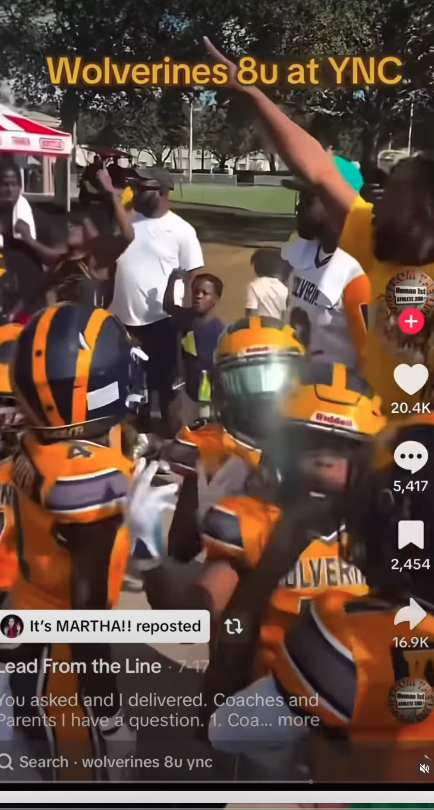
@PierreFleury_ is someone I’ve reposted often on IG, and one of his recent posts (screenshot above) shares a video I think every coach should watch and grapple with. It shows what appears to be the pregame hype routine for a youth football team. More specifically, Pierre takes issue with the chant the ADULTS appear to be leading the kids in.
Press play yourself and then ask your staff, “Would we want these kids—or your own HS or college guys—launching into a ‘B***h WHAT’ chant before we kick off, tip off, or start running?”
Seriously, if you watch this video, you will see the glee the adults are having alongside the kids. The family members in the background JOINING IN, and even younger siblings echoing the chant. What are we even doing here?
We are not seeing a space ABSENT of life lessons. To the contrary, we see a space normalizing language and ritual around sport that clearly involves problematic language and ideas. And this isn't language sneaking past the adults. The adults appear to be helping lead it. We see the architects of this being the adults who are responsible for establishing what is normal in this team space.
We’ve said it before and we’ll say it again: “Team rooms are not neutral. They are either spaces of unlearning and growth OR they are spaces of perpetration and harm.”
Coach: You have enormous influence over where your space lands. What are the rituals you’re allowing—or actively leading—teaching your guys?
Coach Prompts
What pregame, locker-room or team rituals have become so routine that your staff has stopped examining what they actually communicate?
What language would you immediately correct from an athlete but currently tolerate when it's wrapped in competition, humor or hype?
If younger athletes copied every behavior your staff currently models and celebrates, which ones would you be proud to see replicated?
Player Prompts
What are some things you've learned are "normal" in sports simply because older players or adults did them first?
Does language become harmless because everyone is laughing or using it to get hyped? Why or why not?
What team traditions would you want younger athletes copying from you someday?
If today's post made you wonder what your team's everyday rituals are teaching your athletes—whether you intended those lessons or not—don't guess.
Click here to run the free Decision Confidence Analysis™ and discover where your program is reinforcing healthy decision-making—and where hidden gaps may still exist.
What This Research Should Make Coaches Question
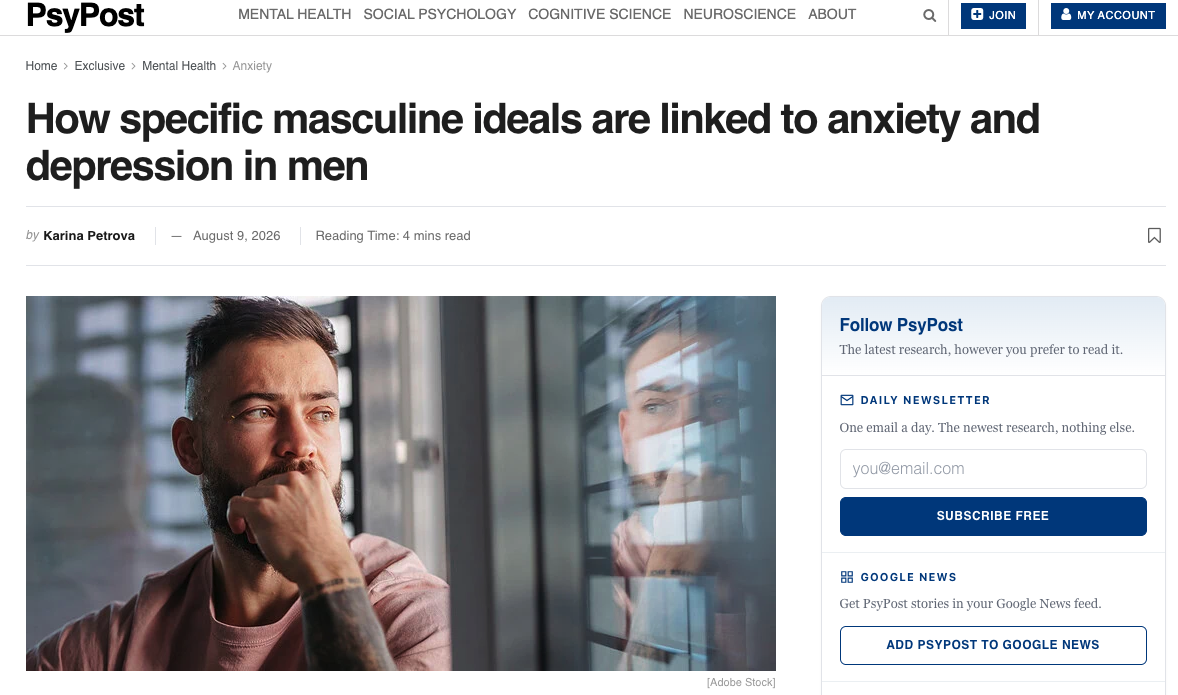
It’s been awhile since I shared one of his links, but Professor Michael G Flood on X is a must follow. In the early days of TeamsOfMen, I would wager he was one of our most retweeted and shared researchers on men, masculinities, gender, and violence prevention. The article screen grab above links to one of those “If Professor Flood shared this, it’s worth reading” moments.
As always, I don’t want to help you be lazy, so PLEASE go read the entire article. But, what the two bullet points I believe are vital for you, your staff and your players are below:
“…a recent survey reveals that specific norms—namely emotional suppression and extreme self-reliance—are uniquely linked to higher rates of anxiety and depression.”
“Men also face high rates of internalizing symptoms. Internalizing symptoms refer to mental health conditions where individuals direct psychological distress inward, rather than acting it out aggressively, with common examples including depression and anxiety disorders.”
Those two statements hold tremendous insight and ramifications for your program and players. If you accept, as TeamsOfMen believes, that your sport can be a driver of point number one (“hey man, you gotta be a dawg, you gotta handle your business out there on the field”) then we have to recognize that our spaces can reinforce some of the exact norms this research associates with higher rates of anxiety and depression.
And then, when distress does show up, how often does sport reinforce the silence described in point number two?(“we don’t got time for p***ies here man, get your -ish right and go ball out”). Now we’ve potentially reinforced the suppression AND made it harder for a young man to tell us what’s actually going on.
This is not to say “men can’t have stress in their lives.” To the contrary, I’m saying you need a plan for helping them process and move forward despite it. And that plan cannot be “drive it down and ignore it via gritting your teeth harder.” The research points to another option “Additionally, the authors suggest that school programs focusing on emotion labeling could help boys develop healthier emotional functioning long before they reach adulthood.”
I recognize not everyone is moved by fancy studies and scientific terminology (hell, in the article I first learned that “Alexithymia describes a personality trait characterized by a severe difficulty in identifying and describing one’s own emotions”) but think about the coaching implication of that for a second: How can a young man regulate an emotion he can’t even identify?
We don’t need coaches to become psychologists. But unfamiliar terminology can’t stop us from using every resource available to help our young men grow while in our care and playing our sport.
Coach Prompts
What messages do your athletes hear from your staff about what they should do when they're stressed, scared, overwhelmed or struggling?
Does your program teach athletes how to process difficult emotions, or mostly reward their ability to conceal them?
If a player couldn't identify what he was feeling beyond "good," "bad," "pissed" or "fine," what opportunities does your program currently give him to build that skill?
Player Prompts
What's the difference between controlling an emotion and pretending you aren't experiencing it?
When something is bothering you, what makes it easier—or harder—to tell someone else what's actually going on?
How good are you at identifying what you're feeling before it affects how you play, communicate or make decisions?
If today's post made you wonder whether your program actually teaches young men how to recognize and navigate difficult emotions—or simply expects them to figure it out—don't guess.
Click here to run the free Decision Confidence Analysis™ and discover where your program is reinforcing healthy decision-making—and where hidden gaps may still exist.
Who's Making Money Off Your Player’s Insecurity?
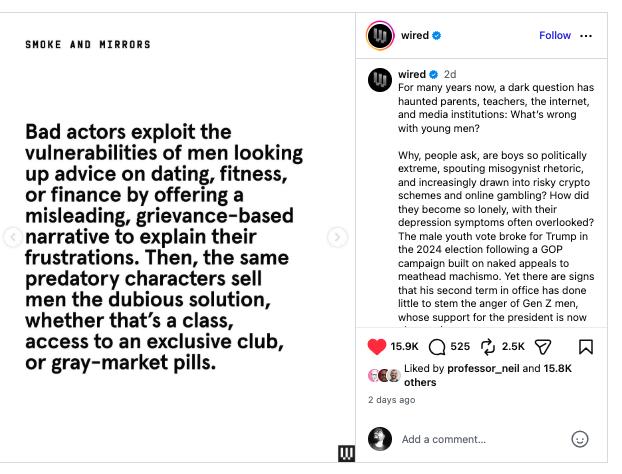
Despite 15 years and counting in the ecosystem that is “positive masculinity and the fight against the manosphere” I still find myself shocked by the appeal of the manbox. I still find myself shocked at how any person could land on ideas and beliefs that are harmful to themselves, to the people in their vicinity and to the community they live in.
Like, it literally makes no sense.
But leading with “WTF is wrong with you man” rarely moves anyone towards outcomes I would like to see so I’m always looking for entry points to the mindset in order to hopefully better position myself to help people find the exit sign. That being said, this framing (as laid out in a long IG carousel by @wired) is new and could be a break through.
I’ve never seen the economic “pyramid scheme” lens taken in our work but it absolutely makes sense. We know our society is full of opportunities to grift, and there is no shortage of folks willing to make a buck off the backs of someone’s suffering elsewhere. So of course, as the post lays out, it stands to reason that if manbox thinking has men (especially the 18-29 year old crowd) second guessing their looks, their body types, their dating life, of course there would be people offering phony ass solutions for a special “$49 today only” rate.
I won’t spoil the entire post (but will link to the study it cites by Equimundo here) because I think it warrants a read from you, a bullet break down for your staff AND ultimately a convo with your guys.
And imagine the power of presenting this to them—and, if you're a high school coach, their parents—not initially as a conversation about misogyny or masculinity, but about the financial shell game some online "gurus" are running on young men.
Who benefits financially from you believing you're not muscular enough? Not rich enough? Not getting enough women? Not "alpha" enough?
What happens to their business model if you actually become comfortable with yourself?
Coach Prompts
What online personalities are your athletes learning from about money, fitness, dating and masculinity—and which of those people are also selling them something?
How could financial literacy become an entry point for discussing manosphere content without immediately putting athletes on the defensive?
When an influencer identifies a problem young men supposedly have, how often are we teaching athletes to ask who benefits from them believing that problem exists?
Player Prompts
Think about someone online who regularly gives men advice: what does that person eventually want their audience to buy?
How can you tell the difference between someone helping you solve an insecurity and someone who financially benefits from keeping you insecure?
What would happen to an influencer's business if his followers eventually decided they were already good enough?
If today's post made you wonder whether your program is actually preparing young men to question the messages—and messengers—competing for their attention, don't guess.
Click here to run the free Decision Confidence Analysis™ and discover where your program is reinforcing healthy decision-making—and where hidden gaps may still exist.
"We Have Good Guys" Is Not a Prevention Plan
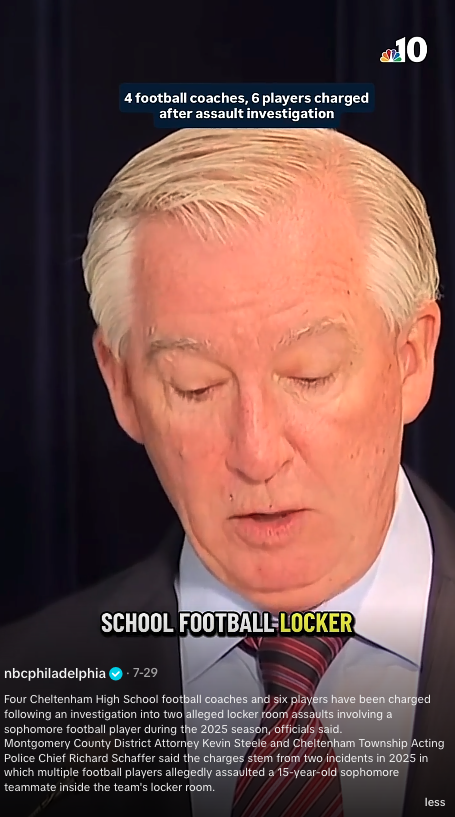
I struggle with the phrase “ambulance chaser.” On one hand, I know there is precedent for media to go towards “the flashing lights” so to speak to find something newsworthy. But on the other hand, I also know that awareness is a key component to driving change so sharing things that should raise alarm bells is necessary.
I’m leaning more on the latter today.
Let’s start by sharing the various reports about the debacle at Cheltenham HS (PA) and their football program. The video above and the article here detail an awful situation at Cheltenham High School in Pennsylvania, where a 15-year-old football player was allegedly assaulted twice in the locker room. Six players now face charges, and prosecutors allege four coaches subsequently attempted to cover up what happened.
A truly awful situation all around.
What’s the TeamsOfMen angle here (besides the obvious “We need to be molding better moral compasses in our guys”)? First, what’s the current plan you have for your players when the final bell rings on a HS campus and before the first whistle blows at practice? How long, how often and where are they unsupervised? If there are logistics at play that make staffing your spaces difficult, what early season conversations have you had that dictate the expectations in the locker room AND what “courage” looks like when you stand up for someone being bullied? Have your players ever actually practiced what intervention looks and sounds like when the person crossing the line is their teammate?
Those are just a few of the questions I would use as an AD and a Head Coach to ensure we have a plan of prevention not reaction to something this serious.
And to be clear, “Well, that won’t happen here because we have good guys” is NOT a solution.
Coach Prompts
Where and when are your athletes regularly together without direct adult supervision, and what expectations have you explicitly established for those spaces?
Have you taught your players what intervention actually looks and sounds like when a teammate is being humiliated, bullied, hazed or harmed?
If a player reported something serious to your staff today, does every coach know exactly what happens next—and who must be told?
Player Prompts
What makes it difficult to step in when the person doing something wrong is your teammate or friend?
What could you actually say or do if you saw a teammate being humiliated or harmed in the locker room?
At what point does watching, laughing, filming or staying silent make you part of what's happening?
If today's post made you wonder whether your program actually has a prevention system—or simply good intentions—don't guess.
Click here to run the free Decision Confidence Analysis™ and discover where your program is reinforcing healthy decision-making—and where hidden gaps may still exist.
The Coaching Myth We Keep Repeating
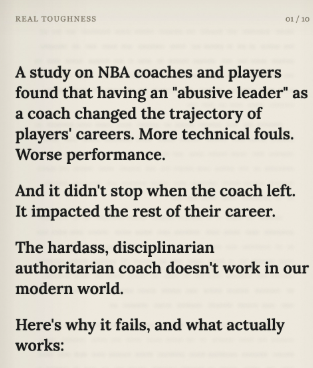
There's a phrase I've heard from coaches for years: "I was coached by a hardass, and look how good I turned out."
It’s a common cliche I hear a lot when I discuss what type of transformation someone’s coaching will undertake if you onboard TeamsOfMen, and something we push back against hard, usually via a “Well, I think you’re overestimating his significance and underestimating your own resilience”. But maybe this study will help folks identify that it literally DOES NOT produce the outcomes you think it does.
Posted on IG by @stevemagness, it not only details the career impact on NBA players of “hard ass coaching” (I’ll give you a hint: more techs, less points) but also lays out information on power dynamics, types of parenting models, and short term vs long term ability to make decisions on your own as both a player and person. These are all aspects of our job that we would want a study to reveal positive outcomes from using, when in fact this study reports poorer outcomes in several of the areas coaches often care about most.
This likely is NOT a blog post you want to share with your players, but rather use exclusively with your staff in the preseason before you launch a campaign. Is this worth our time to reevaluate the way we go about our jobs? Because if the report is true and “…they are only ‘tough’ when someone they fear is right next to them” we aren’t preparing then we're preparing athletes to perform under surveillance, not to make good decisions independently.
Coach Prompts
When you think of the toughest coach you've ever had, which lessons came from accountability and which came despite fear?
How would you distinguish between demanding excellence and leading through intimidation?
What behaviors do your athletes display when you're not in the room, and what does that reveal about your coaching?
If today's post made you wonder whether your coaching system is building independent decision-makers or simply compliant athletes, don't guess.
Click here to run the free Decision Confidence Analysis™ and discover where your program is reinforcing healthy decision-making—and where hidden gaps may still exist.
Strength Needs a Counterweight
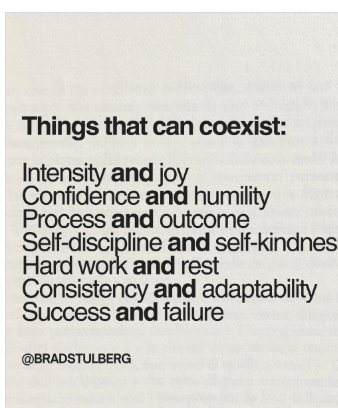
How many of the words on the right side of the graphic in the IG post above from @bradstulberg are welcome in your program? How often do you hear your male athletes use those words when talking about themselves, their teammates, or your program?
I ask because I have a sneaking suspicion that the left side words spend a lot of time existing in your world. I would wager that they are probably even championed by signs, shirts and slogans you use often. And I’m not arguing that that is a bad thing either.
I’m simply arguing that the words on the right describe states of being that are just as important as the words on the left. I’m arguing that the words on the right are just as much ingredients to winning as the others are. The manbox has taught us to see those traits as soft...But, as the original author argues, there is plenty of space alongside their companions and much NEEDED space at that. In many of the comparisons, they are the balancer, the leveling out component someone needs to become well rounded. Consistency can become a trap without adaptability. Confidence devolves quickly to cockiness without humility. The examples are numerous.
So, the main question I pose today to staff’s reading this: If you leave no stone unturned searching for balance in your offense, defense, or training plan, why wouldn't you pursue that same balance in the character traits your program celebrates?
The goal isn't replacing one side with the other. It's recognizing that the best competitors learn to hold both at the same time.
Coach Prompts
Which words from the right-hand column would your players say are genuinely celebrated in your program—and which are rarely acknowledged?
Are there qualities your athletes privately value but publicly avoid because they don't fit the image of toughness?
How intentionally do your slogans, praise, and corrections reinforce balance rather than extremes?
Player Prompts
Which pair on this graphic feels hardest to hold at the same time? Why?
Which word from the right-hand column do you think takes the most courage to live out as a male athlete?
If someone watched your team for a week, which words from this graphic would they use to describe you?
If today's post made you wonder which traits your program consistently celebrates—and which ones unintentionally get left behind—don't guess.
Click here to run the free Decision Confidence Analysis™ and discover where your program is reinforcing healthy decision-making—and where hidden gaps may still exist.
Is Your Locker Room Anyone's Favorite Place?
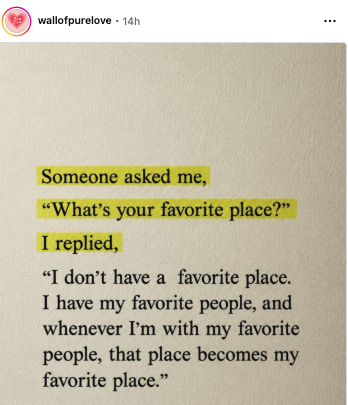
I’m not going to lie, I’m writing today’s blog with no clear cut landing spot in mind. What do you I mean by that? Typically, when I start these, I’m struck by a post or news item and I know in my mind the scaffoldings I’m going to build in my writing to both correctly frame the incident for a coach of male athletes AND what piece of TeamsOfMen philosophy it ties to.
Today is different.
The quote above (originally posted on IG by @wallofpurelove) stopped my scrolling. I nodded my head along with the sentiment, and thought “there’s blog here” but honestly, I wasn’t exactly sure what angle or frame I wanted to put on it. There were many candidates in my mind, including :
Men need a 3rd space (that isn’t HOME and JOB)
Can teams really offer valuable 3rd spaces if the space is filled with people they don’t trust?
Does favorite people always include teammates?
Power in your favorite place being fluid and nimble rather than static (and more susceptible to being taken away from you)
Do favorite places have to be free of strife
But then I thought “That's exactly what makes this quote useful.” and that means open to discussion and framing from your guys, not necessarily from you. This is one of those ToM sessions you can run by simply putting the quote/graphic up on your wall (or say out loud) and let them lead the room. Let them discuss it in pairs, small groups, or as an entire team, what defines favorite space, how they would label their own, and what qualities they think your space should have to even be considered a favorite space.
One final qualifier I would add for you and your staff: If one of your athletes honestly said, "I love this sport, but this locker room, weight room, or practice field isn't one of my favorite places to be," what would that tell you about your program?
Coach Prompts
What qualities would your athletes say make a space feel safe, welcoming, and worth returning to?
If your locker room disappeared tomorrow, what relationships would your players miss most?
How much of your program's environment is intentionally designed versus simply inherited?
Player Prompts
Who are the people that make a place feel like your favorite place?
Can a place still be one of your favorites even when it's difficult or challenging? Why?
If someone visited your team's locker room for the first time, what would they experience that might make them want to come back?
What Happens When Girls Walk Into the Weight Room?
I want you to think about last season for a minute. Go back to last season and picture the two or three places your team gathered most often to practice, lift, or train. Got the images?
Now, I want you to remember times a young woman, a group of women or a team in your athletic department of women walked through those spaces. How did you guys act? Was there cat calling? Was there snickering? Was it business as usual?
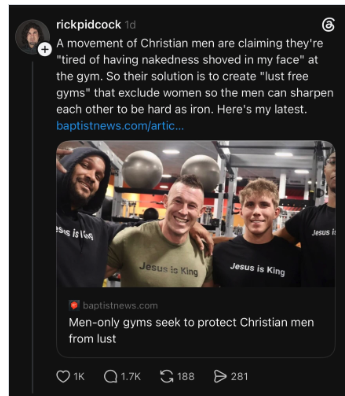
Why did I start today’s blog with this? Because the post I screenshotted to share above (originally posted on IG by @mentalhealness) is probably one you could share in a one off with your guys. Put it up, ask them to think about the weight room, and then walk through how ridiculous it is for a group of guys to admit (without knowing it) that they are unable to finish their own set of weights simply because a woman is present.
As if women wake up every morning and choose their workout attire to tempt men, as if women’s sole purpose on this earth is to convince men to have sex with them, and that men are so feeble of mind that they immediately go into a cartoon-like trance of assaulting anything that moves in their presence if skin is visible. The implication is that women bear responsibility for men's thoughts simply by existing in shared spaces. That shifts responsibility away from men's own choices and self-control. I HOPE you could share this and have that conversation with your guys.
However, I started this entry with the exercise I gave you because while your players may not be to this level of weaponized victimhood, they may have failed miserably in the moments I asked you to visualize. If you are a hoops coach, what happens in the transition time between the girls team leaving the floor and your guys taking the floor? If you’re a football coach, how do your guys behave while waiting for the soccer team to finish their practice before you take the field? If you are a strength coach, literally what happens when you have mixed gender training sessions (and if you avoid them, is it rooted in the silliness of the supposed Jesus is King guys in the graphic’s “lust free” desires)?
Today's post isn't really about these men or their gym. It's about using their argument to #MirrorTrain and examine what actually happens in your own spaces when women enter them.
Coach Prompts
Think about your shared athletic spaces. What behaviors consistently appear when girls or women enter the room?
Where are athletes receiving the clearest message about respect: during formal team meetings or in everyday transition moments?
If a female coach or athlete observed your team for one week, what would she say your culture communicates?
Player Prompts
Do you act any differently when girls or women enter the weight room or practice space? Why?
What message does your behavior send to someone who doesn't know you?
What does real self-control look like in shared spaces, and who is responsible for it?
Run Your Program's System Audit
If today's post made you wonder what your athletes actually communicate in the moments you're not addressing directly, don't guess.
Click here to run the free Decision Confidence Analysis™ and discover where your program is reinforcing healthy decision-making—and where hidden gaps may still exist.
Three Mirrors for Coaches

Let’s be clear: I’m not above snark.
I’m very okay with letting folks sit in some discomfort after being shown the hypocrisy of their own words vs their actions. That’s not an issue for me.
So, the slide show above (from IG poster @professorpolished) had me smiling through the scroll. But, it also sent me on a journey of “what would this type of show look like if it was pointed at the excuses I most often here in this work”?
So, after some brainstorming, I came up with around 25 of them, but I’ll just share 3 of them below
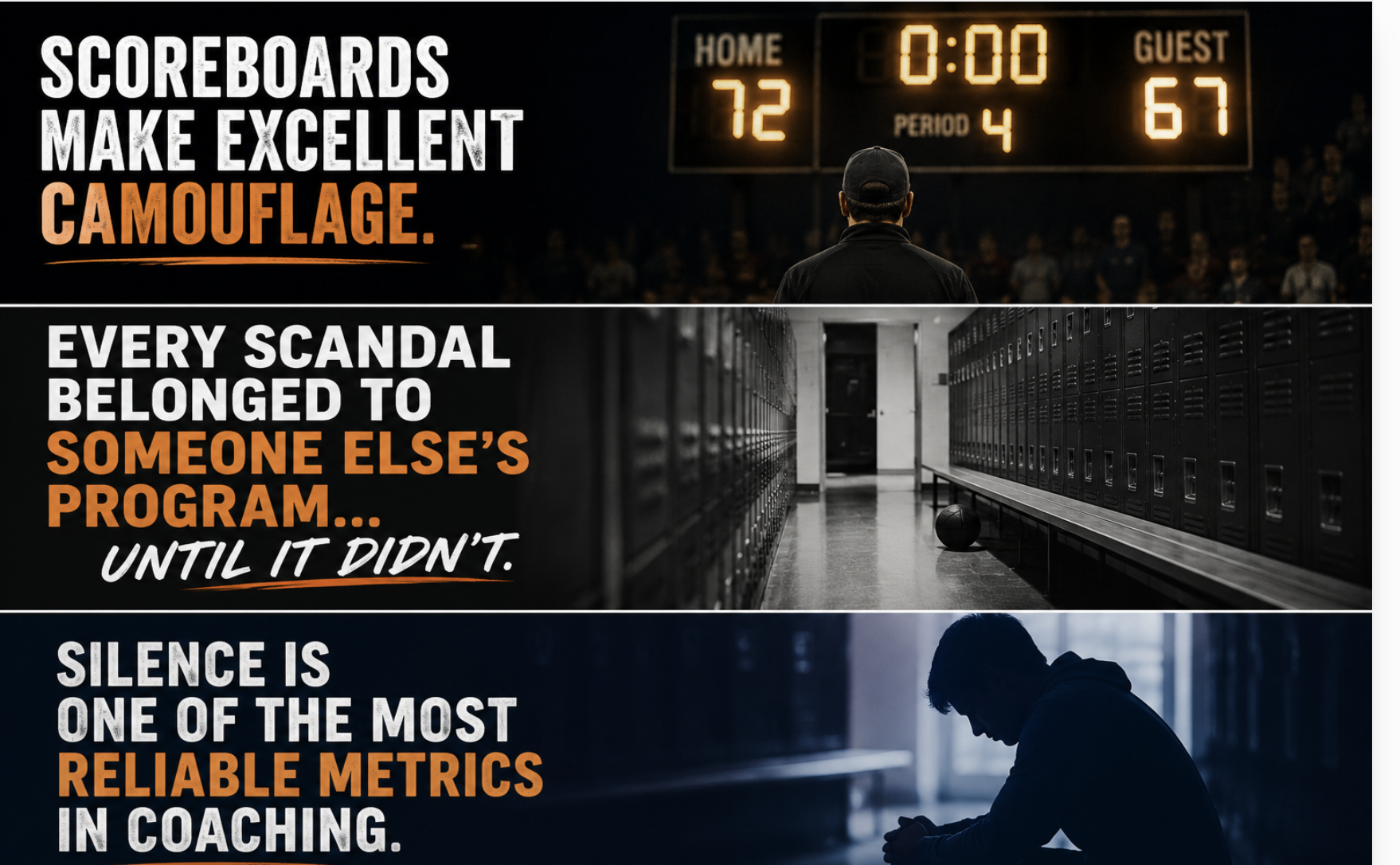
I will spare you all from explaining the biting “gotcha” moment of each, but I do want you to explore them and find for yourselves. Probably worth an exploration with your staff and or your players to, at the very least, find ways to disprove what I’m saying when applied to your program. If you can’t find concrete evidence that my statements are revealing the reality of how you coach your male athletes, it might be the impetus you need to change.
I might just know a guy you could call to get the ball rolling…
Coach Prompts
Which of the three statements made you immediately want to defend your program? Why?
What evidence—not intentions—would you point to that disproves each statement?
If your players anonymously answered these questions instead of you, would their answers match yours?
Player Prompts
Which statement do you think coaches most often miss? Why?
What does your team stay silent about that probably deserves more attention?
What parts of your team's culture are visible only when nobody from the coaching staff is around?
You wouldn't let your team run a game without a scout, but most programs leave their decision system entirely to chance.
If these statements made you even a little uncomfortable, don't guess whether they're true in your program.
Run the Decision Confidence Analysis™ (DeCA)—a free 15-minute system audit that helps coaches identify the invisible scripts, blind spots, and reinforcement patterns shaping how their athletes make decisions when no coach is around.
The report is free. The conversations it starts are often the most valuable part.
Take the DeCA and see what your program is actually teaching—not just what you hope it's teaching.
The Language Your Players Borrow
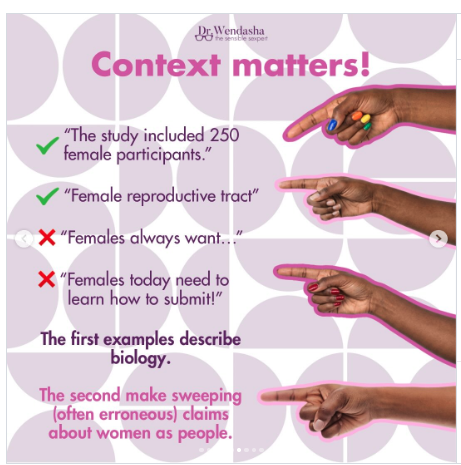
An excellent graphic from @thesensiblesexpert immediately made me think of two places I've heard the word "female" used.
NBA player Michael Porter Jr’s silly self on damn near every podcast he’s ever appeared on talking about “females be like” or “females are my vice”…
In my own team room, it's not something I hear every day, but I've heard it often enough that it caught my attention: "That's just how females are, man."
I think the entire slide show is worth your time, and this is an example of a session you can run as more educational than accusatory. My guess is many high school boys have never actually been taught the distinction. They've simply repeated language they've heard from peers, podcasts, social media, or adults. This doesn’t have to be a lecture from on high session where you come down on them necessarily.
More effective would be to approach it with “Have you heard this before” and “what context/what sentence structure did you hear it used”. Write all those out on the whiteboard and then launch into why using “females be like” should be avoided. As the author in the IG post points out, the issue isn't the word female. The issue is using a biological label in places where we'd normally refer to people as women. It subtly shifts the language away from personhood and toward categorization.
While I am loathe to sanitize any TeamsOfMen sessions (too often we hear people weaponize something like “meet them where they are” and really what they are asking for is “don’t make them feel bad” protection for men) but I do think semantics in language can be nuanced and this is a good opportunity to adjust tone. When the goal is learning rather than winning an argument, coaches can still be direct while helping athletes understand why language shapes the way we think about other people.
Coach Prompts
Where have you heard your athletes casually repeat language from podcasts, social media, or influencers without thinking about what it communicates?
How can you create space for players to examine language without making the conversation feel like a public shaming?
What everyday phrases have become "normal" in your locker room that deserve a closer look?
Player Prompts
Where do you think most of the phrases you use about girls and women originally came from?
When someone refers to a group as "females," what message do you think it sends compared with saying "women" or "girls"?
Can you think of words or phrases you've stopped using because you learned they affected people differently than you intended?
Run Your Program's System Audit
You wouldn't let your team play a game without a scouting report, yet most athletic programs leave their decision systems entirely to chance.
If today's post made you wonder what everyday messages your athletes are absorbing—and reinforcing—inside your locker room, don't guess.
Click here to run the free Decision Confidence Analysis™ and discover where your program is reinforcing healthy decision-making—and where hidden gaps may still exist.
The First Thing They Say Matters
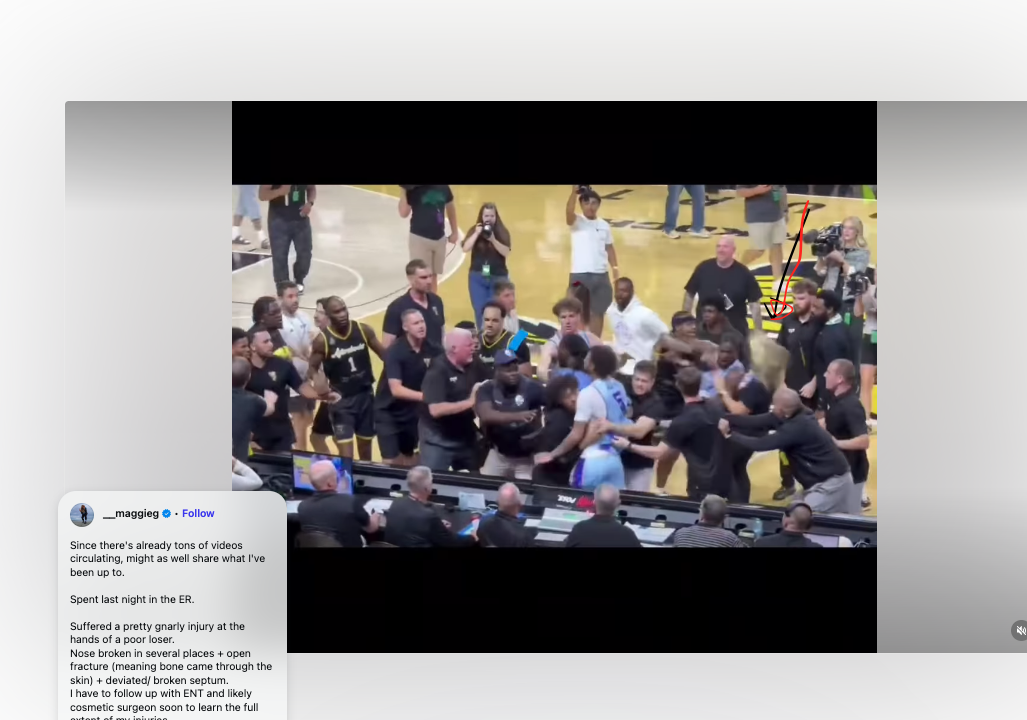
First assignment(s) before going any further in this blog:
Click on the image above and WATCH the video.
Pay particular attention to the woman on the right (red arrow I added to the screen grab above should help you find her).
Now, as you watch, you can also be given context that this happened post game of the TBT tourney and the team in blue had hit a buzzer beater to win on the team in black’s home floor (I don’t want to waste time going over the details of what the TBT is, who the two teams are, etc because to do so I think would lean into ‘hey, you gotta understand emotions were high” bullshit excuses people are already assigning to the melee that took place). The post is from the woman, and you can read the litany of injuries she suffered during this.
Now, play the video for your team and staff. Then, without any other questions or words from you or the players allowed, show the image below (whichshow the image below, which reflects a sentiment repeated throughout the comment section.)
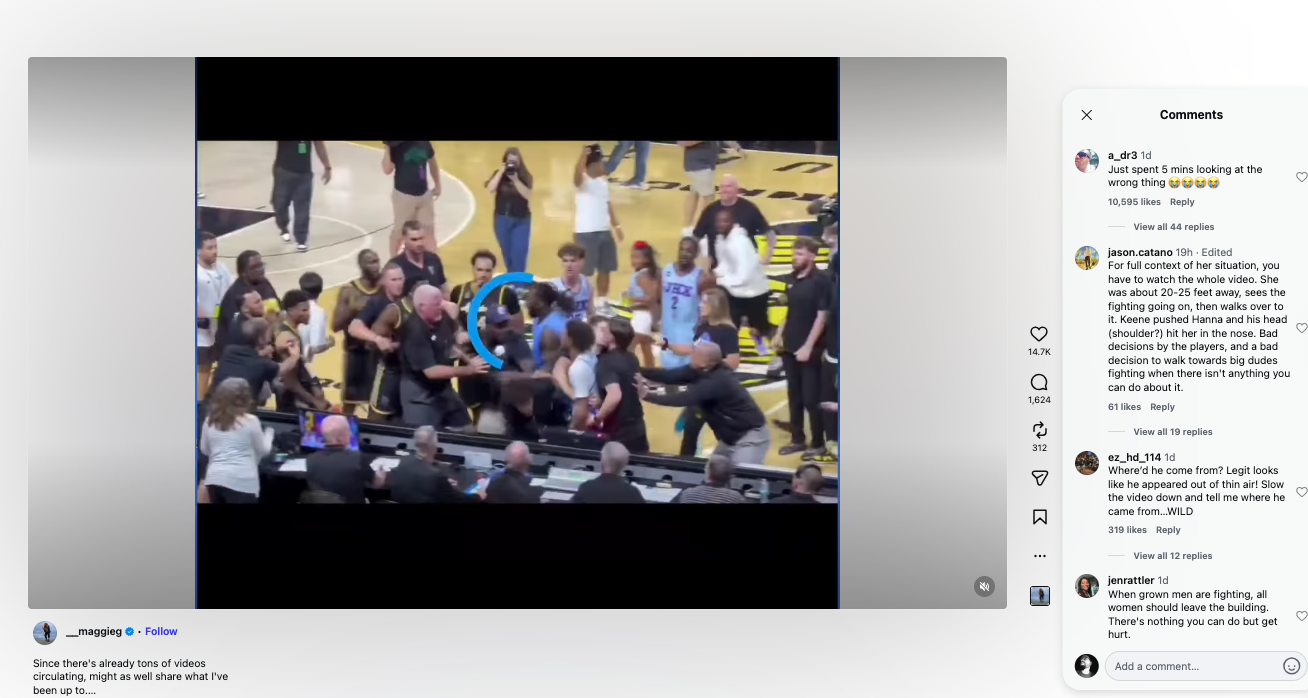
Men are literally jumping in this woman’s comments to explain why it was somehow HER FAULT for getting her nose broken and face smashed here. That “she should know better” than to get in the middle of men losing their goddamn minds over a silly game. This is clearly, as I stated above, victim blaming. This is obviously sanitizing and excusing of men’s emotional illiteracy and the harm they cause when in the throws of it. Hell, there’s even other women blaming her for not knowing to leave when men escalate.
I want you to garner input from your staff and players without my obvious leaning here. I want you to gauge your room and I want you to understand that if you have a staff or team full of dudes repeating this comment, you have a culture of complicity and a climate that excuses violence. Period.
I can’t sugar coat it for you. At a minimum, I'd hope your players respond with empathy: "Oh my God...that poor woman."
At the highest level, I'd hope they're angry—not simply because someone was injured, but because they recognize the comments afterward as another example of excusing men's inability to regulate themselves.
Unfortunately, I don't think enough locker rooms are there yet.
Moments like this are why I don't believe a single guest speaker changes a program. They reveal beliefs that have been quietly rehearsed for years. If we want different first reactions, we have to spend years building different first instincts. That's why TeamsOfMen has never been about one conversation.
It's about changing the scripts players automatically reach for when moments like this happen.
Coach Prompts
Before offering your perspective, what did your players' first reactions reveal about the beliefs already present in your locker room?
When harmful situations happen, does your team instinctively ask, "What happened to her?" or "Why was she there?" What does that difference tell you?
How intentionally are you shaping your players' first instincts, not just their answers after discussion?
Player Prompts
What was the very first thought you had after watching the video?
Why do you think so many people immediately focused on what the woman "should have done" instead of what caused her injuries?
If someone had been hurt trying to stop a fight involving one of your teammates, what responsibility would your team have afterward?
Run Your Program's System Audit
This discussion wasn't really about a basketball fight.
It was about the invisible beliefs your players and coaches reached for before anyone started teaching. Every athletic program is building those scripts—whether intentionally or not.
If today's exercise made you wonder what beliefs are quietly shaping decisions inside your own locker room, don't guess.
Click here to run the free Decision Confidence Analysis™ and discover where your program is reinforcing healthy decision-making—and where hidden gaps may still exist.