

The Manbox Loves Military Metaphors
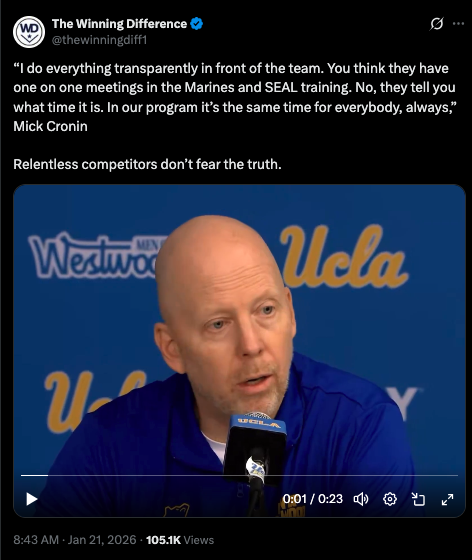
Today’s blog is in response to this rant from UCLA coach Mick Cronin — and really, to the larger pattern of coaches using military jargon and “warrior” aspiration as both a media persona and a coaching philosophy.
In this clip, Coach Cronin explains he doesn’t do 1-on-1 meetings with players because “the Marines and SEAL training” doesn’t.
What?
No, seriously.
I know Coach Cronin has won hundreds more games than me and he coaches at one of the meccas of college hoops… but this reeks of either (1) a deliberate attempt to avoid authentic dialogue with his guys, or (2) a grown man immersed in a fantasy he’s using to justify his worldview.
We don’t coach soldiering.
We are not in the business of training men to kill, to deploy, or to defend strategic assets.
We coach a game.
Yes — we want guys who are hard-nosed, competitive, resilient. Of course. But we don’t “take on armed adversaries.” We trap ball screens. We guard actions. We finish through contact.
And avoiding calm, respectful, one-on-one communication with players isn’t suddenly excusable because you borrowed a drill-sergeant script.
Also… if you’ve never served, how are you so certain what is or isn’t done? Because you read a David Goggins book? (Or more likely: saw a quote graphic on Instagram attributed to “a Marine” once?)
We have to escape this line of thinking — both as men and as coaches.
Coach Prompts
Where do you borrow “war” language to justify behavior you wouldn’t defend in plain English?
What do you gain by avoiding 1-on-1 conversations with players — and what does your team lose?
Do your athletes experience you as “hard” or as “unsafe to talk to”? Be honest.
What’s one “toughness” script you’ve inherited that you’re ready to retire?
Player Prompts
When a coach talks like you’re in combat, what does it make you feel: motivated… or disconnected?
If you needed to say something real to a coach, would you feel safe doing it? Why or why not?
Where do you use “toughness” as a mask to avoid honest communication?
When New Tools Threaten Old Scripts

Today’s blog is about a discussion on the JAAM podcast on why some people fight sex education so hard.
Quick note: it’s a progressive take. Those of you who read me know that’s where I lean, too. But even if you don’t share that worldview, I want you to consider the core argument underneath it:
Once you know, you can’t un-know.
It’s the same thing we deal with in sports and life.
Once your players learn the expectations for a play, a defense, or a training standard… they can’t pretend they don’t anymore.
Once you learn the expectations of punctuality at your job… you can’t keep showing up late and act confused.
The JAAM conversation highlights the same dynamic with sex education and relationship skills:
When you give young people real information — boundaries, consent, healthy communication, red flags — you’re handing them tools that make it easier to notice when someone is violating those standards. They can’t live in the dark anymore. And neither can the adults around them.
That’s why this stuff gets resisted so aggressively. Not because knowledge is dangerous — but because knowledge creates accountability.
TeamsOfMen is built on the belief that young men want to be better, want to be good people. And when we stop speaking in vague warnings and start giving them the “how”… most of them lean in.
Coach Prompts
Where do you stay vague because clarity would require you (and your staff) to hold a harder line?
What “life skill” do you assume players should already know, but you’ve never actually taught?
When players learn better, are you prepared to be held to that same standard?
Player Prompts
Where do you see guys crossing lines—and what do you usually do in that moment?
What would it look like to be a teammate who makes your circle safer, not just funnier?
What’s one boundary you need to get clearer on—in how you talk, flirt, joke, or pressure?
You Can’t Coach What You Won’t Practice
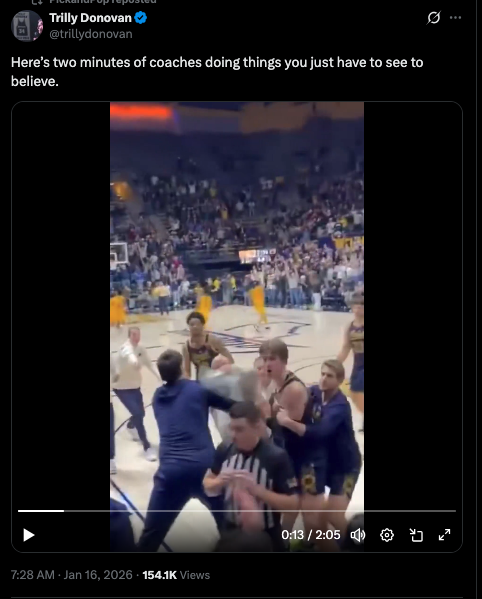
Today’s blog is about a 2-minute compilation video titled something like “coaches doing things you have to see to believe” — and it’s exactly what you think it is.
It’s packed with moments most of the coaches shown (many at the D1 MBB level) would want back: emotional rage, physical outbursts, verbal tirades, heat-of-the-moment comments… the kind of stuff that, if a player or staff member did it, the same coach would say, “That can’t be who we are as a program.”
The TeamsOfMen POV is simple:
We can’t beg and plead with young men to have poise and emotional control… while we constantly go over the line, refuse the pause, and then excuse it with “I’m a competitor” or “it was the heat of the moment.”
I’m not arguing coaching isn’t high-stakes and high-tension. It is. It’s a profession laced with pressure and constant hits to your nervous system. No debate.
But here’s the question I can’t get past:
With how much time we spend preaching preparation to players — “do the work,” “train for tough moments,” “stay poised when it’s tense” — why aren’t we doing the same thing?
Why aren’t we investing in therapy? De-escalation skills? Calming techniques? Breath work? Tools that help us stay in control when the stress spikes?
We are the adults in the room.
We don’t get the same “he’s just a young man finding his way” pass our players do.
We have to be better — and we have to be willing to show our guys how we’re trying to be.
Coach Prompts
Where do you use “competitor” as a cover for behavior you’d never accept from a player?
What’s your tell right before you go over the line (tone change, pacing, blaming refs, sarcasm)?
If your worst sideline moment went viral, would it reflect your stated values?
What tools are you actively building for regulation (therapy, breath work, de-escalation skills)—and who on your staff knows you’re working on it?
What’s one “pause rule” your staff could adopt this week (10-second reset, assistant steps in, no ref-chasing, etc.)?
Player Prompts
When a coach loses it, what message do you actually receive—about control, leadership, and respect?
What’s the difference between being intense and being reckless?
If you acted the way some coaches act, what would the consequence be? What does that teach you?
What’s one reset you can use when you feel yourself spiking (breath, hands to sternum, walk-away, phrase)?
MLK Day: The Cost of Looking Away

I chose this image for today’s blog because it’s one of two I’m using with my players on MLK Day 2026.
MLK Day has always mattered. But in the world we’re living in right now, I think it’s also a day coaches quietly decide to ignore — not because they don’t care, but because they’re weighing the potential blowback of acknowledging what the day actually represents. If you coach in a deep-red community, that fear is real. I get it.
But I also think it’s worth remembering: Dr. King wasn’t “controversial” because he was rude. He was “controversial” because he was committed. And he was killed for it.
So here’s how I’m trying to honor him today without doing the usual quote-fest (especially knowing how often Dr. King’s words get cherry-picked and weaponized by people who don’t actually stand for what he stood for).
We’re going to talk about one concept: turning a blind eye.
I’m going to ask my guys to define it. Then I’m going to ask why people choose it — why we willingly ignore harm or injustice happening in our vicinity… or caused by us. And what that kind of silence costs a team, a school, and a society.
Because Dr. King’s life was built on the opposite of blindness. His actions were those of a man unwilling to stay quiet, unwilling to look away, and determined to do something about what he knew was wrong.
Then I’m going to bring it home to them.
I’ll ask them to look for baby steps toward courage in their own lives — starting with themselves. And I’ll ask a specific question:
What’s the red line in our team room, our school hallways, or our team bus that would make you speak up — even if it costs you something?
It won’t take longer than eight minutes.
But I’m hopeful it gives them something real to act on.
Coach Prompts
Where have you “kept it moving” because addressing it felt inconvenient or risky?
What’s one topic you avoid with your team because you’re afraid of blowback — and what does that avoidance teach?
What’s a clear “red line” in your program that you’re willing to name out loud and protect consistently?
How do you model courage: with speeches… or with actions?
Player Prompts
What does “turning a blind eye” look like in your world (team room, hallway, group chat)?
What’s the difference between “staying out of it” and choosing silence?
What’s one moment you wish you would’ve spoken up — and what stopped you?
What’s your red line: what would make you say, “Nah. Not here. Not us.”
The Gambling Talk We Pretend Isn’t There
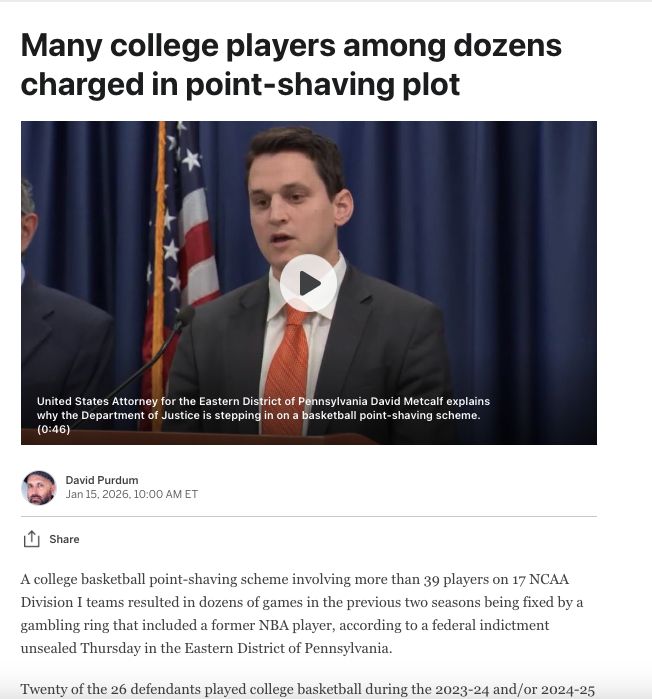
Today’s blog is in response to new reporting from ESPN regarding gambling in college sports — specifically tied to college basketball and an alleged point-shaving scheme.
I’m writing about this not because I think you have a kid on your team trying to “perform to a prop bet” to get paid by gamblers… although let’s be real: that is now a component of sports in 2026.
I’m writing about it because I wonder how many of us are hearing — and even helping create — gambling culture inside our own programs.
The language is everywhere: overs, unders, +100 / -250, parlays… team lines, player props, fantasy football. That terminology is bathing college and high school locker rooms.
And yes, sports gambling is legal in most states now. But legal doesn’t automatically mean healthy — especially for developing teenage and young adult minds.
What’s terrifying about this story isn’t just the wrongdoing. It’s the depth. The reach. The way it touched so many programs.
To me, that’s a call for every staff to at least have a real conversation about two things:
What are we going to do with what we hear in our locker rooms?
What are we willing to say out loud to players about our own habits — fantasy, betting talk, “lines,” and the way we normalize it?
Because the slope is real. And pretending we’re not part of the environment doesn’t protect our guys from it.
Coach Prompts
Where is gambling language showing up around your team (parlays, props, “lock,” overs/unders) — and are you treating it like background noise?
What’s your staff’s line: what do you ignore, what do you address immediately, and what do you proactively teach?
How often do adults in your building model it without thinking (fantasy talk, betting apps, “I had them -6”) — and what message does that send?
Player Prompts
What’s the difference between following sports and needing sports (emotionally or financially) to hit for you?
Have you ever felt pressure to perform a stat, not for your team, but for someone else’s “bet” or “fantasy” outcome?
When does gambling stop being “just for fun” and start being a problem? What are the signs?
The Palms-Up Problem
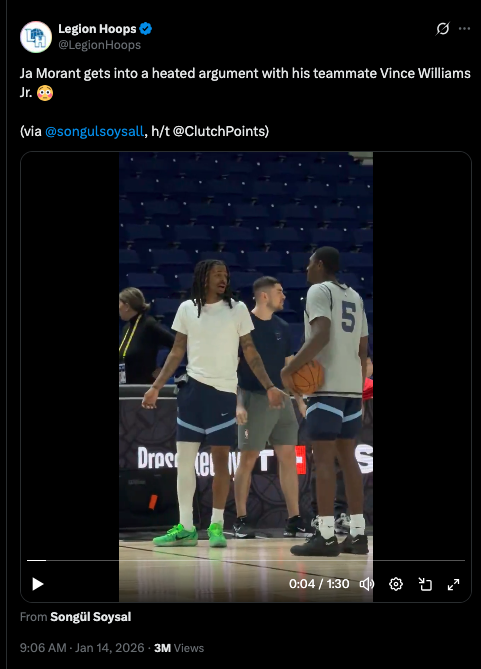
Today’s blog is in response to the interaction video making the rounds between Memphis Grizzlies players Ja Morant and Vince Williams Jr.
I’m not going to speculate on what they’re arguing about. I’ve seen the “expert lip reader” takes floating around — I’m not doing that.
The TeamsOfMen teaching moment here is body language, specifically the hand gesture Ja uses a lot: the double palms up look.
I’ve argued for a long time with my players (college and high school) that double palms up is often the last bastion of regulating anger and frustration. Once you hit that posture, you’re inches away from giving up on rationale, giving up on the conversation, or deciding the other person isn’t worth trying with.
So we’ve taught our guys a simple replacement this year:
Take those palms and press them together (almost like prayer hands), and bring them to your sternum — or point them toward the actual topic.
It’s a redirect. A focal point. A way to center yourself and your feelings so you can stay productive instead of sliding into contempt.
Is it foolproof? Of course not.
But we believe conflict is inevitable — it doesn’t have to be hurtful.
We believe truth matters — but truth doesn’t have to be delivered like an asshole.
NOTE: If you show this to your players, I’d play it on mute first. The body language tells you plenty. And pay attention to the moments where others in the org feel it and try to step in — that’s part of the lesson too.
Coach Prompts
What “tells” do your players show right before they spiral—palms up, eye rolls, walking away, sarcasm?
Do you coach body language the same way you coach footwork and spacing? Why or why not?
What’s one replacement cue you can teach your team for conflict moments (a physical reset, a phrase, a breath)?
Player Prompts
What does your body do when you’re about to check out of a conversation?
When was the last time you were “right” but still made it worse by how you delivered it?
What’s one small move you can make to stay productive in conflict—without pretending you’re not mad?
The Most Unpopular Skill in the Manosphere
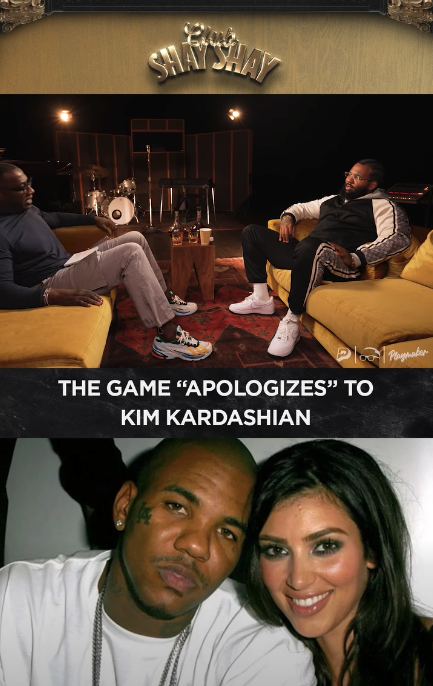
Today’s blog is in response to this interview with The Game and Shannon Sharpe on Sharpe’s Club Shay Shay. The topic is a past statement and rap lyrics The Game used to call out previous intimate relations with Kim Kardashian (during her marriage to Kanye West).
Now, almost everyone involved in this story gives you plenty to quarrel with in terms of morality and humanity (and yes — Kanye in particular is off the rails with his vitriol). But I still think this moment is useful.
Why?
Because The Game — a manbox-bathed hip hop artist whose public persona and lyrics often scream a scripted version of masculinity — does something you rarely see: he admits there is no excuse for what he said and did.
He says he spent years trying to justify it.
And now he’s in a place where he can name it plainly: he caused harm, and he should not have done it.
That level of accountability is rare in today’s manosphere.
Most guys — and especially famous ones — double down on the past. They hide behind “I gotta do me,” or “that’s just who I am,” instead of reflection, repair, and owning harm without bargaining.
SIDEBAR: I might be old enough that your guys don’t even know who The Game is… or who Kim Kardashian is… so this might not land. But the principle absolutely does.
Coach Prompts
Where do you see men in your program default to “explaining” harm instead of owning it?
What does real accountability sound like to you—without excuse, without blame shifting, without “context” doing all the work?
How do we teach repair after harm without turning it into humiliation or performative shame?
Player Prompts
What’s the difference between an explanation and an excuse?
When was the last time you owned something without adding “but…” at the end?
If you hurt someone, what does “repair” actually look like beyond saying sorry?
A Funny Video. A Real Point.
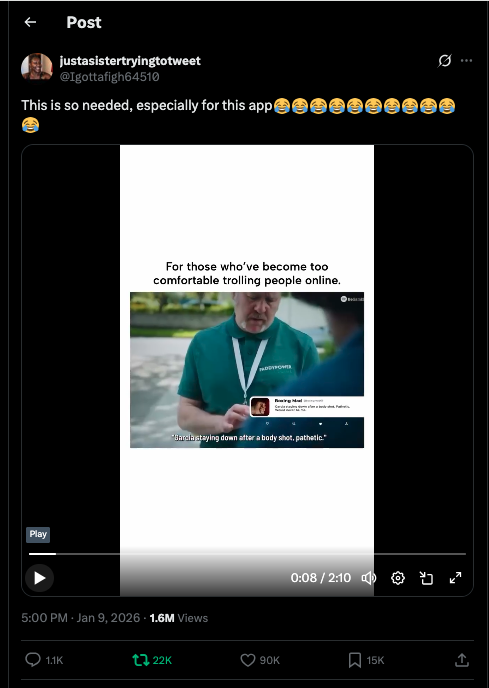
Today’s blog is in response to a viral video showing a “mobile team” called the Social Media Squad that allegedly pays home visits to men who make inflammatory, derogatory, or harmful claims on Twitter/X.
Watch the video and you’ll see the bit: they show up at the doorstep with real-world consequences attached. For example, they bring a boxer to the front door of a man who tweeted that he’d “never go down” from that boxer’s punch, etc.
I’m posting this knowing full well it’s not real — and honestly, it couldn’t be. Can you imagine the lawsuits?
But I still think it’s worth using.
Because it’s a funny way to make a serious point: accountability in the digital world is real, even when it doesn’t show up at your front door.
We can’t physically enforce it. But we can enforce something else:
We can ask one another — especially when we follow each other across platforms — to be better about what we post, and what we retweet/repost/cosign.
This is one of the more taxing parts of coaching in 2026. It’s not what most of us got into coaching to do.
But we have to do it.
Because the ramifications of a dumb post are severe — not only for the player who hit “send,” but for the program he represents.
Coach prompts
What do we say is “off limits” online for our program — and have we actually said it out loud to players?
How do we want players to handle it when a teammate posts something reckless: ignore it, laugh, or intervene?
What’s our standard for retweets/reposts/likes — what counts as cosigning in your eyes?
Player prompts
What’s something you’ve posted (or almost posted) that you’d never say to someone’s face?
What does it mean to “cosign” something online — and why do people pretend reposting doesn’t count?
If your post got screenshot and put on the wall of your locker room, would you stand by it?
You’re Partner Is Not A Vending Machine
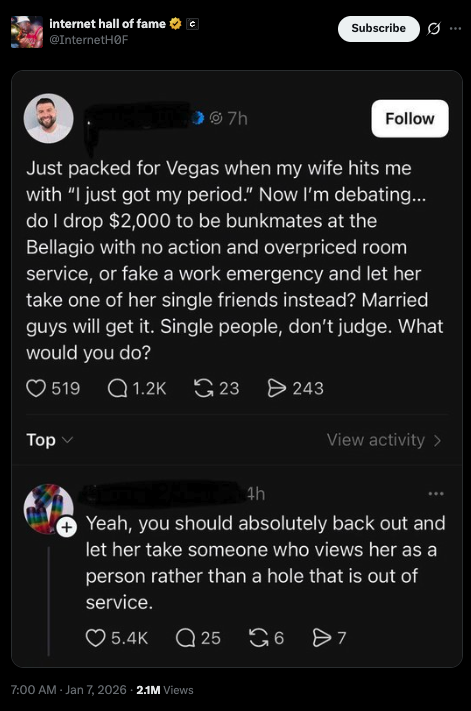
I’ve tried to keep the 30-Second Timeout space focused almost exclusively on framing current sports moments — players, coaches, teams, pro and college.
But this one was too good not to use.
Why?
Because you have players in your program (and coaches on your staff… and if we’re being honest, maybe even you) who would read the original post and think:
“Hmm, that seems pretty reasonable.”
or
“I’ve thought that way myself.”
The idea being: if we’re going on [insert trip / date / vacation] together, of course sex is part of the deal — otherwise why go?
And I think the highlighted reply is the exact smack in the face many of us need as men.
A relationship cannot be reduced to a physical transaction.
What we plan, pay for, or arrange in terms of “quality time” with a partner cannot exist solely as a down payment for sexual access later. And if that’s how we’re thinking — even quietly — it’s worth naming the manbox trappings we’ve fallen into.
This shows up everywhere.
For a high school coach, it might be players who believe buying dinner and a movie earns them some level of physical “payback.”
For a college coach, it might be players in longer-term relationships who start thinking, “Things were way hotter when we first got together… now I’m bored.”
This moment — and that response — can spark real conversations about what relationships actually require beyond novelty, access, or entitlement.
Because intimacy isn’t owed. Bodies aren’t rewards.
And being partnered with someone means seeing them as a person — not a service that’s temporarily “out of order.”
Coach Prompts
Where do you see transactional thinking show up in how young men talk about dating or relationships?
Have you ever heard players imply that money, effort, or time should guarantee physical intimacy?
How do we create space to challenge this thinking without shaming or lecturing?
Player Prompts
What’s the difference between planning time with someone and expecting something in return?
Where did you first learn the idea that sex “comes with” effort or money?
How would your thinking change if intimacy was viewed as mutual choice, not payoff?
Youth Hoops Isn’t a Military Boot Camp
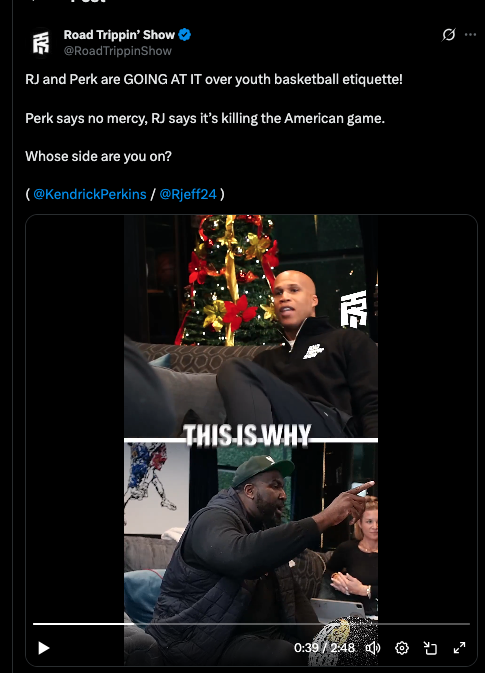
This conversation sits right at the intersection of two of my biggest passions: hoops and developing the next generation.
Both Kendrick Perkins and Richard Jefferson live in that space. Former NBA players. Current commentators. Guys who run club programs for young players. They’re both clearly invested, and I respect that.
My issue — which won’t surprise anyone familiar with our TeamsOfMen philosophy — starts with Perk’s very first rebuttal and the line about “developing killers.”
That phrase is completely soaked in manbox thinking.
This is a game.
If you want to develop “killers,” send them to the military.
And even if someone says, “Kip, he meant a killer mentality,” that’s still an opportunity for growth. As adults, we can evolve our language. He could say, “We’re developing players who know how to close out a win.” Words matter.
But here’s the bigger point: that’s not even the real argument being made.
RJ already establishes the common ground. He’s saying, when you’re up 30, the game is sealed — how do you approach the remaining time on the clock?
That’s it.
You can develop competitive, driven young people and teach them how to finish a contest with respect and dignity for a defeated opponent. Those things are not opposites.
The idea that a club sport team should function as a training ground for hardened, empathy-less souls is exactly the mindset we’re trying to dismantle with this work.
We don’t need youth basketball to produce “killers.”
We need it to produce skilled players, thoughtful competitors, and whole human beings who know how to win and how to be decent when the scoreboard already says they have.
Coach Prompts
When you’re up big, what specific lessons are you trying to teach in the remaining minutes?
How often do you rely on phrases like “killer mentality” instead of naming the actual basketball skill you want?
Where might your language about toughness be teaching values you don’t actually intend?
Player Prompts
What does it look like to finish a game the right way once the outcome is decided?
How do you separate being competitive from trying to embarrass an opponent?
What kind of teammate do you want to be remembered as when you’re clearly the better team?
Manbox Loyalty vs. Moral Courage
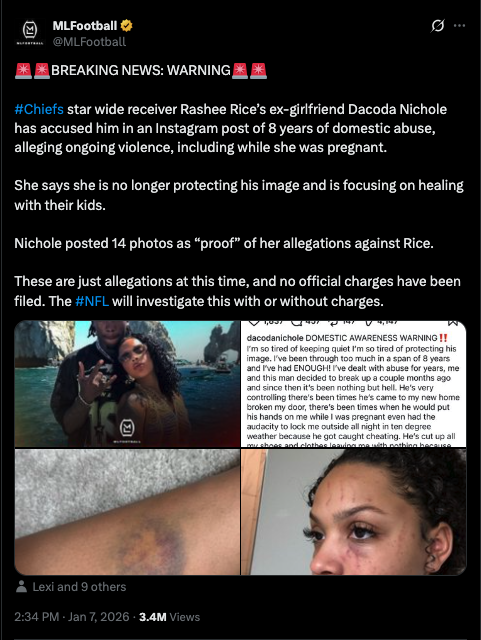
Today’s blog is in reaction to the recent allegations from Rashee Rice’s longtime girlfriend, Dacoda Nichole, regarding domestic violence and abuse.
I’m writing this to reiterate something that has been central to my TeamsOfMen work for over a decade: believing women and believing survivors matters. It is one of the hardest lifts in this work — and one of the most necessary.
Almost immediately, the comment sections filled with the same tired victim-blaming tropes that live inside DARVO tactics:
“Why did she wait so long?”
“How much money does she want?”
“She could have just left.”
“We don’t know the whole story.”
I will say this: I was genuinely encouraged to see some male Chiefs fans step up and say plainly, “We don’t want this type of person on our team.” That matters. It shows cracks forming in a culture that too often defaults to defense and denial.
But we also have to hold the larger context.
Earlier this year, Chiefs players wore “Free Rashee” shirts during warmups while he was serving a six-game suspension for a hit-and-run incident. That decision reeked of circling the wagons — not around accountability, but around image protection. It framed him as a wrongly accused victim rather than someone who, at bare minimum, deserved to sit out football games for his actions.
That instinct — defend at all costs, never admit fault, never show remorse — is straight out of the manbox playbook.
We teach men that loyalty means silence.
That accountability is betrayal.
That protecting “one of our own” matters more than truth or harm.
And then we act surprised when violence continues.
We can teach something different. We can show our players that accountability is not weakness. That honesty is not self-destruction. That reflecting on personal failure is not the end of a career — but often the beginning of real growth.
If we want young men to live differently, we have to model it differently.
And that starts with believing survivors, naming harm clearly, and refusing to hide behind the scoreboard.
Coach Prompts
What do you notice about your first instinct when allegations like this surface—defense, doubt, curiosity, discomfort?
How does “circling the wagons” show up in your program when a player messes up?
What language do you use with players to separate accountability from shame or abandonment?
Player Prompts
Why do you think people ask “Why did she wait?” instead of “Why did this happen?”
What’s the difference between supporting a teammate and excusing harmful behavior?
How might real accountability actually protect you—and others—long term?
Failure Hurts. Denial Lasts Longer.
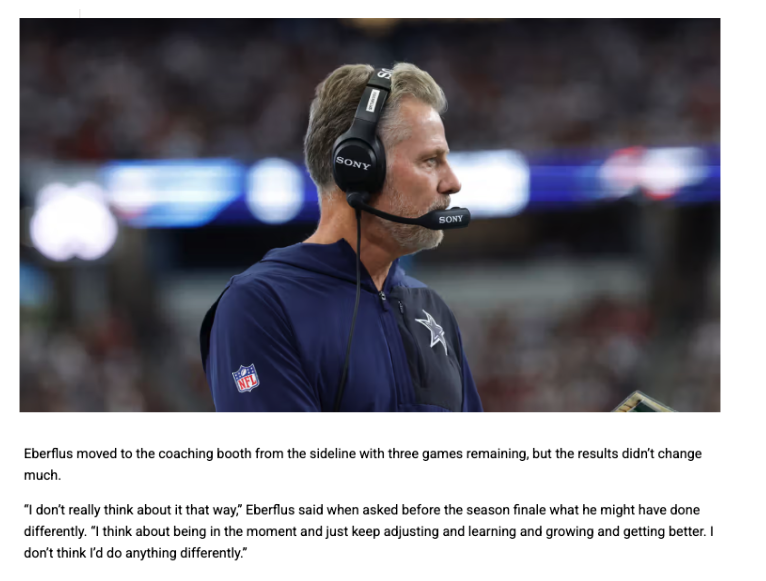
Today’s blog is in response to recently fired Dallas Cowboys DC Matt Eberflus’ statement:
“I think about being in the moment and just keep adjusting and learning and growing and getting better. I don't think I'd do anything differently.”
I have two direct connections to that quote.
First, as most know, I am a lifelong, die-hard Cowboys fanatic. That’s my team. That’s my fall mood dictator. That’s my oldest son and my most frequently discussed topic. Cowboys. Cowboys. Cowboys.
Second, as most also know, I’ve been fired as a coach.
It sucks. It is devastating. It is a scar — a wound — that never really leaves you.
I’m sharing this quote not to pile on the Cowboys or dehumanize the real cost of being fired. Being told “you can’t coach here anymore” hurts, no matter what the check looks like on the way out. Coach Eberflus will be fine financially, but that doesn’t erase the emotional reality of it.
What I want to sit with is the mindset reflected in that quote — because it’s one many men recognize.
You can hear the internal tension in the sentence itself.
On one hand, there’s language that aligns with TeamsOfMen values: learning, adjusting, growing. On the other hand, there’s a familiar manbox reflex that follows immediately: “But I wouldn’t change anything.”
I’ve heard that line over and over again. And I think it might be the last stronghold of a thought pattern that helped create the moment in the first place.
Because here’s the thing: If you genuinely believe in learning and growth, then by definition you would do something differently with the benefit of what you know now.
If you say you’re about adjusting, then you’re also saying, “I learned enough to coach this differently.”
What I’ve told people repeatedly is this: if I could go back to the losing seasons of my past and magically give those players more wins, I absolutely would. Without hesitation.
But I don’t want to lose the lessons I learned inside those failures — lessons that made me a better person and a better coach now.
Sometimes pride shows up in the form of cliches we repeat because they sound strong.
And if you’re responsible for the worst defense in the history of a franchise, it’s okay to say:
“Yeah, looking back, there are things I know now that I would have changed then if I had those tools.”
That doesn’t mean you lacked passion.
It doesn’t mean you didn’t care.
It means you grew.
And growth isn’t proven by saying you wouldn’t change a thing. It’s proven by being willing to say what you would.
Coach Prompts
When you say you’re “always learning,” what’s something you’d actually do differently if given another chance?
Where might pride be disguising itself as confidence in your leadership language?
If the results stayed the same, but you had today’s tools back then, what would you change without hesitation?
Player Prompts
Have you ever said “I wouldn’t change anything” to avoid sitting with a mistake?
What’s the difference between standing by your effort and refusing to adjust your approach?
How do you know when growth is real versus just something you say out loud?
Consent Still Counts When a Screen Is Involved
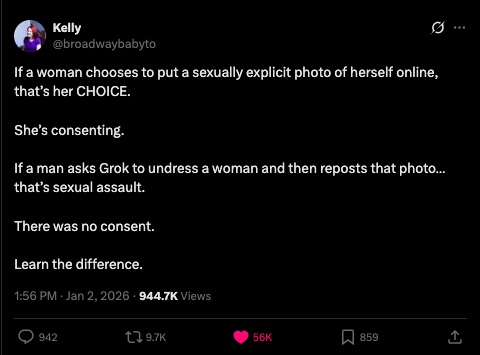
Today’s blog is based on this specific post and the alarming trend spreading across digital spaces — especially those frequented by teens and young adults — where AI is being prompted to undress women in real photos and produce what appear to be “real” images of them naked or semi-clothed.
It is horrifying.
It is disgusting.
And it is absolutely not a joke.
The post says it plainly:
If a woman chooses to put a sexually explicit photo of herself online, that is her choice.
That is consent.
If a man uses AI to undress a woman in a real photo — or reposts an image generated that way — that is sexual assault.
There was no consent.
That distinction matters. And it’s one too many men are pretending not to understand.
If you reflect honestly with your staff, this is not some distant issue your players might stumble into one day. It is something they will either: do in silence cosign with laughter forward in group chats or minimize with “It’s just a joke, Coach.”
It is not a joke.
It is a violation of consent.
It shows a complete disregard for the permanence of images once they exist online.
And it causes real harm to real people — often girls they know.
This is exactly why these conversations have to happen before an incident, not after. We cannot keep treating consent as something that only applies in physical spaces. Digital actions still involve real bodies, real people, and real consequences.
And if an act like this is committed, it cannot be handled with a shrug, a warning, or a “boys will be boys” explanation. It requires real accountability. Full stop.
Ignoring this doesn’t protect our players.
Coach Prompts
Have we ever clearly defined digital consent with our players, or have we assumed they’ll “figure it out”?
If this behavior surfaced in our program, do we have shared language — or would we scramble to react?
What consequences have we actually communicated for violations that happen online but impact real people?
Player Prompts
Why do people say “it’s just a joke” when someone else is clearly being harmed?
What’s the difference between someone choosing to share their body and someone else taking control of it?
How would you feel if an image like this existed of someone you care about — and you couldn’t make it disappear?
Crash Out Culture: The Moment, The Message, The Missed Opportunity
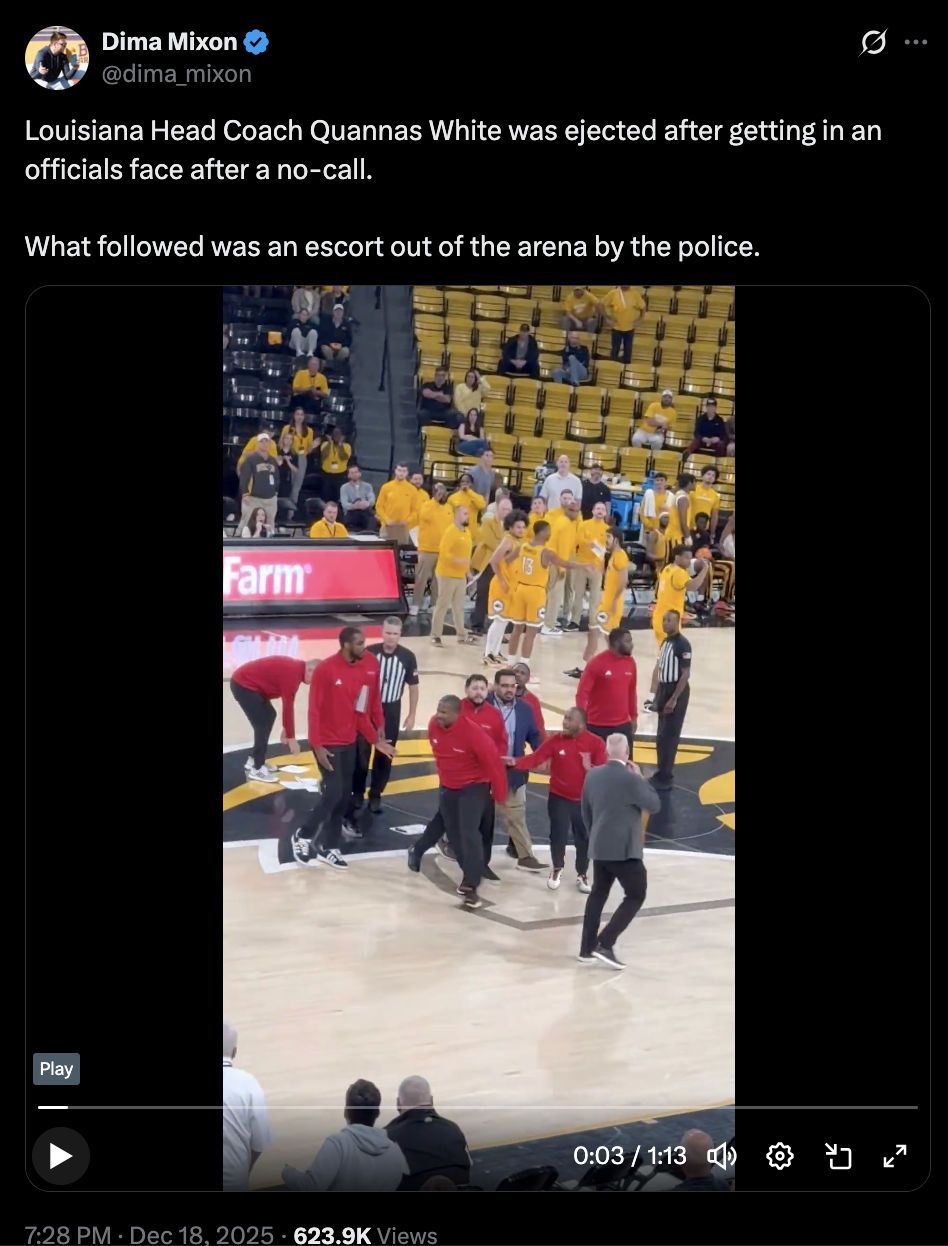
When Louisiana Head Coach Quannas White was ejected after a heated outburst at Southern Miss, the scene went viral. What followed wasn’t just a walk to the locker room—it was a full police escort off the floor. That visual, and the reaction to it, deserves your time and reflection.
Here’s why we’re putting it front and center:
1. You & Your Staff: Mirror Check
Bad officiating happens. And yes, frustration can boil. But we can’t be the ones begging our athletes to stay poised if we’re the ones cracking first. I’ve gotten techs. I’ve barked at stripes. But I’ve also made a decision the last five years: No more “working the officials,” no more sideline theatrics disguised as passion. Because my guys are watching. So are yours.
In the clip, it takes nearly the full staff to hold Coach White back at halfcourt. That image—grown men physically restraining another grown man—is not one we should ever accept as “part of the game.”
2. What the Comments Say About Us
Scroll the replies and you’ll see the real reason this clip belongs in a TeamsOfMen conversation: the reaction isn’t “How did we get here?” It’s “Why’d they need cops?” “This is soft.” “He didn’t do anything.”
This is crash out culture. The belief that our emotional spirals are someone else’s fault. The refusal to hold men accountable for public meltdowns. The normalization of grown men acting like kids when the pressure gets high.
We’re not here to pile on Coach White. We’re here to say: We’ve been there. Or we’ve been one laugh away from being there. The difference is whether we learn from the moment or excuse it.
Coach Prompts
How often do you and your staff talk about officiating strategy—beyond Xs and Os?
What message does your sideline behavior send your players after a tough call?
If a video of your worst sideline moment went viral, would it reflect your values?
Player Prompts
How do you react when things feel “unfair” on the court? What’s your outlet?
Have you ever watched a coach crash out? What did you think in that moment?
Why might the ability to stay composed under fire be a true separator—not just in games, but in life?
Success, Access, and the Lie We Keep Teaching Young Men
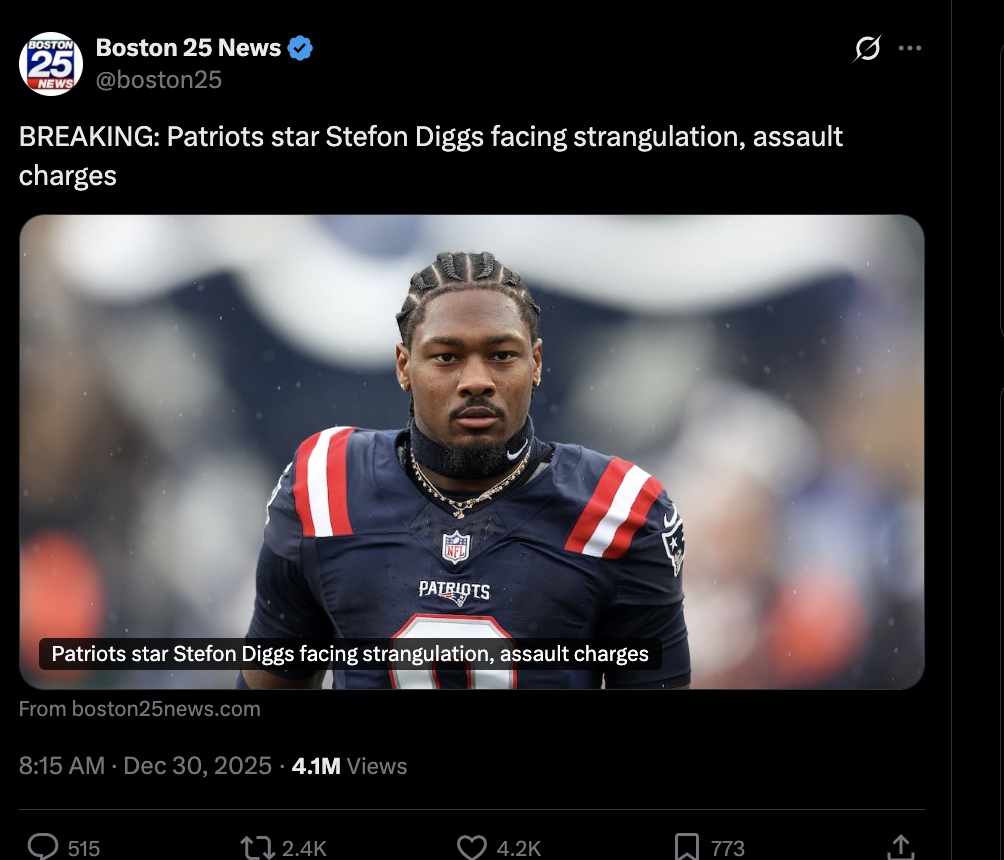
I want to be clear up front: Stefon Diggs has denied the allegations, and the legal process matters. Nothing here is about declaring guilt before facts are established.
But this situation still belongs in a team room conversation — especially with young men.
Because when you zoom out, this isn’t just about one player or one case. It’s about a script that keeps showing up.
Diggs is facing serious criminal charges. His attorney has reportedly attempted to seal records and disclosed efforts to resolve the situation financially. Separately, public reporting confirms multiple children with multiple women in overlapping time frames — including while in a highly visible relationship.
People will ask, “Why is this any of our business?” or, “Why would I bring this up with my players?”
Here’s why.
This is a textbook example of the Man Box formula that tells young men:
When the scoreboard says you’ve made it — when your stats, money, or status hit a certain level — access to women’s bodies is part of the reward.
That script doesn’t just distort how men treat women.
It distorts how men treat themselves.
Because having that many intimate relationships at the same time isn’t just about desire — it reflects a complete lack of boundaries, responsibility, and respect for bodies, consent, and consequences. At the very least, it signals behavior driven by entitlement rather than intention.
And let’s stop pretending this is “separate” from football.
If Diggs misses time because of legal consequences tied to violence or coercion, it costs the Patriots. When we say, “I don’t get into their personal lives,” this is exactly where that logic collapses. Personal choices don’t stay personal when they reflect power, control, and disregard for others.
Some will say, “Those women throw themselves at famous athletes.”
Cool — then answer this honestly:
What did you teach your players about the value of their own bodies?
About consent being mutual, ongoing, and not something money, fame, or effort buys?
If we never challenge the script that sex is proof of success, we shouldn’t be shocked when men chase validation instead of integrity — and leave wreckage behind.
This isn’t about policing relationships. It’s about teaching young men that achievement does not entitle you to anyone’s body — including your own being treated as disposable.
If we won’t talk about this, we’re not neutral. We’re complicit.
COACH PROMPTS
Where does your program explicitly challenge the idea that success equals sexual access?
How do you talk about consent outside of legality — as a value and a responsibility?
What message do your players receive about bodies, boundaries, and accountability?
PLAYER PROMPTS
Where did you learn what success with women is “supposed” to look like?
How do you know when desire turns into entitlement?
What does respecting your own body actually require of you?
Power, Scoreboards, and the Lie We Keep Telling Ourselves
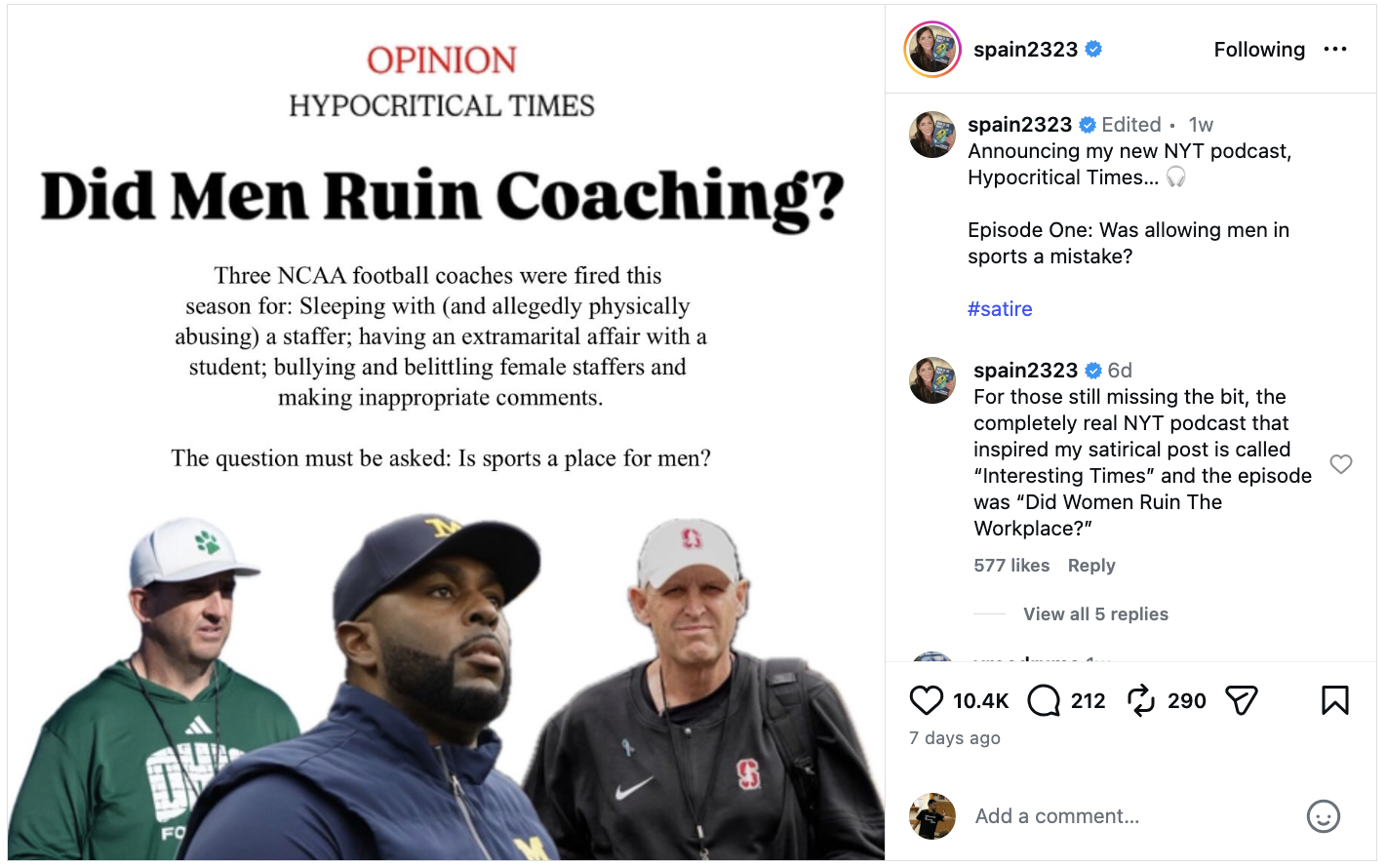
I’m sharing this spoof post from Sarah Spain not just because I respect her voice in the sports world, but because it lands on something we keep refusing to sit with.
Her satirical headline — “Did Men Ruin Coaching?” — is a direct response to two things happening at the same time:
a rash of college football coaches committing serious moral violations while in positions of power, and a very real New York Times podcast episode titled “Did Women Ruin the Workplace?”
That contrast matters.
Because we do have a long list of men who decided that scoreboard success should come bundled with either access to women’s bodies — often subordinates, often within clear power imbalances — or the right to rule their environment through vitriol, intimidation, and unchecked rage.
And yet we still call this a profession that “builds character” through the game alone.
Then comes the second wave — articles and commentary from other men saying, “We weren’t taught how to hold this kind of power,” followed by a full DARVO pivot that turns the disgraced coach into the victim. Suddenly the focus isn’t the wife, the children, or the younger woman now publicly branded for her proximity to power — it’s the coach’s pain, his pressure, his fall from grace.
Read the comments under Spain’s spoof and you’ll see it immediately:
Defensiveness. Anger. Blame-shifting.
“Women will get ya.”
“The power of the p***y.”
Every cliché soaked in Man Box thinking, all designed to avoid the same thing: accountability.
Here’s the reality we don’t want to face:
People who are willing to abuse power often seek it out — and are rewarded with it.
Which is exactly why I’ve always believed coaches of young men sit in a uniquely dangerous and hopeful position. We can reinforce the same scripts that keep producing these outcomes… or we can interrupt them early.
Reimagining manhood isn’t a side project to coaching.
It’s the work.
And whether we like it or not — WE are the work.
COACH PROMPTS
Where does your program explicitly talk about power — not just leadership?
How do you respond when accountability for men is framed as an attack instead of an expectation?
What messages about entitlement and access are your players absorbing without anyone naming them?
PLAYER PROMPTS
How do you usually react when someone you admire is held accountable — defensive, curious, or reflective?
What stories about success and access have you been taught that deserve to be questioned?
What kind of man do you want to be trusted with power — and why?
You Can’t Teach the Pause If You Don’t Use It
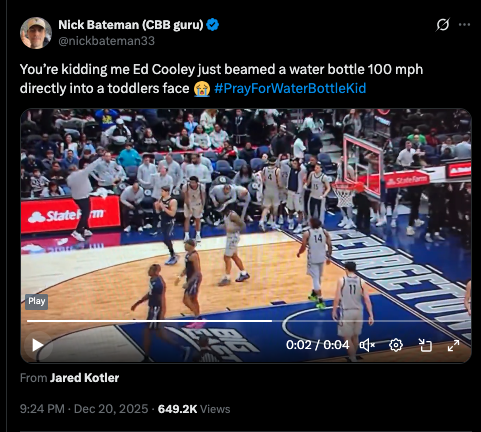
I’ve been a Georgetown fan since the Big John Thompson and Patrick Ewing days — through the Zo and Dikembe twin towers (I saw Zo’s final NCAA Tournament game in Boise), and peaking during the Allen Iverson Elite Eight run. I love the Hoyas. And I think Ed Cooley has done a credible job trying to turn that program around.
Which is why I was deeply disappointed seeing the clip last week of him losing emotional regulation and hurling a water bottle into the stands — striking a child.
I have zero doubt he did not intend to hit a kid. But intent isn’t the point here. The pause is.
If we expect players to pause in moments of disappointment, rage, or injustice — if we tell them to breathe, to regain composure, to channel emotion instead of ejecting it — then we have to ask: what was the best-case scenario when that bottle left his hand?
At best, someone was getting splashed.
At worst… exactly what happened.
I’m using this moment today because I tell partner programs and coaches — including my own staff — something we forget too often: kids are incredibly perceptive. They don’t miss contradictions. They smell hypocrisy immediately. They notice when the standard shifts depending on who’s wearing the whistle.
And when that happens, trust erodes.
This is now real work for Coach Cooley. Not a press release. Not an apology tour. But the slow, intentional rebuilding of the credibility required to look a player in the eye and say, “Hey — calm down,” or “Get it together.”
You don’t get to teach emotional regulation from a place of contradiction.
You teach it by modeling it — especially when it’s hardest.
COACH PROMPTS
What moments in your season test your ability to use the pause button the most?
Where might your players be quietly noticing contradictions between what you say and what you do?
How do you repair trust when you miss the moment?
PLAYER PROMPTS
How do you usually release frustration — and who might be affected by it?
What does “pausing” look like for you when emotions spike?
How do you respond when leaders around you don’t model what they expect?
A Stat Isn’t the Same Thing as a Story

We live in a world—and a coaching culture—that loves numbers.
Wins. Losses. Milestones. Bullet points.
But numbers are terrible at telling the whole story of who we became while chasing them.
I recently crossed a career stat that’s supposed to come with celebration.
Instead, it came with questions.
About time.
About comparison.
About the voices we internalize that tell us what should matter.
That tension—between the scoreboard and the mirror—is exactly where TeamsOfMen lives.
If you’re a coach, leader, or man who’s ever hit a number and still felt unsettled, I wrote about it more fully here: https://kioane.medium.com/a-stat-i-dont-know-how-to-feel-about-8ff2312808ba
Coach Prompt:
What stat do you secretly use as a verdict on yourself?
Player Prompt:
Who told you what “success” is supposed to look like—and who benefits from that definition?
The False Binary That Keeps Hurting Young Men
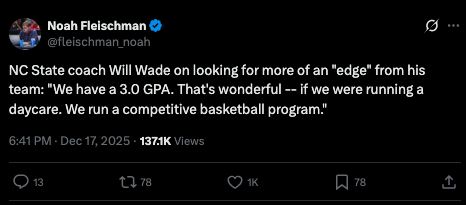
This quote attributed to NC State head coach Will Wade is a perfect example of the false binary TeamsOfMen exists to pull coaches out of.
The idea that we can either win or develop competitive young men who are thoughtful, emotionally fluent, and successful in the classroom — but not both — is a lie we keep telling ourselves because it’s convenient.
I’ve long recruited against that mindset. I tell my high school players the same thing now:
We are chasing both.
We refuse to sacrifice one for the other — in either direction.
We can compete.
We can be intense.
We can want to win badly.
And at the same time, we can demand academic excellence, emotional growth, and basic human decency.
If this quote is accurate (and to be clear, I haven’t done a deep journalistic dive to verify it), it reflects a familiar coaching shortcut:
“My job is to win, so winning requires sacrificing everything else.”
“You can’t win with softness.”
“Competitive teams need edge, not empathy.”
That’s Man Box–bathed nonsense.
Young men are capable of duality. They can be fierce competitors and smart as hell. They can be driven and emotionally aware. They can handle nuance — if we actually hold them to it.
Here’s the part that worries me most:
Once you decide it’s okay to expect less of your players as people, it becomes very easy to treat them as less than fully human.
That’s when coaching turns into rage.
Into humiliation.
Into constant demeaning language disguised as “standards.”
We don’t need that to win.
We never did.
We can be better — and the best programs already are.
COACH PROMPTS
Where have you unconsciously accepted a false choice between winning and humanity?
What standards do you hold players to off the court that match the intensity of your on-court demands?
How does your language communicate belief in your players’ full capacity — or lack of it?
PLAYER PROMPTS
Do you feel like your coaches expect you to be great in all areas — or only when it affects the scoreboard?
How do you define “competitive,” and who taught you that definition?
What would it look like to chase excellence without losing yourself?
We Are the Work — Even on the Good Days
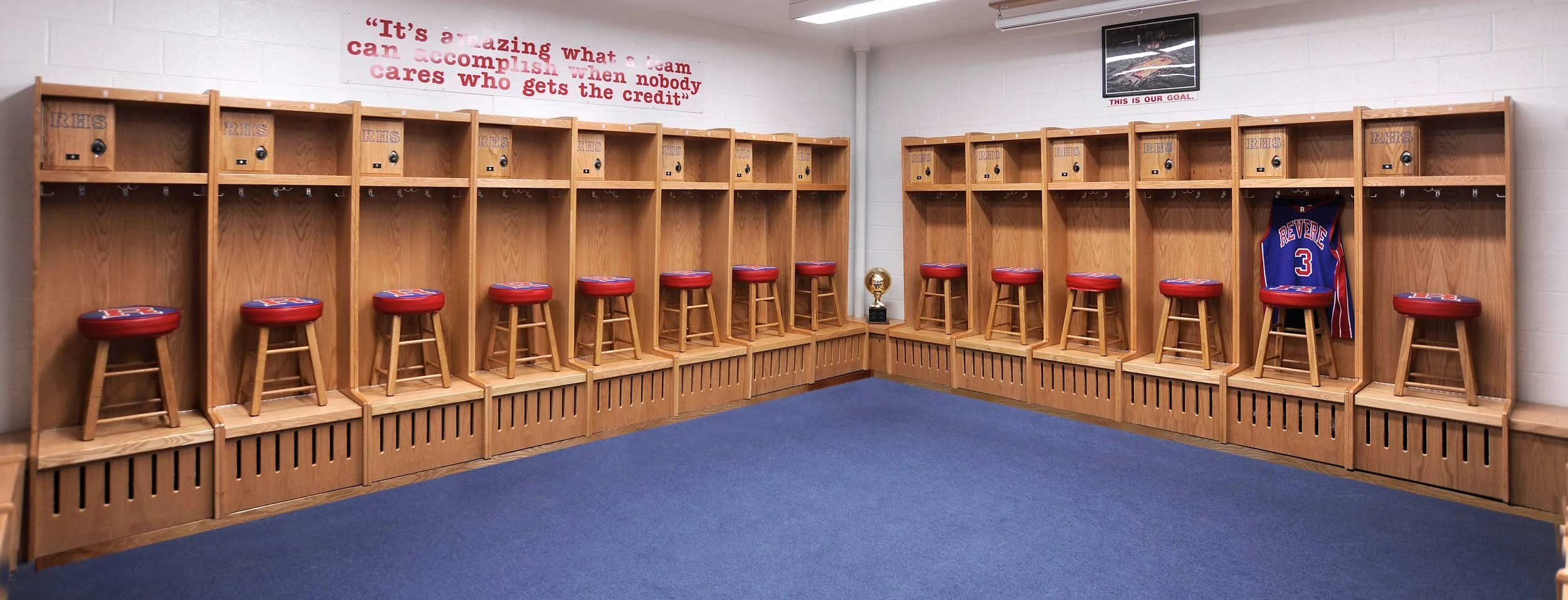
The last few weeks in our team room gave me a perfect snapshot of why this work matters — and why it never ends.
First, the win.
This fall, we spent time connecting consent to something concrete for our guys: my locker, my stuff, my space. What it means to ask before using someone else’s things, and what it means to trust that you can leave your stuff unguarded in a shared space.
Then it showed up.
A junior needed smelling salts and asked a coach for another player’s number. The coach said, “Go ahead — he won’t mind.” And the kid paused and said,
“No — remember, we said we have to ask.”
That moment mattered.
That was language turning into action.
That was TeamsOfMen showing up without a worksheet or a speech.
And yeah — we all need those moments. Proof that what we’re saying actually sticks.
But a week later? Reality checked us.
Players started coming in:
“Coach, someone took my shorts.”
“My shooting shirt got stolen.”
“My stuff keeps getting moved.”
Same space. Same standards. Same conversations.
Different choices.
And that’s the truth of this work. Growth isn’t linear. Progress doesn’t cancel relapse. One breakthrough doesn’t eliminate the need for reinforcement.
So we don’t quit.
We don’t get cynical.
We don’t pretend the win means we’re done.
We create more intentional space.
We name what’s happening.
We keep teaching, correcting, and modeling.
Because consent isn’t a lesson you deliver.
It’s a practice you build.
And in this program, we don’t outsource that responsibility.
We are the work.
Every day.
COACH PROMPTS
Where have you seen your values show up in small, unscripted ways?
How do you respond when progress and regression coexist?
What systems could reinforce trust and consent in shared spaces?
PLAYER PROMPTS
How does asking for permission change how you treat people’s stuff — and their space?
What does trust in a locker room actually require from everyone?
When you mess up, do you own it or hope it goes unnoticed?